Catch Rate by Lure Calculator
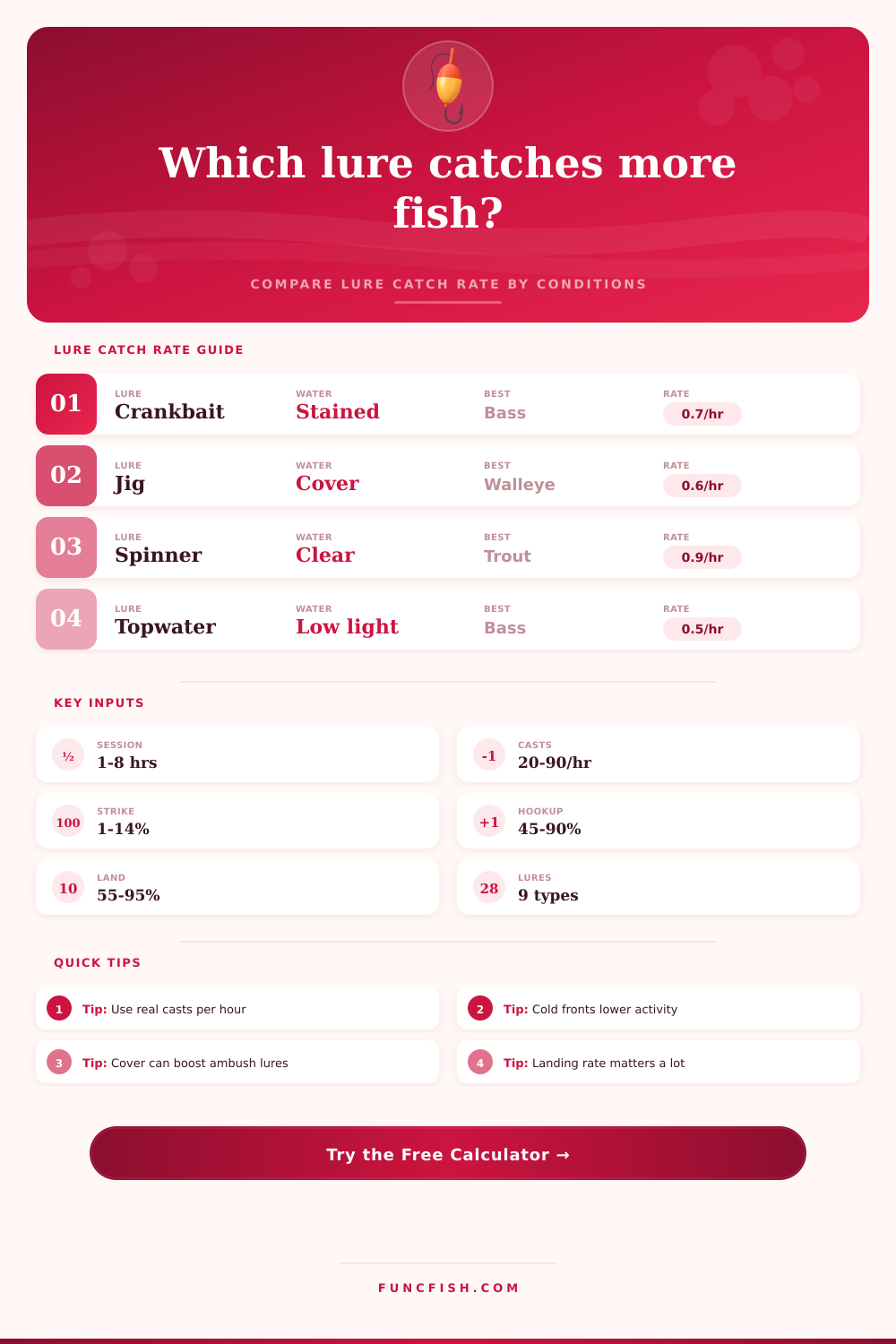
Estimate catches per hour from lure type, casts, species behavior, water conditions, hookup rate, and landing efficiency.
🎯Scenario presets
⚙Catch rate inputs
Lure catch rate estimate
Calculation breakdown
📊Lure performance data
Inline Spinner
Crankbait
Jig
Topwater
📘Lure match reference
| Lure family | Typical strike rate | Strongest condition | Weakest condition | Hookup note |
|---|---|---|---|---|
| Inline spinner | 4.0-8.5 per 100 casts | Trout, panfish, clear current | Heavy weeds | High hookup with single hook |
| Spoon | 2.8-6.8 per 100 casts | Pike, trout, open water | Snaggy wood | Landing rate drops with jumps |
| Crankbait | 3.0-7.2 per 100 casts | Stained water and active fish | Thick grass | Treble hooks raise contact rate |
| Topwater plug | 1.8-6.0 per 100 casts | Dawn, dusk, shallow feeding | Bright cold front | Delay hookset to raise hookups |
| Jig | 2.5-6.5 per 100 casts | Bottom cover, cold water | Fast-moving fish schools | Strong hooks improve landing rate |
| Soft plastic | 3.2-7.0 per 100 casts | Pressured bass and redfish | Low-contact open water | Rigging alignment affects hookups |
| Swimbait | 1.2-5.5 per 100 casts | Big-fish targets and bait schools | Very small forage | Large hooks need firm pressure |
| Jerkbait | 2.0-6.4 per 100 casts | Clear cold water and suspended fish | Muddy water | Light drag helps keep trebles pinned |
| Bait rig | 3.5-9.0 per 100 casts | Catfish, panfish, stationary targets | Fast covering water | Circle hooks improve landed fish |
🐟Species and activity reference
| Species | Prime temp | Productive lure types | Typical casts/hour | Rate expectation |
|---|---|---|---|---|
| Panfish | 62-78°F / 17-26°C | Micro jig, inline spinner, bait rig | 45-90 | High numbers when schools are found |
| Trout | 48-64°F / 9-18°C | Spinner, spoon, jerkbait, jig | 35-70 | Current seams can cluster bites |
| Largemouth bass | 60-78°F / 16-26°C | Crankbait, jig, soft plastic, topwater | 30-70 | Cover contact raises odds |
| Smallmouth bass | 58-72°F / 14-22°C | Jerkbait, drop shot, crankbait, jig | 35-75 | Clear water favors precision |
| Walleye | 45-68°F / 7-20°C | Jig, crankbait, jerkbait, live bait | 25-55 | Low light improves strike rate |
| Pike | 50-68°F / 10-20°C | Spoon, spinner, swimbait, jerkbait | 25-55 | Fewer bites but strong chases |
| Redfish | 62-82°F / 17-28°C | Soft plastic, spoon, topwater, jig | 25-60 | Tide stage changes opportunity |
| Muskie | 55-72°F / 13-22°C | Swimbait, jerkbait, topwater, bucktail | 20-45 | Low rate, high-size target |
⚖Condition modifier table
| Condition | Low modifier | Neutral modifier | High modifier | Calculator use |
|---|---|---|---|---|
| Water clarity | Muddy: 0.78 | Stain: 1.02 | Matched lure: 1.12 | Changes lure visibility and reaction range |
| Fish activity | Slow: 0.58 | Neutral: 1.00 | Feeding: 1.42 | Scales the strike chance per cast |
| Fishing pressure | Tournament: 0.70 | Moderate: 1.00 | Low: 1.14 | Reflects lure conditioning and traffic |
| Cover density | Open: 0.94 | Moderate: 1.08 | Heavy: lure-specific | Boosts ambush lures, penalizes snaggy lures |
| Temperature | Outside prime: 0.68 | Near prime: 1.00 | Prime band: 1.18 | Compares input temp with species range |
💡Calculation notes
Use the observed strikes field when you have real notes. Entering strikes per 100 casts overrides the model's strike estimate while still applying your hookup and landing rates.
Separate casts from fishing time. Boat control, reties, lure changes, and travel reduce effective casts per hour, so use the number of real presentations.
A fishing calculator allow a person to understand how many fishes a person might catch on a fishing trip. The fishing calculator wont provide a guarantee that a person will catch fish during there fishing trip, but it will allow a person to project the number of fish that may be caught based off a data that a person enters into the fishing calculator. Additionally, this fishing calculator allows for a person to compare different fishing trip choice to determine which decisions a person can make during their trip.
One of the first variable that a person can consider with a fishing calculator is the number of casts that a person can make during one hour. The number of casts that a person can make are important because this will determine the number of times that a person will present a lure to the fish. While many anglers believe that the amount of time that they spend on the water is representative of the number of times that they will successfuly cast and reel in fish, the time spent on the water may include breaks for traveling to different area of a lake or river, or for fixing the tangles of the fishing lines.
How to Use the Fishing Calculator
Therefore, by increasing the number of casts that a person can make during one hour, the number of times that the fish will be bait increases, which may lead to an increase in the number of fish that is caught. The second variable to consider is the strike rate of the fish. The strike rate is essentially the frequency with which the fish will attempt to eating at the baited lure.
The strike rate is based upon the clarity of the water, the temperature of the water, and the type of bait that is used. For instance, certain types of bait will cause the fish to strike at the bait when the water is stain with other substances, but the same bait may not be as successful in clear water. Additionally, the temperature of the water can impact the strike rate, as the temperature can impact the desire of the fish to chase the bait.
Therefore, a person can alter some of these variable to see the impact that each variable may have upon the strike rate of the fish. The third variable to consider is the percentage of the fish that is hooked (hookup percentage) and the percentage of those hooked fish that the angler successfully lands (landing percentage). Each of these percentages can have an impact upon the success of a fishing trip.
For instance, a high strike rate for the baited lure may not be as useful for anglers if the hookup percentage for the fishing line are low. Similarly, an angler may hook a high percentage of fish, but if the landing percentage is low, the angler will land few fish. Each of these percentages may change with the use of different type of lures.
For instance, lures that use treble hooks may increase the hookup percentage but decrease the landing percentage of those hooked fish. The fourth variable to consider is the behavior of the specific type of fish species that the angler is targeting. Different types of fish have different feeding pattern and strike rates.
For instance, panfish may exhibit a high interest in areas where there are many cast made per hour, while species like muskies may require the anglers to exhibit patience and spend fewer amount of time casting line. Additionally, species like walleyes may only exhibit high strike rates with the baited lures during times of low light versus midday. A fishing calculator of this type allow for anglers to change the variable for the type of fish species to see the impact upon the estimated catch rate.
In addition to the variables mentioned above, there are also additional factor in the fishing calculator that may impact the outcome of a fishing trip. For instance, the approach of a cold front may reduce the strike rate of the fish, or the increased pressure of fishing tournaments may also reduce the strike rate of the fish. Additionally, the presence of heavy weeds in the fishing areas may impact the number of casts that an angler can make during a trip due to the likelihood that the fishing lines may get stuck in the weeds.
These environmental variable can also be accounted for by anglers using the fishing calculator. Finally, this fishing calculator also allow anglers to compare different fishing strategies. For instance, anglers can use the fishing calculator to determine whether changing from using crankbaits to jigs will result in a catching of more fish, or if spending additional time on the fishing spot will result in an increase in the number of fish that are caught.
Thus, this type of fishing calculator allows anglors to turn each of these variables into a projection as to the number of fish that may be caught, which allows for anglers to reduce the guesswork that they may experience while fishing during their trip. You should of used this tool to help you.