Combi Rig Length Calculator
Balance stiff boom length, supple hinge, hook size, bait diameter, hooklink material, lakebed type, target species, and lead arrangement.
Compact anti-eject
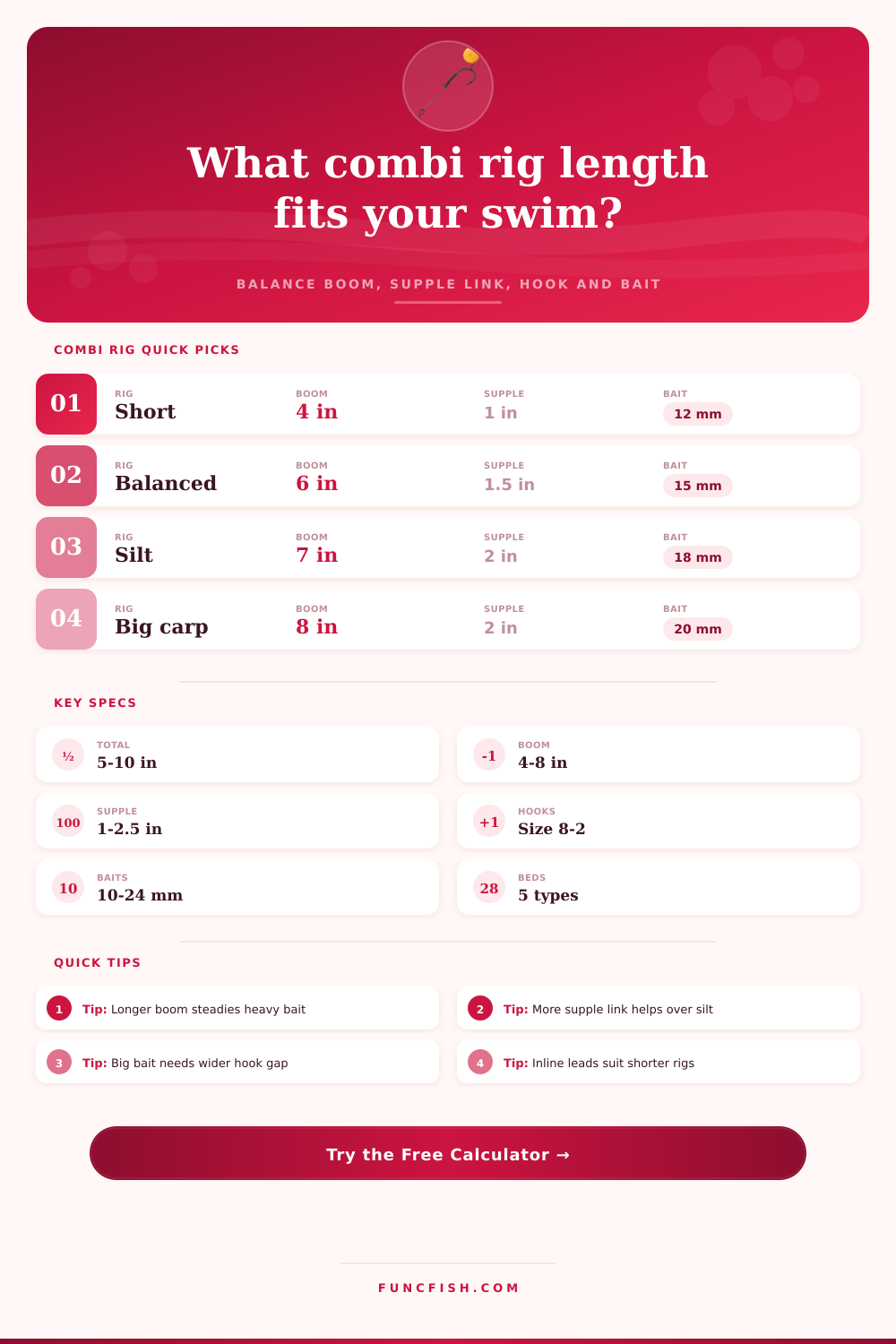
Shorter 5 to 6.5 in rigs suit inline or method leads where the hookbait should sit close to the lead and turn quickly.
Balanced all-rounder
A 6.5 to 8 in total with a 15 to 22 percent supple section gives separation without losing reset speed on clean bottoms.
Soft-bottom searcher
Longer 8 to 10 in rigs spread the bait away from the lead and keep the hinge mobile over silt, chod, or light weed.
| Hook size | Best bait diameter | Typical combi length | Use case |
|---|---|---|---|
| Size 8 | 10 to 12 mm | 12 to 17 cm / 4.7 to 6.7 in | Tench, bream, pressured carp |
| Size 6 | 14 to 16 mm | 16 to 21 cm / 6.3 to 8.3 in | All-round carp and wafters |
| Size 4 | 18 to 20 mm | 18 to 24 cm / 7.1 to 9.4 in | Big bottom baits and snowmen |
| Size 2 | 22 to 24 mm | 20 to 26 cm / 7.9 to 10.2 in | Large carp or small catfish baits |
| Condition | Length adjustment | Supple adjustment | Presentation note |
|---|---|---|---|
| Clean gravel | Baseline | Baseline | Best for crisp boom reset |
| Soft silt | Add 2 to 4 cm / 0.8 to 1.6 in | Add 0.5 to 1 cm / 0.2 to 0.4 in | Keeps bait clear of the lead plug |
| Light weed | Add 1 to 3 cm / 0.4 to 1.2 in | Add 0.5 cm / 0.2 in | Helps the hinge settle on top |
| Method feeder | Subtract 2 to 4 cm / 0.8 to 1.6 in | Keep short | Compact hookbait separation |
| Target species | Starting total length | Hook range | Rig priority |
|---|---|---|---|
| Carp | 17 to 23 cm / 6.7 to 9.1 in | Size 6 to 4 | Anti-tangle reset and hook turn |
| Tench | 13 to 18 cm / 5.1 to 7.1 in | Size 10 to 8 | Small bait mobility |
| Barbel | 18 to 25 cm / 7.1 to 9.8 in | Size 8 to 4 | Flow resistance and abrasion |
| Small catfish | 22 to 30 cm / 8.7 to 11.8 in | Size 4 to 2 | Wide gape clearance |
| Material | Stiffness | Length effect | Best lakebed |
|---|---|---|---|
| Fluorocarbon stiff boom | High | Can run 1 cm shorter | Gravel or clay |
| Stripped coated braid | Medium | Neutral reference | Mixed gravel and silt |
| Soft braid hinge | Low | Add 1 to 2 cm boom | Silt and weed edges |
| Tungsten coated braid | Medium high | Use normal length | Clear clay or low weed |
The lengths of a combi rig is a detail that will determine where a hookbait will sits. The length of a combi rig will determine if a hookbait will sit in the correct locations. A combi rig must have some stiffness in the end to allow it to reset after a fish has passed through the combi rig.
However, it must also have enough flexibility in the last section of the combi rig to allow the bait to move natural if a fish is investigating the bait. If a person does not find a balance between the stiffnesses and flexibility of a combi rig, then the combi rig may become entangled during its cast, or the combi rig may lie flat in the water and not turn the hook effective. The stiff boom on a combi rig must stay clear of the lead.
How to Choose the Right Combi Rig
The length of the stiff boom allow the hook to have more room to pivot when a fish picks up the bait. Using a longer stiff boom is helpful in areas with clean gravel in that the longer stiff boom allows the hook to reset quick when a fish has bitten at the bait. However, in soft bottoms the fish will often dig into the silt with the lead and the hookbait will follow the lead into the silt.
A longer supple section will allow the bait to stay more higher above the lakebed while the stiff boom provides a spine for the combi rig. The size of the hook should match the diameters of the bait before considering the balance of the rest of the combi rig. If the hook is too small for the size of the bait the gape will be limited in how fast the hook can turn.
Using a large hook with small bait will expose too much metal to the fish which may cause the fish to eject the bait prior to the hook being able to secure the fish. The calculator processes these variables to determine the best combi rig for the fisherman. The material that a person uses for the combi rig will change in what ways that the combi rig performs.
Fluorocarbon maintains its shape but sinks quick so it is good for clear gravel areas. If a person uses coated braid the coated braid will provide a hinge in the combi rig if it is stripped back a few inches from the hook. However, coated braid is not completely limp like other braids.
Using soft braid will allow for more flexibility in the combi rig which is helpful when casting over light weed. However, soft braid will require a longer boom so that the rig does not collapse on itself. This grid will show the length of a combi rig with each type of braid so that the fisherman is aware of the length of the combi rig prior to having to form it.
The type of lakebed that is being fished in will impact the combi rig that is used. In lakes with gravel, a compact combi rig will work well because the compact combi rig will allow the hook to reset after each bite and it will allow the fisherman to keep the point of the hook visible. In lakes with silt or light weed a longer total length of the combi rig will allow the bait to remain clear of the silt depression that the lead will make on the silt.
Additionally the type of lead that is used will also impact the combi rig. For instance inline leads are used in shorter combi rigs. However, lead that is arranged in helicopter or clip fashions allows for more separation between the lead and bait which changes the percentage of the supple section.
Lastly, the type of fish that is being targeted will change the requirement for the combi rig. For instance tench and bream will require a combi rig that allows for small and delicate movements of the bait. Carp, however, will require more strength on the combi rig to move the bait several inches before the fish will begin to pull the bait into its mouth.
Barbel live in flowing water in lakes so the material of the combi rig will have to be more resistant to abrasion and the length of the combi rig will have to be longer to fight against the movement of the water. Many fisherman makes mistakes when forming their combi rig with the supple section. For instance some fisherman will make the supple section too short on their combi rig because they want it to look neat they will find that the hook does not turn enough.
Others make the supple section too long on their combi rig and lose the benefit of the stiff boom on their combi rig. The supple section should ideally be between 15% and 25% of the total length of the combi rig. However, the exact percentage will depend upon the other variables with the combi rig.
The calculator provides this percentage based off all of the variables. Finally, after a person has set the combi rig numbers, they should test the combi rig on the bank. During the initial few casts the fisherman should watch the behavior of the combi rig and only adjust one variable at a time.
The combi rig calculator will provide the fisherman with the best combi rig for his need, but the water and the fish will tell him if adjustments need to be made to the balance of the combi rig.