Fishing Weight To Current Speed Calculator
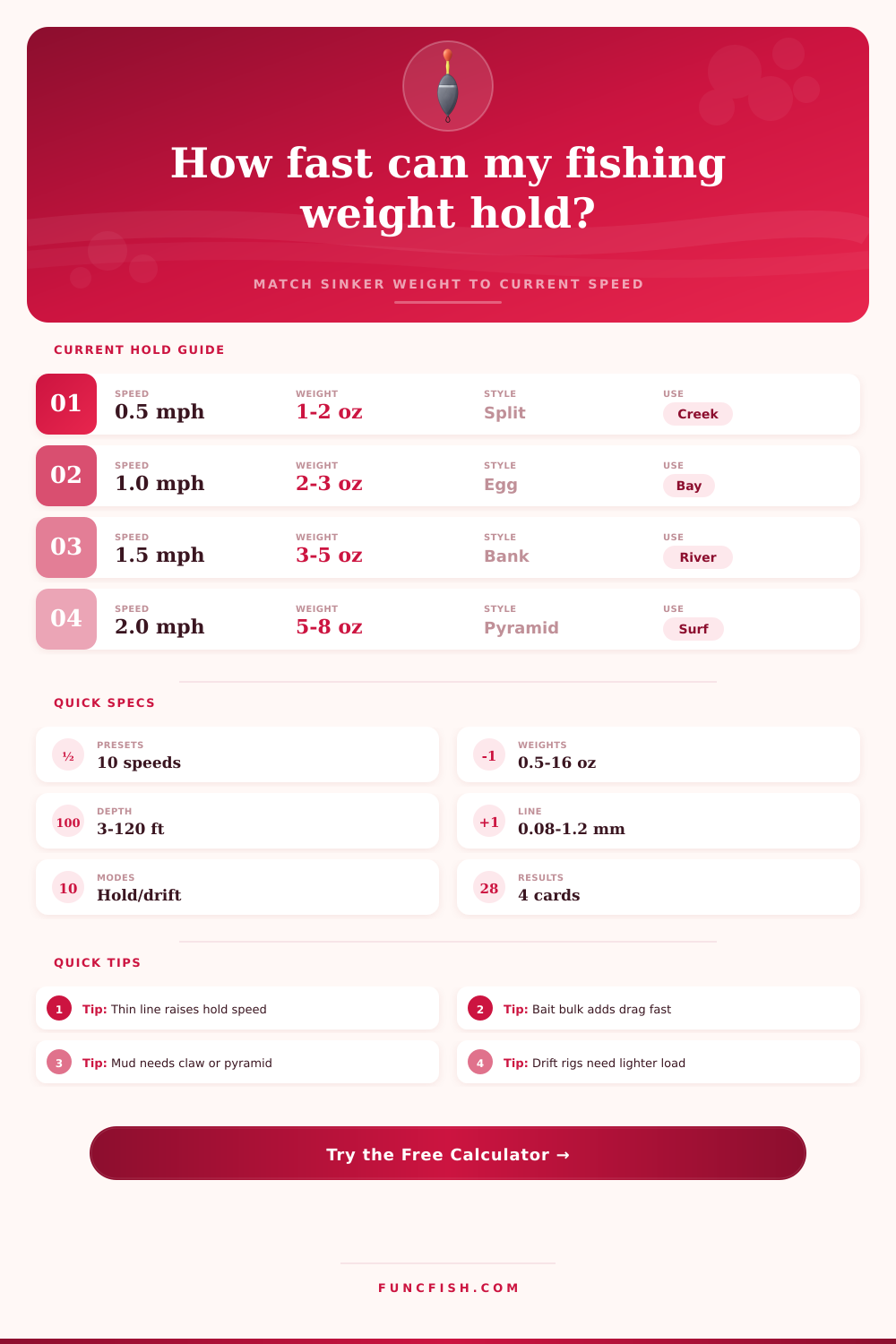
Estimate the current speed a sinker can hold or drift through by combining weight style, line diameter, rig drag, bait profile, depth, bottom grip, target species, and fishing mode.
🌊Current speed presets
⚙Weight, current, and rig inputs
Current speed match
Choose inputs to estimate current hold, drift band, line angle, and rig load.
Calculation breakdown
🧱Sinker, current, and rig comparison grid
Egg Sinker
Bank Sinker
No-Roll
Pyramid
📊Reference tables
| Current preset | Speed range | Typical water | Weight cue |
|---|---|---|---|
| Back Eddy | 0.2-0.4 mph / 0.09-0.18 m/s | Creek pools, slack bank pockets | Split shot to 1 oz usually moves naturally |
| Slow Tide | 0.7-0.9 mph / 0.31-0.40 m/s | Bay channels and bridge edges | 1-3 oz egg, bank, or drop-shot weights |
| Walking Tide | 1.3-1.5 mph / 0.58-0.67 m/s | Inshore passes, broad river push | 3-5 oz bank, no-roll, or pyramid styles |
| Inlet Run | 2.0-2.2 mph / 0.89-0.98 m/s | Inlets, tailraces, strong surf sweep | 5-10 oz grip styles with thin main line |
| Tailrace Flow | 3.0-3.4 mph / 1.34-1.52 m/s | Heavy river discharge | Specialized hold only; drift is often cleaner |
| Sinker style | Hold behavior | Drift behavior | Bottom match |
|---|---|---|---|
| Split shot / pinch weight | Low hold, easy to adjust | Excellent for natural drift | Gravel, small streams, shallow runs |
| Egg sinker | Rolls when current rises | Smooth controlled movement | Sand, mud, light channel edges |
| Bank sinker | Balanced hold for river bait | Moderate bounce with less snagging | Gravel, mixed sand, shell |
| No-roll flat sinker | Strong lateral resistance | Poor for free drift | Mud, sand, catfish flats |
| Pyramid sinker | Strong bite in sand | Deliberately slow | Surf sand and firm bars |
| Storm / grip sinker | Highest hold, more snag risk | Not a drift weight | Sand, shingle, strong sweep |
| Rig drag profile | Drag index | Line angle effect | Common use |
|---|---|---|---|
| Single hook leader | 0.90 | Lowest angle rise | Trout, bass, light bait |
| Slip sinker rig | 1.00 | Baseline | Catfish, drum, general bait |
| High-low two dropper | 1.18 | More leader water drag | Surf bait and pier fishing |
| Float, bead, or cork rig | 1.30 | Floats lift the line | Pompano, trout, shallow drift |
| Live bait harness | 1.38 | Bait movement adds swing | Striper, redfish, salmon |
| Large chunk bait rig | 1.52 | Highest bait drag | Catfish, drum, sturgeon |
| Target species | Current preference | Line angle target | Weight behavior |
|---|---|---|---|
| Trout / panfish | 0.3-0.9 mph / 0.13-0.40 m/s | 15-35° | Light weight should tick bottom, not pin |
| Bass | 0.4-1.2 mph / 0.18-0.54 m/s | 20-40° | Enough contact to feel rock or grass edges |
| Walleye | 0.7-1.6 mph / 0.31-0.72 m/s | 25-45° | Bottom bouncer or bank style works well |
| Catfish | 0.8-2.2 mph / 0.36-0.98 m/s | 25-55° | No-roll and bank weights reduce rolling |
| Striped bass | 1.0-2.6 mph / 0.45-1.16 m/s | 30-55° | Thin line helps keep bait in the strike lane |
| Sturgeon / heavy river | 1.4-3.2 mph / 0.63-1.43 m/s | 35-60° | Heavy hold may need specialized anchor-style rigs |
💡Calculation tips
Tip: If the estimated line angle is high, reduce line diameter first. A thinner main line often improves bottom contact more cleanly than adding another ounce.
Tip: In drift mode, the best weight is usually below the full hold estimate. Aim for steady bottom ticks instead of a locked sinker.
When fishing from moving waters, a balance must be found between the fishing rig and the current. The fishing rig must remain in the strike zone, yet it shouldnt be pinning to the bottom of the water column or swept away by the moving water. If the fishing rig contain too light of a weight, the bait will not travel slow enough for the fish to find the bait.
Yet, if the fishing rig contains too many weight, the fishing rig will lock to the bottom of the lake or river, and the heavy fishing rig will make the bait look unnatural to the passing fish. Several variable enter into the balance of the fishing rig. For instance, the shape of the sinker will affect how well it bite into sand compared to other shapes of sinkers.
How to Balance a Fishing Rig in Moving Water
Additionally, the thickness of the line will affect how much the moving water impacts the line. Other variables that will impact the balance of the fishing rig include the size of the bait and the angle of the fishing rod. The depth at which the fishing rig is cast will also alter the tension of the fishing rig; the fishing rig will hold its position at a depth of eight feet, but may move at a depth of twenty-five feet.
Additionally, the type of bottom where the fishing rig lands will impact the behavior of the fishing rig. For instance, if the bottom is sandy, the weight will adhere to the sand more than if the bottom is muddy. Additionally, the type of gravel will cause the fishing rig to possibly bounce or get stuck on the gravel and shell.
The different species of fish require different type of weights. For instance, fish like trout and panfish prefer lighter weights to allow the bait to tick along the bottom, but fish like striped bass and sturgeon require more weight to allow the fishing rig to move through the strong currents these fish like to travel in. Conversely, walleye prefer weights in the middle ground as they want some contact between the bait and the bottom of the water column.
To catch the target species of fish, the anglers should adjust the current of the water with the weight of the fishing rig. Anglers often make the mistake of using the same weight on all fishing trips. The weight that work well in one condition may not work in another.
For instance, a three-ounce bank sinker may roll along the bottom of the lake when the tide is high, but may allow better contact with the bottom when the tide is lower. Additionally, a weight that feels heavy when fishing in strong current may stick to the bottom when fishing in slow moving back eddies in the lake. Prior to going fishing, an angler should of use a calculator to adjust the weight of the fishing rig according to the conditions of the area in which they plan to fish.
Another factor in the balance of the fishing rig is the angle of the fishing rod. Anglers can adjust the angle of the tip of the rod to alter how the fishing rig interacts with the current. For instance, angling the tip of the fishing rod high will pull the line into the current, but angling the tip of the fishing rod low will allow the fishing rig to remain close to the sinker.
Additionally, the profile of the bait will also affect the balance of the fishing rig. For instance, using live minnows as bait will increase the movement of the fishing rig compared to using only a hook with no bait attached. If an angler changes from a bare hook to a chunk of bait, the added weight will require an adjustment to the weight of the fishing rig.
By understanding how each of these variable can impact the balance of the fishing rig, anglers can better control the movement of the fishing rig and increase there chances of catching fish. For instance, an angler can adjust the diameter of the fishing line to improve the hold of the fishing rig, or switch to a different type of fishing rig altogether. Anglers need to understand each of these variables in order to effectively fish.
By understanding how the weight of the fishing rig interact with the current in which they are fishing, anglers will understand the behavior of their fishing rig in the water. It is actualy alot of work to get it right.