
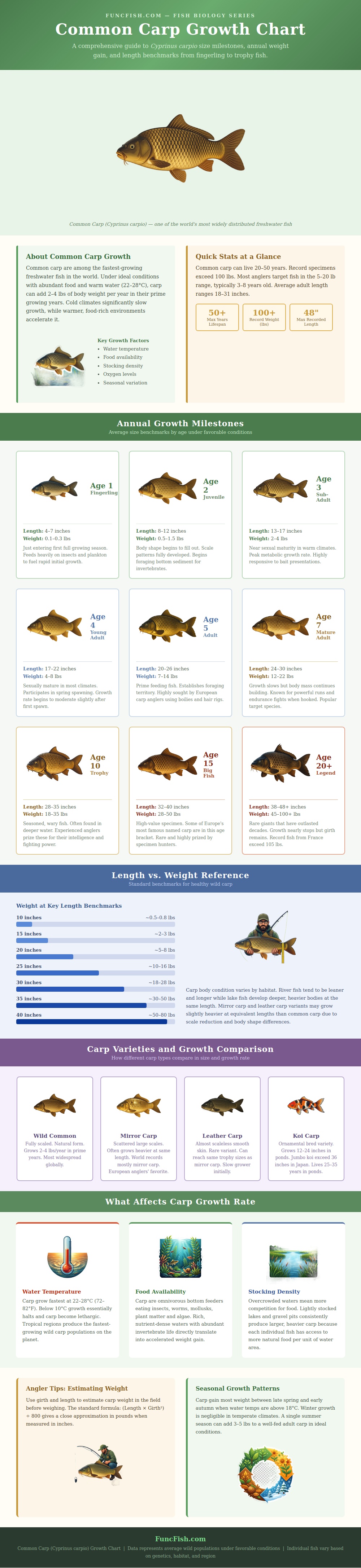
When you get a bite do you think it’s a good one? Or is it some little bitty junker? Because common carp grow so aggressively in their early years, that guesswork matter more then with most species. But knowing that common carp reach their full potential early then slow down later gives you an idea of where they are at any given time. And it’s the reason you can have two very similar lakes side by side with drastically different size classes of fish.
The chart shows how size benchmarks shifts from fingerling to trophy. What causes them to change? How does that affect you on the water? The chart outlines progression from fingerling to trophy size but the key is in understanding why and applying that to your fishing.
How Carp Grow and Change Size
Young carp are metabolic machines. For their first couple of years, they are like vacuum cleaners. They will inhale anything they can get their mouths around including plants, worms, mollusks, and yes, even insects. Their metabolism push them to feed relentlessly. As a result, they adds much weight every year. In fact, if the water is rich in nutrients, some carp can gains multiple pounds during one warm season.
Rather than simply growing longer, three-year-old carp begin getting thicker, which makes them feel heavy on the end of your line. They grow so fast at first because there is plenty of food and not much competition. Those little fish that are only two or three years old explode in size if the pond is lightly stocked. They dominate the food supply, especially since they are young. This leads us to an important part about baiting. Younger adults tends to be the easier ones to catch if you target their feeding grounds correctley.
As carp age, the rules shift. By about three or four years of age they begin to divert their energy towards reproduction instead of just accumulating body mass. They still grow but not as fast. At this point trophy potential depend on habitat quality. A fish might live for decades, but it will only keep growing if its environment permits.
Because carp are cold blooded, water temperature is an enormous factor. When the water cools below fifty degrees, they slows down drasticly. Carp stay active and feed more months out of the year in warmer climates or deeper lakes that retain heat better. This longer period enables them to pack on more weight then fish in cooler northern waters can ever match. A carp that’s ten-years-old in a tropical river can weigh much heavier than a 20-year-old carp from a cool mountain lake.
The other item that will impact growth is stocking density. Fish don’t grow when they’re in survival mode vs growth mode. When they’re overcrowded in a pond, then they competes harder for scraps and put less effort towards converting that food to muscle. That’s why you see bigger fish come from large lakes with low densities like gravel pits. In those situations each fish get a bigger chunk of the available natural food base.
You’ll also notice that mirror carp and leather carp varieties tends to get heavier than common scaled carp. It’s been known by anglers for years. Less armor means more bulk.
Look around the next time you’re out on the water. Feeding activity peaks during the spring and summer months. Better results will come from targeting deep margins with growing vegetation different than fishing cold, still water during the winter. Estimate what you’ve caught by using length and girth to weigh it after catching it. A thirty inch carp has a wide range in weight based off their condition.
You want to learn about the ecosystem that’s producing the fish more then anything. When you pull up on a big one, you are looking at decades worth of patience, an abundant food supply and ideal conditions to do so. People don’t realize that those circumstances needed to survive makes big fish less common but not uncommon, which is why many think big fish are hard to find.
Consider this the next time you pick up that rod and cast. The history of the water is there. All you have to do is read it right, and you’ll be on to the places to find the legends.