Cooler Hold Time Calculator
Estimate how long ice should hold a fishing cooler below your chosen chilled threshold after fish load, ambient heat, lid openings, ice style, drain setting, and insulation are factored together.
📌Scenario presets
⚙Cooler settings
Cooler hold forecast
Full breakdown
📋Cooler and ice reference grid
Basic Hard
Marine
Rotomolded
Soft Bag
Cubed Ice
Block Ice
Crushed Ice
Slurry
📊Hold time reference tables
| Fishing use | Typical cooler | Starting ice | Fish or bait load | Usual target |
|---|---|---|---|---|
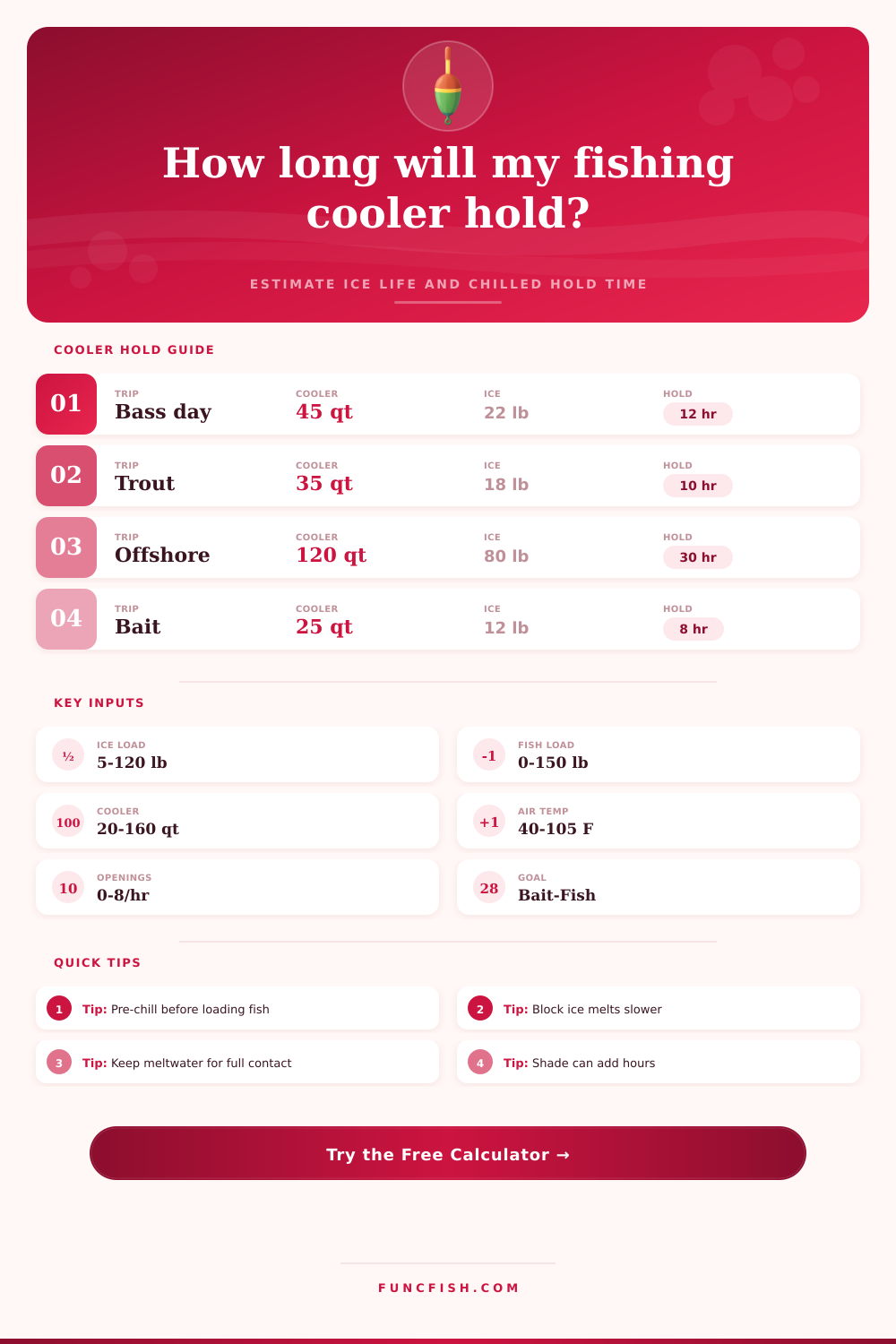
| Bass tournament day | 45-65 qt / 43-62 L | 20-35 lb / 9-16 kg | 10-25 lb / 5-11 kg | 8-12 hr |
| Trout stream limit | 25-45 qt / 24-43 L | 12-25 lb / 5-11 kg | 5-15 lb / 2-7 kg | 6-10 hr |
| Offshore whole fish | 100-160 qt / 95-151 L | 60-120 lb / 27-54 kg | 40-150 lb / 18-68 kg | 12-36 hr |
| Surf or pier cooler | 50-90 qt / 47-85 L | 30-60 lb / 14-27 kg | 15-60 lb / 7-27 kg | 8-18 hr |
| Bait shrimp or minnows | 20-35 qt / 19-33 L | 8-18 lb / 4-8 kg | 2-10 lb / 1-5 kg | 4-10 hr |
| Adjustment | Heat effect | Ice effect | When to use | Model action |
|---|---|---|---|---|
| Full shade | Lower heat gain | Longer ice life | Covered deck or cabin | 0.82x heat leak |
| Beach sun | High radiant load | Faster melt | Sand, pier, open bank | 1.42x heat leak |
| Drain closed | Better contact | More usable chill | Whole fish on ice | 1.04x energy |
| Drain open | Less cold mass | More ice needed | When water must drain | 0.90x energy |
| Frequent opening | Warm air entry | Adds melt load | Culling or bait checks | BTU per opening |
💡Calculation checks
Tip: Enter fish load as the weight that starts warm. Fish already chilled on ice needs less initial cooling energy.
Tip: For long drives, use the planned-hours result and the remaining-ice card together. A positive hold time can still finish with a thin ice margin.
Keeping the fishes cold on the water depend on many different factors. It is not about the number of variables used but the number of factors that impact the ability of the ice to melt as fast as the fish create heat. For example, ice will melt faster if the sun shine on it.
However, warm fish will cause the ice to melt more faster. Similarly, if the cooler lid is left open the ice will melt faster. The same is true if you allow the meltwater from the ice to drain from the cooler.
Keeping Fish Cold in a Cooler
The number of factors that impact the ability of the cooler to maintain temperature is more important than the total initial amount of ice that was placed into the cooler. The preparation of the cooler prior to the addition of the fishes is important in determine how long the fish will remain cold. If the cooler was placed in a garage all night, the cooler will have a high shell temperature.
The cooler will need to use some of the ice to lower the shell temperature of the cooler and the temperature of the items that is placed into the cooler. This is difficult for many individual to recognize until they open the cooler and see the melted ice. If the cooler was pre-chilled, this load created by the shell temperature can be eliminated.
Consequently, the amount of ice that is required will allow for the fish to remain cold for several hour longer. The starting temperature of the fish will also have an impact upon how much ice will be used to cool the fish. For example, fish taken from warm water will have a higher starting temperature than fish that is caught in cold mountain streams.
Additionally, fish that have a higher starting temperature will cause the ice to melt at a faster rate than fish that have a lower starting temperature. An angler can use a calculator to determine how much ice will be available for maintaining the temperature of the fish. The calculator will allow the angler to eliminate guesswork about the cooling of the fish by calculating how much ice will be needed to perform each tasks.
Drain settings on coolers present a compromise between maintaining temperature and cleanliness of the fish. If the meltwater is allowed to remain within the cooler, the rise in the temperature within the cooler will be slower. However, if the drain is left open the fish will be kept in dirty water.
Many anglers will choose to leave the drain closed for the first few hours of fishing and then open the drain periodically between fishing trips to ensure that the fish are kept as clean as possible. The value of having clean fishes, however, is counterbalanced by the rate at which the ice will melt if the water within the cooler is drained. The environmental exposure of the cooler will impact how fast the ice melt within the cooler.
For example, if the cooler is placed in an area that is exposed to the sun the ice will melt at a faster rate than if the cooler was placed in a shade area. Similarly, if the cooler rests on a surface that emits heat the temperature within the cooler will increase. Hot truck beds are an example of such an effect on the cooler.
Each of these factors will alter the rate at which the ice within the cooler disappear. Another factor that impact the rate of melting of the ice within the cooler is the frequency at which the cooler is opened. Each time that the cooler is opened warm air enters the cooler and the ice must melt to cool that air.
Opening the cooler lid for an extended period of time to search for an item can melt more ice than a cooler that is exposed to warm air for an hour. Consequently, the more that the cooler is opened the more that the ice will melt. Anglers who fish for extended periods, especially tournament anglers, will need to prepare with more ice than the weight of the fish alone would suggest.
The style of ice that is placed into the cooler will also impact the length of time that the fish will be cold. Crushed ice melts quick but will only last for as long as the fish require to be cooled. Block ice will last for a longer period of time but it will take more time to reach the desired temperature for the fish.
Many anglers use a mixture of both ice types. For example, the angler can place the blocks of ice on the bottom of the cooler to provide long-term cold temperatures to the fish while the crushed ice is placed around the fish to allow for immediate contact between the fish and the crushed ice. Calculators can be used to determine how long the mixture of both types of ice will last.
The percentage at which the cooler is filled with the fish is also a factor in how long the fish will remain cold. The empty space within the cooler is filled with air. The air within the cooler will increase the amount of volume that the ice must cool.
Consequently, a cooler that is loosely packed will lose its chill at a faster rate than a cooler that is reasonably full of fish. This factor is most important for anglers who are on the water for several day. The margin for error is thin for these anglers.
Finally, an angler should provide a cushion of extra ice within the cooler. Any plan that calculates how long the ice will last is inherently risky. There is always the potential that the trip will take longer or that it will be hotter than expected.
The safest trips are the ones where the calculations indicates that there will still be ice left within the cooler after the planned time for the trip. Consequently, providing a margin of extra ice to the cooler is what separates an angler’s cooler from the one that must be continually attend.