Cooler Size for Catch Calculator
Estimate the cooler capacity needed for kept fish, ice, drain space, bagged fillets, and trip duration so your catch fits without crushing the cold layer.
📌Fishing cooler presets
Choose a realistic trip profile, then tune catch weight, fish form, ice style, temperature, and cooler efficiency to match your boat, bank, kayak, or pier setup.
⚙Catch, ice, and cooler inputs
Cooler size estimate
Calculation breakdown
🐟Species and gear storage grid
Bass and Walleye Box
Trout Stream Cooler
Catfish Hold Box
Offshore Fish Chest
📊Cooler size reference tables
| Cooler class | Nominal capacity | Typical fish load | Length note |
|---|---|---|---|
| Small day box | 20-28 qt / 19-27 L | 6-14 lb / 3-6 kg | Short trout or panfish |
| Mid boat box | 45-65 qt / 43-62 L | 18-35 lb / 8-16 kg | Bass, walleye, inshore |
| Large deck box | 80-120 qt / 76-114 L | 40-70 lb / 18-32 kg | Catfish, pike, surf fish |
| Offshore chest | 150-250 qt / 142-237 L | 75-150 lb / 34-68 kg | Pelagics and mixed holds |
| Fish form | Bulk density | Space effect | Best packing |
|---|---|---|---|
| Whole fish | 5.6-6.4 lb/gal | Moderate voids | Belly down with ice layers |
| Dressed fish | 6.2-6.8 lb/gal | Better nesting | Alternate head and tail |
| Fillet bags | 4.4-5.2 lb/gal | Bag air adds bulk | Flat bags stacked cold |
| Large fish | 6.6-7.2 lb/gal | Length limits fit | Long box or cleaned pieces |
| Trip condition | Ice ratio | Cooler factor | Use case |
|---|---|---|---|
| Cool half day | 0.6-0.8x catch | Low heat | Short shaded trips |
| Warm full day | 1.0-1.2x catch | Medium heat | Most freshwater boats |
| Hot inshore | 1.2-1.5x catch | High heat | Kayak, pier, open deck |
| Offshore overnight | 1.5-1.8x catch | Very high | Large mixed fish hold |
| Species group | Typical kept weight | Cooler hint | Ice priority |
|---|---|---|---|
| Panfish or perch | 0.3-1 lb each | Small box, many pieces | Even layers |
| Bass or walleye | 1-5 lb each | 45-65 qt box | One ice layer below |
| Catfish or pike | 4-20 lb each | Long 70+ qt box | Heavy top ice |
| Tuna or mahi | 15-60 lb each | 150+ qt chest | Slurry or dense ice |
💡Cooler sizing tips
There’s more to choosing a cooler than simply eyeballing the number on the side. The style (i.e. Its type (hard or soft), size, insulation, and shape all affect how well it works. A fifty quart rotomolded chest isn’t the same as a fifty quart soft bag. Whereas one may keep your fish cool for three days, the latter will melt within four hours if left out in the hot sun.
That’s where the calculator comes into play. Simply input your expected catch weight and the duration of your trip. It’ll take into account the amount of fish, the type of fish (i.e. Their bulk density), and the amount of ice they require. It takes into account the type of fish (i.e. Their water density) and the amount of ice they require. Then it adjusts based off your bags’ volume and considers the amount of air inside each and the voids left by the fish themselves. What you’re left with is a suggested capacity based on the ice and air needed to fill these voids.
How to Choose the Right Cooler Size
Also take into account what kind of fish you’re packing. Do you want to pack filleted trout or whole bass? Long pike or something else? Tails and bellies on whole fish create empty spaces. To keep the temperature consistent throughout your haul, you’ll want to use ice to fill these spaces. Fillets stacked in vacuum bags stack well like bricks. You need less overall space, but you still want some protection from the ice. Because of this, you will still require a few layers of ice.
The difference with the tool is it asks how the fish are shaped. It knows one hundred pounds of neatly bagged snapper steaks occupy less space then one hundred pounds of whole catfish. That way you don’t buy yourself a box that’s too short for a longer fish just because the overall capacity sounds large enough.
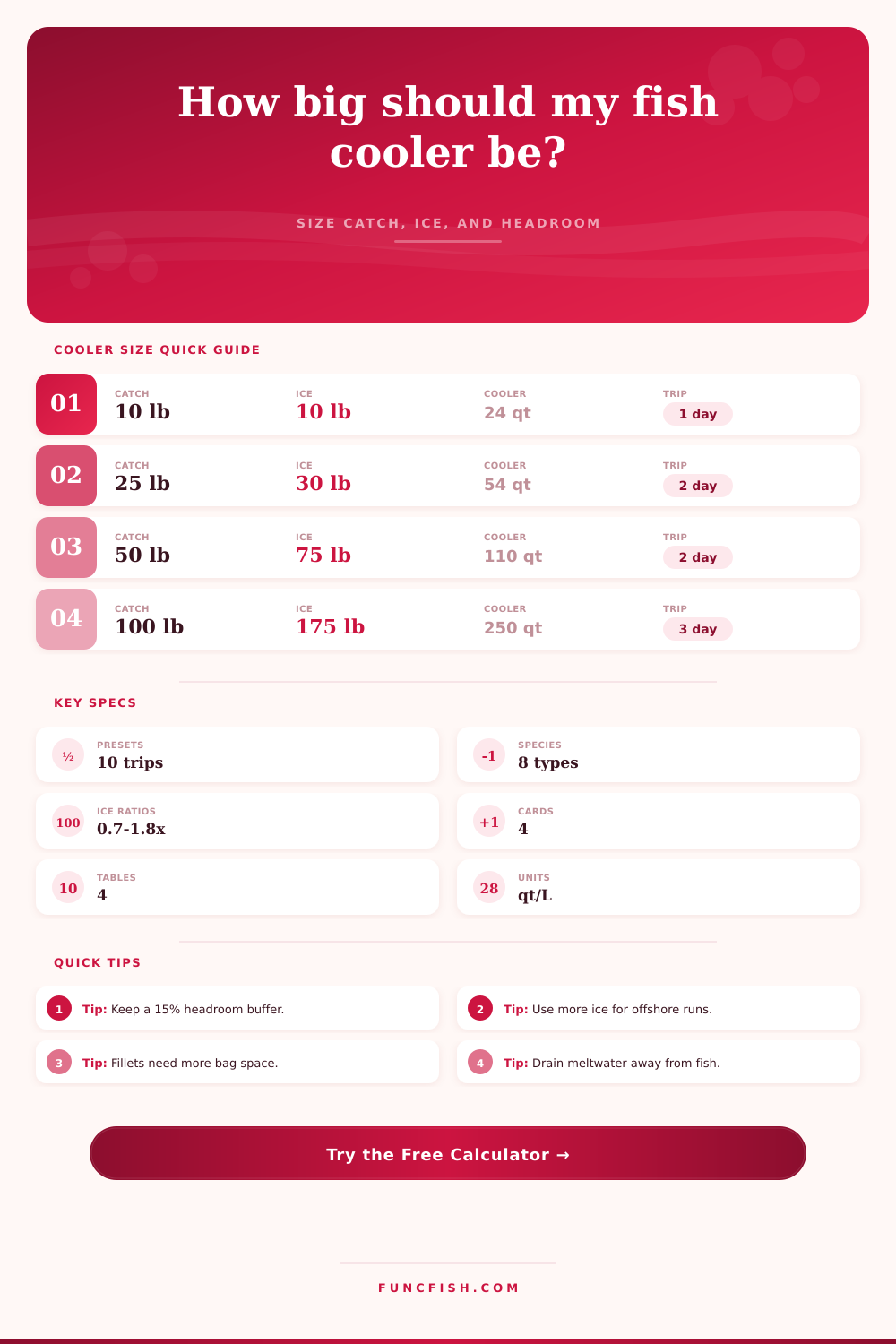
Most anglers makes a mistake with the amount of ice. How much ice do you need? You need enough to fully enclose the fish. Wherever there’s an air gap between the ice and fish, that area gets warm. Where does warm take you? Spoilage. So the calculator assumes how much ice you’d need to ensure you have enough, depending upon how far you’re going and what the surrounding temperature should be when you depart. Obviously, a cooler morning trout stream run will require less ice than a hot offshore trip. The chart shows the ice-to-fish ratios that apply. For shorter trips with a cooler air temp, it begins at 0.6 times the catch weight. For long trips in hotter weather, it can reaches almost double that, nearly twice as much ice per pound of fish caught.
Why? Because that is how it works in practice. Ice melts by absorbing heat. Then it becomes water and stops absorbing heat very well. You want a reserve supply of solid ice to continue to draw warmth away from the fish till you arrive back home. Don’t skimp on that head room buffer. I know, I know, head room buffer is the extra room to store your beer or snacks. No. No. It’s a safety buffer; an insurance policy. Because the size of fish varies. And there may be more than you anticipate. Perhaps you’ll have to reposition some items in the cooler to accommodate bigger fish which should goes on the bottom, where they will be coolest. A fifteen percent buffer prevents you from having to squeeze the lid closed around a bulging package. Squeezing the lid damages the seal. The seal goes, warm air comes in. Cold air goes out. How do you think you can ruin a catch?
This is a cooler for catching fish. You need a cooler that matches the reality of what you actualy do, not what you aspire to do. Catching a hundred pounds of tuna means you don’t need a little day box; it’s a trap. But a two-hundred-quart chest is a burden if you typically catch ten pound of bass. Match the size of your box to the climate of where you fish and the biology of what you’re after. Keep ’em cold. Respect the geometry. Plan for the ice. That’s how you make sure the fight results in dinner rather than disappointment.