Hook Size for Crappie Calculator
Match black or white crappie hooks to minnow length, jig head weight, tube or marabou profile, hook style, line test, cover, clarity, and presentation speed.
📌Crappie hook presets
⚙Crappie rig inputs
Crappie hook recommendation
Calculator output appears here after choosing a crappie setup.
Full breakdown
🎛Crappie profile data grid
Live Minnow
Tube Jig
Marabou Jig
Brush Jig
🧵Crappie jig, hook, and line comparison grid
Finesse Float
Small minnow or hair jig under a float in clear water.
Vertical Jig
Tube, grub, or marabou held over fish or cover.
Brush Pile
Jig or minnow worked tight to limbs and stakes.
Casting Swim
Small shad body, grub, spoon, or blade moving faster.
Spider Rig
Slow trolling minnows or jigs on multiple rods.
📊Crappie hook reference tables
| Crappie setup | Minnow or body length | Starting hook | Target gap | Line match |
|---|---|---|---|---|
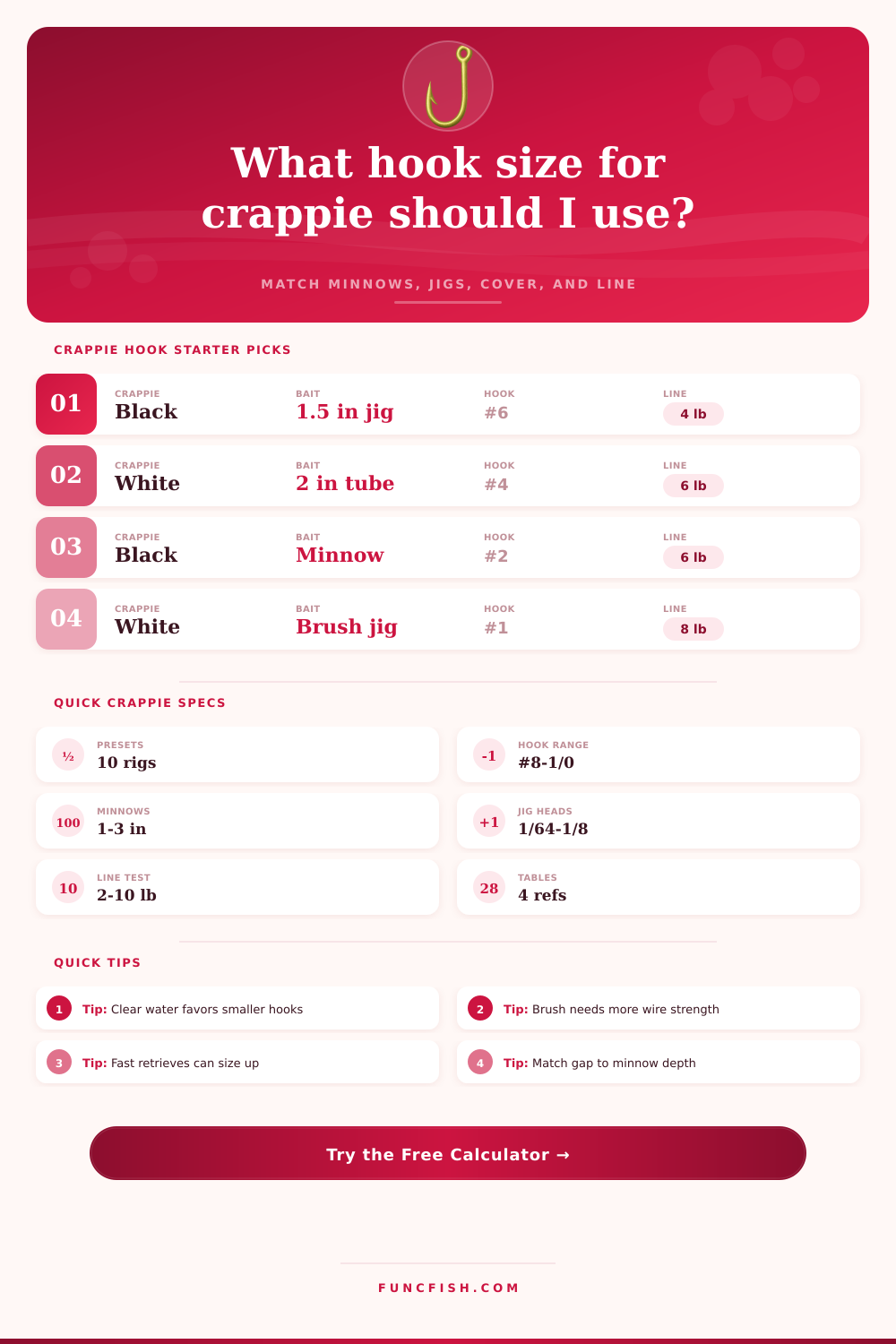
| Clear-water black crappie | 1.0-1.5 in / 2.5-3.8 cm | #8 to #6 | 4-6 mm / 0.16-0.24 in | 2-4 lb / 0.9-1.8 kg |
| All-around minnow rig | 1.5-2.25 in / 3.8-5.7 cm | #6 to #2 | 5-8 mm / 0.20-0.31 in | 4-6 lb / 1.8-2.7 kg |
| White crappie brush rig | 2.0-3.0 in / 5.1-7.6 cm | #4 to #1 | 7-10 mm / 0.28-0.39 in | 6-8 lb / 2.7-3.6 kg |
| Compact tube or hair jig | 1.25-2.0 in / 3.2-5.1 cm | #8 to #4 | 4-7 mm / 0.16-0.28 in | 4-6 lb / 1.8-2.7 kg |
| Fast casting or trolling | 1.75-3.0 in / 4.4-7.6 cm | #4 to #1/0 | 7-11 mm / 0.28-0.43 in | 6-10 lb / 2.7-4.5 kg |
| Jig head weight | Metric weight | Common hook | Depth and speed use | Crappie note |
|---|---|---|---|---|
| 1/64 oz | 0.44 g | #10 to #8 | Shallow float, tiny hair jig, slow fall | Best for pressured black crappie in clear water. |
| 1/32 oz | 0.89 g | #8 to #6 | Docks, light tubes, shallow vertical jigging | Good starting point for 1.5 inch plastics. |
| 1/16 oz | 1.77 g | #6 to #2 | General vertical jig, brush edge, slow swim | Most common all-around crappie jig weight. |
| 1/8 oz | 3.54 g | #2 to #1/0 | Wind, deep bridge piles, faster casting | Use enough hook gap without overpowering small fish. |
| Bare hook | 0 g | #6 to #2 | Live minnow, slip float, spider rig leader | Aberdeen wire protects thin crappie mouths. |
| Hook style | Useful size range | Best crappie profile | Wire behavior | When to avoid |
|---|---|---|---|---|
| Aberdeen minnow | #8 to #1 | Live minnows, slip float, spider rig | Light wire bends free from snags | Heavy brush with hard hooksets. |
| 90-degree jig hook | #8 to #1/0 | Tube, grub, shad body, marabou | Standard jig wire with stable tracking | Very tiny minnows or ultra clear water. |
| Sickle jig hook | #6 to #1 | Vertical jigging and faster casts | Sharper bend holds short strikes well | Delicate live minnows in clear water. |
| Small circle hook | #6 to #1 | Slow live bait and rod holders | Short-shank shape needs open gap | Fast jigging or hard plastic bodies. |
| Small treble | #10 to #6 | Spoons, blades, small hard baits | Multiple points, small individual gaps | Brush piles and soft crappie mouths. |
| Cover and clarity | Hook adjustment | Line adjustment | Presentation speed | Practical target |
|---|---|---|---|---|
| Open clear water | Downsize 1 step | 2-4 lb / 0.9-1.8 kg | Deadstick to slow | Small silhouette and fine wire. |
| Docks and shade | Use calculated size | 4-6 lb / 1.8-2.7 kg | Slow to steady | Balance skipping, fall rate, and hookups. |
| Brush piles | Size up 1 step | 6-8 lb / 2.7-3.6 kg | Slow vertical | Enough wire to steer fish from limbs. |
| Standing timber | Size up 1 step | 6-10 lb / 2.7-4.5 kg | Deadstick to slow | Strong hook with controlled pressure. |
| Muddy or fast water | Size up 1-2 steps | 6-10 lb / 2.7-4.5 kg | Steady to fast | Larger profile and more positive contact. |
💡Crappie hook sizing tips
Minnow gap tip: Hook gap should clear the deepest part of the minnow without locking the bait rigid. If the minnow rolls or tears, reduce hook size or wire weight before changing line.
Jig balance tip: Jig head weight often sets the practical hook range. When you move from 1/32 oz to 1/16 oz, recheck hook gap because the head may carry a larger hook than the bait body needs.
When you are planning your crappie fishing trips, you must pay attention to many different detail. One of the smaller details that have a significant impact on your success is the size of the hook that you use. Because the crappie has a thin, flexible mouth, a hook that is too large will tear the fish mouth.
If the hook is too small for the bait, the crappie will spit out the bait when it senses that it cannot have a succesful fight with the hook. The type of bait that you use will significantly impact the size of the hook that you use. If you use live minnows as your bait, your hook has to have a gap large enough to allow the minnow to exit the hook, but the hook should not be so large that the minnow cannot swim proper.
Choose the Right Hook Size for Crappie Fishing
If the minnow cannot swim properly, the crappie will not eat the bait. Depending on the type of bait that you use, you could use soft baits, such as tube jigs and marabou jigs, which will collapse when the crappie eats on the bait. These types of soft baits will use a smaller hook size than the hard plastic bait of the same length.
Curly tail grubs and smaller shad bodies fall somewhere in the middle in terms of the hook size that they require. These baits need enough clearance for the tails of the bait to move but do not collapse as much as the tube or marabou bait. A fishing hook size calculator will allow you to determine the correct hook size for the bait that you are using.
Using a hook size calculator will eliminate the guesswork involved in choosing the right hook size for crappie fishing. The location where you fish will change the type of hook that you use. If you are fishing in open water, where there is no underwater cover, you can use a smaller hook.
However, if you are fishing in areas covered in brush or standing timber, you need a larger hook so that you can steer the fish away from the cover. If the fish starts to wrap itself around the cover, the small hook may not be strong enough to hold the fish. In these cases, you need to move up one hook size.
If the water is clear, the crappie will be able to see the hook as you fish. However, in cloudy water, the crappie will not be able to see the hook as well. In these cases, you can use a larger hook so that the crappie will be less likely to avoid your bait.
The line that you use and the size of the jig head will also significantly impact the size of the hook that you use. If you use a light fishing line with a small jig head, the hook will need to do most of the work in enticing the crappie. Therefore, small hooks with fine wire will work best for fishing in clear water.
If you use a heavier fishing line with a larger jig head, the line will put more pressure on the hook. In this case, you will need a hook that can take the extra pressure and the extra cover in the water. Therefore, you need to consider the type of fishing line that you use when choosing the size of your fishing hook.
The speed at which you present your bait to the crappie will impact the hook size. If you use a slow presentation of your bait, such as vertical jigging or using a float, the crappie will have more time to take the bait with its mouth. In this case, a smaller hook will work better.
If you are using a fast presentation technique such as trolling or fast casting with your bait, you will get more short strikes at your bait. In this case, you need to use a hook with a larger gap to accommodate these short strikes by the crappie. Because the two presentations are significantly different from each other, the same minnow will require two different size of hooks depending on the speed of the presentation.
It is common for many people to make mistakes in choosing the size of the hook that they use. Many people will simply use the same size of hook for every situation. Some people use the same size of hook that they have used in the past when they were fishing.
It is unlikely that this size of hook will work in another situation with different water clarity or cover. People who use a small hook will lose alot of their crappie fish when they fish in areas covered in brush. The fish will wrap themselves around the brush, and the small hook will fail to hold the fish.
In situations where the crappie fish only hit the bait for a brief time, people should of used a larger hook size. If the minnow rolls instead of swimming when the crappie takes the bait, people should use a smaller hook size to ensure that the minnow moves correct through the water. Finally, the weather and the time of year also impact the hook size that you choose.
If a cold front is moving into your area, the crappie fish will likely be less aggressive in their attempts to eat the bait. In this case, you will need a smaller hook for a slow presentation. If the crappie are spawning, they will be more aggressive in their attempts to eat the bait, and they can take larger hardware.
However, these same crappie could be more cautious in water that is very clear to them. If there is a lot of wind while you are fishing, you may need to use a larger jig head to fight the wind. In this case, you may also need a larger hook.
When choosing the hook size, you need to consider the bait, the cover, the line, the jig head size, and the speed of your presentation to get the best result.