
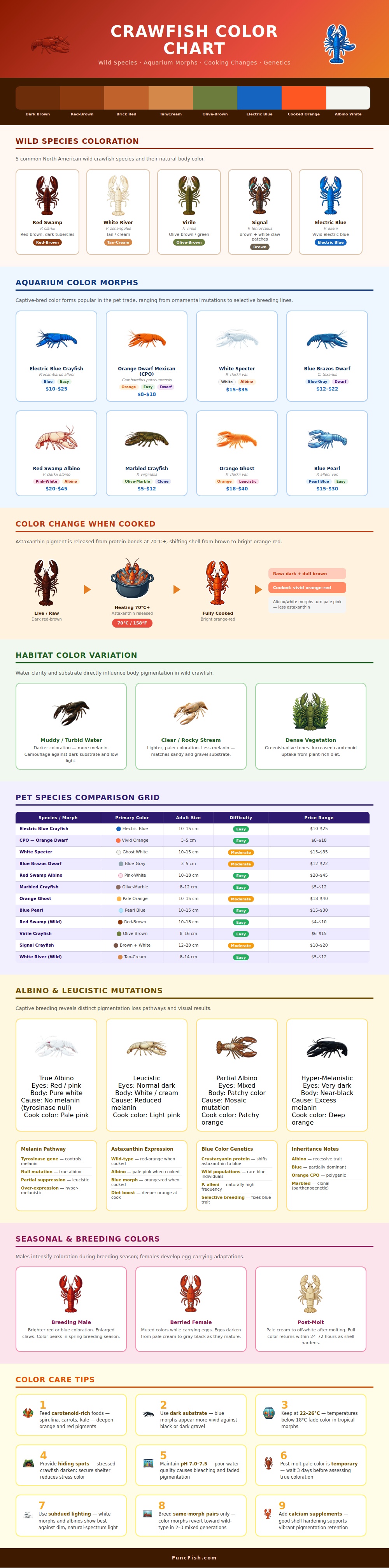
It’s an electric-blue crayfish, one that’s so bright it appears artificial. It flashes before your eyes as you gaze into aquarium. Is it some trick of your lights? Did you accidently add food coloring to the tank? Nope; the crayfish is genuine. Its color wasn’t manufactured but inherited through genes alone.
Why does this matter? Because it confuses beginning cichlid keepers who expect wild caught animals to be different from those sold as pets. Many don’t realize that captive breeding programs has yielded a whole range of colors far beyond what nature ever provide at the same time. The table above explain the connection between wild-caught (red-brown) forms and the highly colorful (white or blue) morphs found in pet shops. Knowing this help you take better care of them.
Why Crayfish Change Color
Wild crawfish are highly camouflaged. In the muddy south, they hide better when the ground is darker because more melanin is deposited on it. Where crawfish encounter clear water in creeks and other streams, they’ll take on more of that sandy bottom hue as a survival tactic… not an option. When you get one in your hands, that survival behavior won’t go away. If he’s comfortable, he’ll be nice and bright; if he’s stressed, he’ll turn very dark.
Why? Because your tank set up play a big role in how his colors is perceived. Blue morphs need good contrast, like that provided by dark gravel to really allow those vibrant color to pop out. Otherwise, you might find your beautiful crayfish dissapears against a light background.
The process for cooking crawfish is also educational. Anyone who has boiled crawfish know they turn bright orange-red when done. According to the infographic, crawfish shells contain an antioxidant called astaxanthin. This antioxidant bind with proteins inside the living creature. Heating cause these proteins to release astaxanthin’s red coloring. Whether you’re raising ornamental crayfish or cooking your own wild-caught bait, this holds true. Albino crawfish appear paler and may not be as “red” than their pigmented relatives. However, a slight pinkish hue develop during cooking. This is just enough to offer a clue that something biological is at work here, beyond the simple fact that they look different.
This all goes to show us that what we see on the surface isn’t always a sign of what lies beneath. In the case of coloration, it’s very much linked to biology. If you want to breed the colors, know your genetics first and be patient. For example, true albinos are a recessive trait, meaning that if both parents carry the albino gene, you will eventually produce pure whites.
If you’re doing blues, the trait depends on the species (e.g., *Procambarus alleni*). The blue can be either dominantly partial or completely recessive. This make it slightly easier to select for color, but it is still tricky. As noted in the chart, breeding back into morphs usually result in reverting back to wild-type color within a few generations. This is where folks go awry, assuming that if I cross a blue giant with an orange dwarf I should of get some perfect hybrid shade. Typically nope. To retain intensity, you must breed true.
Feeding is surprisingly important for their color. Faded out? Give them some blanched kale or even spirulina which are high in carotenoids that will deepen their orange and red color over time. It is not magic; it is just good nutrition. And if you feed poorly your crayfish will be weak and have faded shells. Food equals appearance.
Provide places to hide, keep the water clean, and try to have a stable pH of ~7.0. A stressed crayfish will hide its colors by making its shell darker as a defense. Appreciate the layers in that electric blue one above, genetics, environment, diet, and health. It’s a report card on their well-being.
Respect the biology and take care of the basics. Then let the colors speak for themselves.