
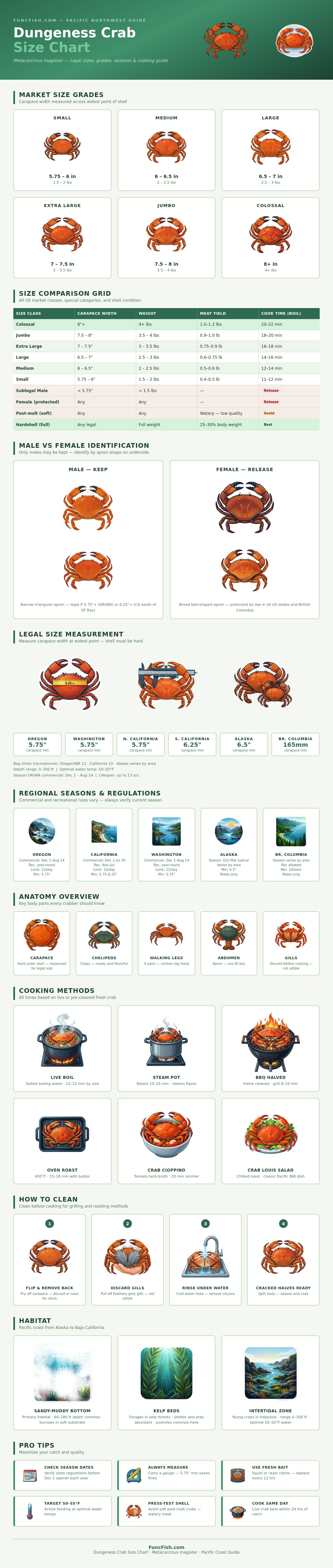
There shouldn’t be any gray area regarding size limit. You’re going to want to keep the crabs you’ve caught and it’s tempting to just grab ‘em and go home, but take my advice, measuring a crab and finding out whether it’s male or female is not something you should of skimp on. Most people tripping over this part seem to think it’s a bureaucratic annoyance, but there are two very real parts to knowing what you’re looking at size-wise. One, you don’t get a ticket; Two, you know if it have enough meat to feed you.
From there, we can see from the chart that meat yield goes with weight and carapace width. That’s where it gets tempting: the bigger the crab, the more food, right? Not so fast; there’s not necessarily a direct correlation here either. You may be willing to sacrifice some size for a little more meat. In that case, it makes sense to go with slightly larger crab rather than the smaller one. But then you end up getting very little more edible meat after all.
How to Catch and Cook Crabs
The graphic outlines relationship between market grades (small, huge) and gives you a guide as to what you’re likely catching. You’ll notice that a large crab differs from a medium in terms of how much meat you get. I find when people are talking about crab they get hung up on total weight rather than what percent makes it into the bowl. Crab percentages shows that as they reach jumbo and extra-large sizes, the percentage of meat yielded goes up.
But the bigger the crab is, the longer it takes to cook. You don’t want to overcook the delicate meat, but you do need to be sure you get it hot all the way through. Boil a small and a large crab together; if you use the same amount of time, the little guy’s meat will turn to rubber before the big guy is even warm in the center. How you cook for each size determine if a meal is good or bad.
What makes it more complicated is knowing what type of crab you should keep. In British Columbia, Washington and Oregon only males may be harvested. To do this you have to turn all your catches over so that you can see underside of their apron. A male’s apron is narrow and shaped like a triangle. A female’s apron is broad and looks more like a bell. Why is this the case? You need breeding females to maintain healthy populations, so releasing these will ensure there are crabs left to catch next time around.
Measure the carapace at its widest point. The minimum size is usually five and three quarter inches but down in southern California it are larger. Shell condition and timing is also important. Hard-shell crabs is good eating. They feel heavy for their size, indicating full muscle density. Shortly after molting, soft-shelled crab will result in lower yield and watery meat. Even if they’re at size limits, these crabs aren’t going to cook up well.
Crabs fished in cooler waters (fifty to fifty-five degrees Fahrenheit) are best. They’ll be most active and feeding heavily when caught at this temperature range. Fresh bait such as razor clams or squid works best to entice them out. Keep the bait fresh by changing it frequently; you don’t want the scent to go stale.
For novices, the trickiest part of making this dish is cleaning the crab beforehand (though it’s simple once you know your way around its body parts). Pull off the top shell; that leaves behind the feathery gills, which you don’t eat. Rinse the insides clean, and your meat will be ready for roasting or grilling. Alternatively, just boil them whole, in which case you’ll do a bit less cleanup. But then you miss some of the flavor details, since no butter or herbs can gets into the tightly sealed body.
The idea is to treat the ingredient with care, from net to plate. So, how do you catch Dungeness? It is half luck and half knowledge, but all patience. First you consult the regulation, then study the tide. If cooked right, a six-inch crab is as satisfying as an eight-incher.
You followed the rules that protect the species. And you’ve got fresh-from-the-ocean seafood in your pot. That old barrier is now just a stop on the way to a good dinner, and it is nothing more than a thin, triangular apron.