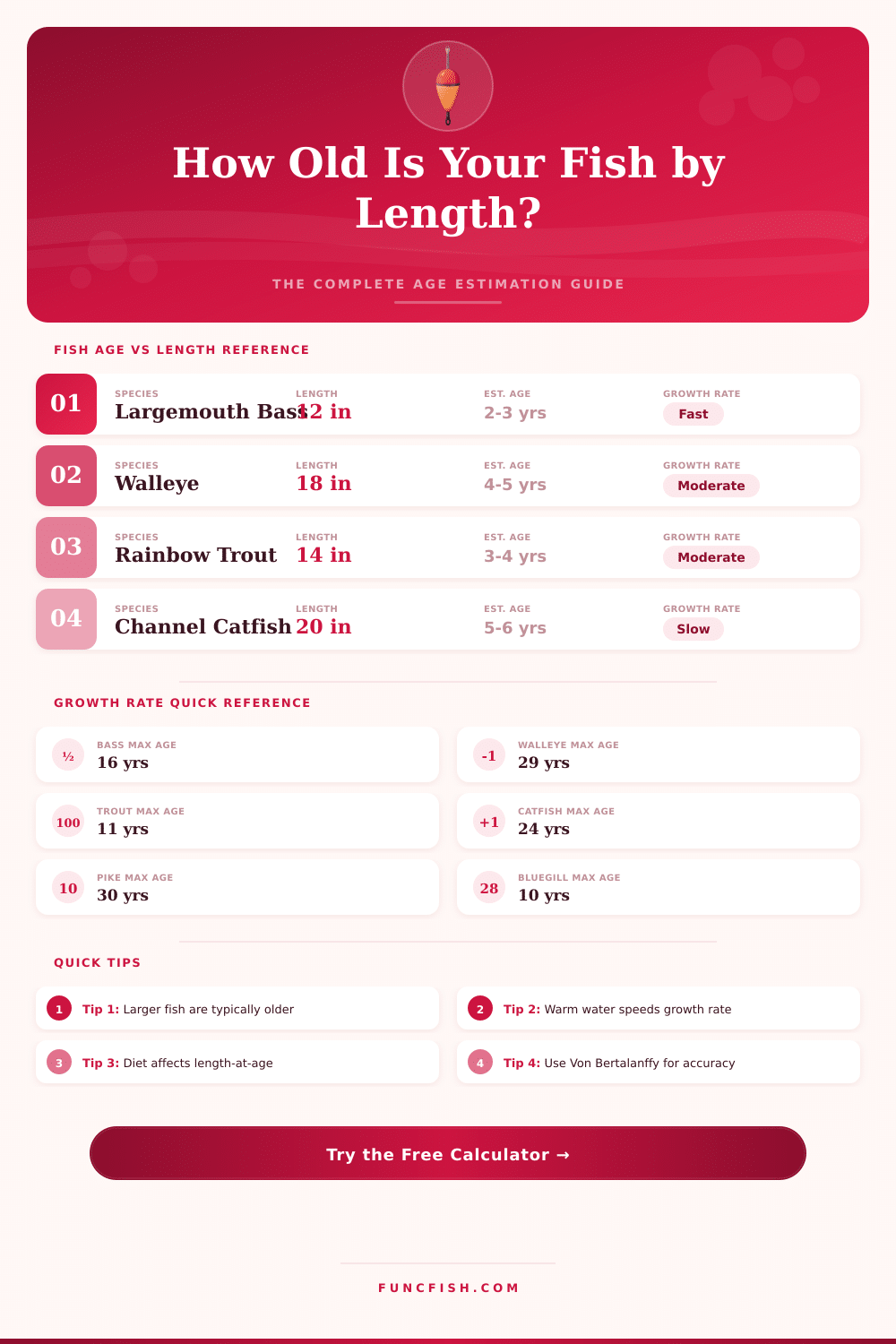
🐟 Fish Age from Length Calculator
Estimate a fish's age from its length using species-specific Von Bertalanffy growth models
| Species | Age 1 | Age 3 | Age 5 | Age 7 | Age 10 | Max Age |
|---|---|---|---|---|---|---|
| Largemouth Bass | 5″ | 11″ | 14″ | 17″ | 20″ | 16 yrs |
| Smallmouth Bass | 4″ | 9″ | 13″ | 15″ | 18″ | 12 yrs |
| Walleye | 6″ | 13″ | 18″ | 22″ | 26″ | 29 yrs |
| Rainbow Trout | 5″ | 11″ | 16″ | — | — | 11 yrs |
| Brown Trout | 5″ | 12″ | 18″ | 22″ | — | 18 yrs |
| Channel Catfish | 4″ | 10″ | 16″ | 20″ | 24″ | 24 yrs |
| Northern Pike | 8″ | 18″ | 26″ | 33″ | 40″ | 30 yrs |
| Bluegill | 2″ | 5″ | 7″ | 8″ | — | 10 yrs |
| Black Crappie | 3″ | 7″ | 10″ | 12″ | — | 15 yrs |
| Muskellunge | 10″ | 24″ | 34″ | 42″ | 50″ | 30 yrs |
| Species | L∞ (Max Length in) | K (Growth Rate) | t0 (Age at 0 length) | Growth Speed |
|---|---|---|---|---|
| Largemouth Bass | 23.6″ | 0.30 | −0.54 | Moderate–Fast |
| Smallmouth Bass | 20.5″ | 0.27 | −0.61 | Moderate |
| Walleye | 29.5″ | 0.22 | −0.45 | Moderate |
| Rainbow Trout | 22.4″ | 0.28 | −0.29 | Moderate |
| Brown Trout | 25.2″ | 0.20 | −0.40 | Moderate–Slow |
| Channel Catfish | 28.0″ | 0.18 | −0.71 | Slow |
| Northern Pike | 46.9″ | 0.19 | −0.55 | Fast Initially |
| Bluegill | 9.8″ | 0.37 | −0.21 | Fast |
| Black Crappie | 14.5″ | 0.32 | −0.38 | Moderate–Fast |
| Muskellunge | 55.1″ | 0.17 | −0.65 | Slow |
| Condition | K Modifier | Effect |
|---|---|---|
| Optimal | +15% | Fish grows faster, looks younger for length |
| Average | ±0% | Baseline growth model applies |
| Poor | −15% | Fish grows slower, appears older for length |
| Species | Female Grows | Male Grows |
|---|---|---|
| Largemouth Bass | Larger/longer | Smaller |
| Walleye | Larger/longer | Smaller |
| Northern Pike | Larger/longer | Smaller |
| Trout (most) | Similar | Similar |
Aging a fish is not as mysterious as it sounds. It is simply a process similar to that, that you use to estimate the age of a tree by its rings. During growth, fish add layers year after year.
Scientists use two main methods: they check the scales or the otoliths, that are small bones in the inner ear of the fish.
How scientists tell a fish’s age
Researchers search for structures, that build up clearly over time, to determine exactly the age of a fish. The usual methods are made up of counting growth rings on scales, otoliths, vertebrae, fin spines, lenses, teeth or bones of the jaw, pectoral girdle and opercular series. The nice thing about that method is, that reading of those rings, called annuli…
Gives a pretty solid estimate about the real age of the fish.
Every pair of annuli usually marks one year. On a scale they show as alternating dark and light bands. The first dark band marks normally the end of the first year, that relates to the first winter of the fish in freshwater.
Here it gets interesting: fish do not grow equally quickly. They speed up in summer and slow down in winter depending on the seasons. During slow growth the otolith forms an opaque zone, and during fast growth a clear zone appears.
One such pair equals one year of life. Newer growth sometimes covers older rings, but you still can see them after cracking the otolith open. One laboratory found in yelloweye rockfish an age of 121 years.
Scientists can also use radiocarbon dating on otoliths to confirm the age, those structures sit in the vestibular organs and are made up of biominerals and calcium carbonate.
Fishing laboratories gather most commonly scales and otoliths. Scales are favored because of there simple collection and analysis, especially if the growth rings are clear and steady. Young fish and tricky species like Atlantic herring or Atlantic mackerel; with hard to extract age structures, get frozen whole and taken to the laboratory for dissection and preparation later.
When you know the age of a fish, you get a window into how quickly a generation from the same birth year shrinks because of fishing pressure and natural death. Older fish are bigger and slower, so more easily targeted by predators. Lifespans range a lot between species.
Some fish live only one year, others reach 50 years or more. Pacific salmon die usually soon after spawning, between 2 and 7 years old. A goldfish in a decent sized tank or pond can live around 20 to 30 years.
And there is Granddad, the lungfish at the Shedd Aquarium, who was thought to bearound 109 years old.