🐟 Fish Age from Scale Calculator
Estimate fish age by counting scale annuli (growth rings) — supports multiple species & both unit systems
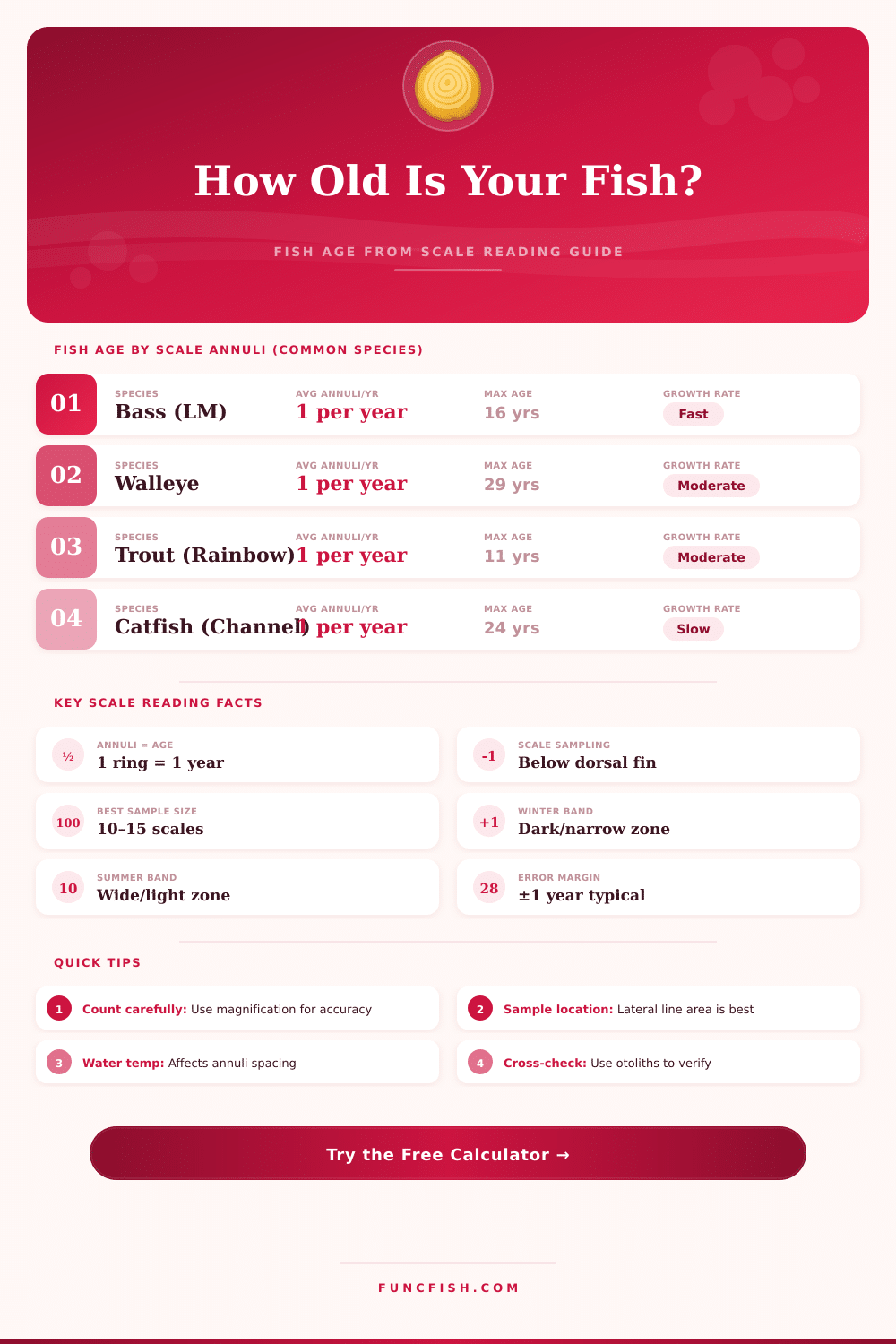
| Species | Annuli Pattern | Max Age (yrs) | Avg Length at Age 5 | Growth Class |
|---|---|---|---|---|
| Largemouth Bass | Clear winter bands | 16 | 14–16 in (36–41 cm) | Fast – Moderate |
| Smallmouth Bass | Narrow winter checks | 18 | 12–14 in (30–36 cm) | Moderate |
| Walleye | Distinct, easy to read | 29 | 16–20 in (41–51 cm) | Moderate – Fast |
| Rainbow Trout | Often unclear in wild | 11 | 12–18 in (30–46 cm) | Variable |
| Brown Trout | Moderate clarity | 20 | 14–20 in (36–51 cm) | Moderate |
| Lake Trout | Otolith preferred | 60+ | 16–22 in (41–56 cm) | Slow |
| Channel Catfish | Spines more reliable | 24 | 14–18 in (36–46 cm) | Moderate |
| Bluegill | Clear, tight annuli | 11 | 6–8 in (15–20 cm) | Slow – Moderate |
| Crappie | Readable, some false checks | 15 | 8–11 in (20–28 cm) | Moderate |
| Northern Pike | Difficult, otolith preferred | 25 | 20–26 in (51–66 cm) | Fast |
| Yellow Perch | Clear, reliable | 13 | 8–10 in (20–25 cm) | Slow – Moderate |
| Muskellunge | Scales unreliable, use cheeks | 30+ | 26–34 in (66–86 cm) | Fast |
| Method | Formula Basis | Best For | Accuracy |
|---|---|---|---|
| Direct Count | Annuli = Age | Simple age estimates | 1 yr (most species) |
| Fraser-Lee | L = (Sl/Ss) x (Lc – a) + a | Compensates for scale formation lag | High (corrected) |
| Dahl-Lea | L = (Sl/Ss) x Lc | Species with early scale formation | Good (uncorrected) |
| Petersen | Length-frequency modes | Population cohort analysis | Moderate (indirect) |
| Ring Spacing | Growth Indication | Typical Cause | Season |
|---|---|---|---|
| Wide, light bands | Rapid growth | Summer feeding peak | Summer |
| Narrow, dark bands | Slow/no growth | Cold temperature | Winter |
| Closely spaced rings | Age or stress check | Disease, spawning stress | Spring/Fall |
| False annuli present | Multiple checks per yr | Temperature fluctuation | Variable |
| Missing annuli | Undercount risk | Fast growth, hot climate | Tropical/warm waters |
Always sample scales from just below and behind the dorsal fin, along the lateral line. Scales from other areas (belly, tail) may show different growth patterns and give inaccurate annuli counts. Collect 10–15 scales per fish for best results.
For older fish (>10 years) or species like Lake Trout and Northern Pike, scales are unreliable. Cross-check age estimates with otoliths (ear stones), opercular bones, or dorsal spines. The Fraser-Lee method corrects for the body-intercept (a) to reduce systematic bias in back-calculations.
Figuring out the age of a fish works a lot like figuring out the age of a tree. As trees form new layers each year fish also produce rings of growth. To age a fish, you use mainly two methods: checking its scales or one of the otoliths, which are inner ear bones.
Researchers who want to figure out the age of a fish look for structures that grow slowly with time. The usual methods involve counting natural growth rings on scales, otoliths, vertebrae, fin spines, eye lenses, teeth or bones of the lower jaw, pectoral zone and opercular series. By reading those rings, called annuli, in the hard parts you can determine fish age quite exactly.
How to Tell a Fish’s Age
Every pair of annuli normally marks one year of growth. They show as dark and bright bands on the scale. The first dark band usually shows the end of teh first year, when the fish spent winter in freshwater.
Depending on the season, fish go through periods of slow and fast growth. In slow phases the otoliths form opaque zones, during fast growth they form clear zones. Such pairs of slow and fast areas in an otolith match to one year of age.
New growth sometimes covers old rings, but they show if you break the otolith in half. The oldest yelloweye rockfish, aged in a lab, was 121 years old. Age can also be estimated by radiocarbon analysis of otoliths.
Those are found in the vestibular organs and are made up of biominerals and calcium carbonate.
Scales are preferred, because they are easier to gather and process, if clear growth patterns regularly appear. Young fish and species with fragile age structures, like Atlantic herring and Atlantic mackerel, are frozen hole for later cutting and processing in the lab.
The number of fish in a group… A population born in a given year, drops from year to year. Known fish age helps to estimate death rate from fishing and natural causes.
With age fish usually grow larger and move more slowly, so they are easier for predators. Almost always they geteat before they die of old age.
Some fish live only one year. Others reach 50 years. Almost all Pacific salmon die shortly after spawning, between 2 and 7 years old.
A lungfish at the Shedd Aquarium was euthanized after 84 years in their care, with an estimated age of 109.