Fish Cooler Ice Ratio Calculator
Estimate ice weight, ice-to-fish ratio, cooler capacity, melt margin, and trip hold time from fish mass, cooler size, trip length, ambient heat, and ice format.
📌Trip presets
⚙Cooler, fish, ice, and heat inputs
Fish cooler ice estimate
Calculation breakdown
🧊Cooler and ice format data
Crushed or Flake
Cube Bag Ice
Block Plus Cubes
Ice Slurry
📊Species and gear comparison grid
Panfish and Trout
Small fish pack tightly but warm quickly when dropped into a lightly iced compact cooler.
0.7:1typical full-day starting ratio
Bass, Walleye, Redfish
Medium fish leave more void space and need steady ice contact for full-day travel.
1.0:1typical full-day starting ratio
Salmon and Stripers
Thicker bodies add heat load and cooler geometry matters more than rated quart size.
1.4:1typical full-day starting ratio
Tuna and Offshore
Large warm fish and hot deck exposure push ice demand toward heavy trip margins.
2.0:1typical full-day starting ratio
📘Reference tables
| Trip and ambient profile | Typical ice ratio | Use when | Capacity note |
|---|---|---|---|
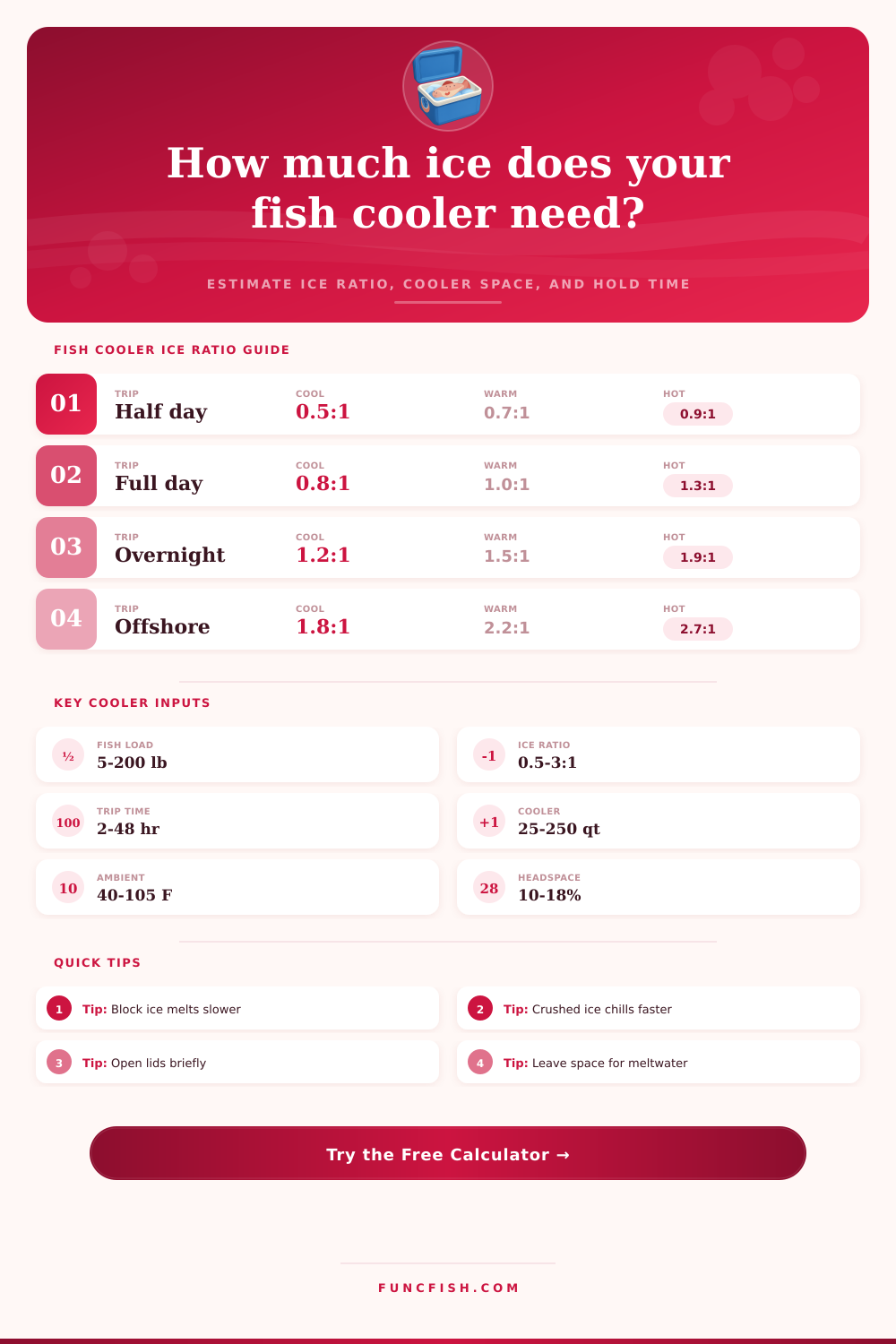
| Half day below 65°F / 18°C | 0.4 to 0.6 lb ice per lb fish | Short run, shaded cooler, small catch | Often fits in 25 to 45 qt coolers |
| Full day 65 to 85°F / 18 to 29°C | 0.8 to 1.2 lb ice per lb fish | Most bass, walleye, trout, and inshore trips | Plan about 1.2 to 1.5 qt per lb fish |
| Hot day above 85°F / 29°C | 1.2 to 1.8 lb ice per lb fish | Bank, kayak, open deck, or truck-bed heat | Headspace fills quickly with cube ice |
| Overnight or offshore | 1.8 to 3.0 lb ice per lb fish | Long hold time, large fish, heavy sun exposure | Use bigger cooler or split catch between boxes |
| Cooler class | Heat leak rating | Best trip fit | Calculator effect |
|---|---|---|---|
| Soft-sided fish bag | High | Kayak, pier, short inshore | Adds more hourly melt demand |
| Basic thin-wall cooler | Medium-high | Half-day or shaded vehicle trips | Needs extra margin in hot weather |
| Marine hinged cooler | Medium | Full-day boat and bank trips | Balanced heat leak and capacity |
| Rotomolded cooler | Low | Long day, overnight, camp | Lower hourly melt, less internal room |
| Offshore kill bag | Medium | Large fish on deck | Good shape fit, sun exposure still matters |
| Deck fish box | Variable | High-volume offshore catches | Large area can raise heat gain |
| Fish group | Heat load factor | Shape factor | Cooler planning note |
|---|---|---|---|
| Panfish, perch, small trout | Low-medium | Packs tight | Crushed ice works well in compact coolers |
| Bass, walleye, redfish | Medium | Moderate voids | Cube or crushed ice usually balances space |
| Salmon, steelhead, lake trout | Medium-high | Long bodies | Check length and rated capacity together |
| Catfish and carp-sized fish | High | Bulky bodies | Use more headspace allowance for odd shapes |
| Striper, snook, cobia | High | Long bodies | Large coolers may run out of length before volume |
| Tuna, mahi, offshore pelagics | Very high | Large thermal mass | Split fish and ice across boxes when possible |
| Ice format | Chill speed | Space efficiency | Best calculator setting |
|---|---|---|---|
| Crushed or flake ice | Fast | Lower lb per quart | Use for quick pull-down and small fish |
| Cubed bag ice | Medium | Medium lb per quart | Use for general trip estimates |
| Block ice plus cubes | Slow start, long hold | High lb per quart | Use for overnight or camp coolers |
| Ice-water slurry | Very fast | Needs liquid volume | Use when rapid cooling matters most |
| Gel packs plus ice | Medium | Reusable but uneven contact | Use with a higher safety margin |
| Dry bagged ice | Slow contact | Clean separation, less surface contact | Use with extra ice or longer contact time |
💡Calculation notes
Ice ratio tip: The calculator separates pull-down ice for warm fish from hourly melt ice for ambient heat, lid openings, sun exposure, and cooler insulation.
Capacity tip: Rated quart capacity is not all usable. Fish displacement, ice bulk density, headspace, and odd fish shapes can make a cooler run out of space before it runs out of cooling power.
When most anglers load up their coolers they have the best intentions, but few has a strategy for keeping fish cold. They’ll snag a couple of bags of ice, throw there catch in there and cross their fingers. Four hours later, they returns to find slushy water, warm fish, and an ice chest that is no longer cold.
It’s not typically a “not trying hard enough” issue. It’s more about failing to understand how volume displacement and heat transfer plays into the equation. A cooler doesn’t contain ice; it contains a struggle between ambient temperature, thermal mass (whatever you stuck in there) and disorder. Once you know how much rain falls on your roof (and you put the numbers into the above calculator) it does all the number crunching for you, no need to worry about conversion or coefficient calculations. But what exactly happen in that box? And why do those numbers matters?
How to Keep Your Fish Cold and Fresh
Ice have a purpose. To take in the warmth of warm fish, cool them down safely and then slow-melt that ice so the coolness lasts throughout your fishing day. Skimp on the first half and the fish spoil before they even turn cold. Skimp on the second and the ice will be gone by noon, either way you end up with the same sad result.
Ice type You’ll notice that all of the above depend on the type of ice. Less surface area against the water mean it lasts longer, but a cube is more convenient. And while we prefer crushed ice for getting initial chill into our fish, crushed ice also conforms to shape of the fish, removing any air pockets where heat might hang out.
A lot of folks overlook that tradeoff. They go with cube because it’s easy to transport and then complain about how their catch was still warm after an hour. This is where the tool come in, adjusting contact efficiency and bulk density depending on your selected type of ice. If you want block ice, it will last the longest but chill the slowest. If you want slurry, it will be instant, but it will fill the container quickly. Know which constraint is more important to you; you know what you should of purchased.
That leads me back to the first point: Fish shape matter more then most people recognize. A 50-quart cooler might seem big enough for three long salmon. They don’t pack into a cube very well. There is too much empty space between them, so hardly any of the cube can be used effective. This leaves voids between their bodies where there isn’t any ice contacting the fish. And that’s where people makes mistakes. They consider the weight ratio but neglect the geometry. The higher headspace setting on the calculator acknowledge this fact. It preserves space for odd-shaped fish (and the inevitable meltwater collecting at the bottom). Otherwise, it’s a waterlogged mess as your fish will float off the cold.
You can’t see heat, but you feel its loss, too late. Opening the lid to peek at dinner lets in warm air and pushes out cold air every time. Heat from the sun baking a black deck box also add more heat for the ice to fight. Even a cool rotomolded cooler battles better than a flimsy plastic bucket, but nothing’s bulletproof. Your ice will melt faster on a sunny day then it will in the morning shade under a dock, so the surrounding temperature matter. On a ninety-degree day, your ice melts twice as fast as it do in the shade of a dock at dawn.
To maintain freshness of your fish, you don’t have to learn about heat movement. You simply must understand time versus mass. How long you can buy with more ice. How long you can go with better insulators. How much smarter you pack to make sure that cold gets to the food. That’s what this table at the bottom of the page does, it gives you a baseline, where there is no exact data. It’s a starting point. Then calibrate based off your personal habits. Do you keep the cooler in the truck bed? Add a safety margin. Put a safety margin on it. Do you leave the drain open? Pack heavier then shown.
In conclusion, freshly caught fish is best. From the time they hit the water to the time they land on your dinner plate, they are handled with care. Save yourself some heartache later by planning a few minutes in advance. Ice heavily, pack wisely and don’t rely on what feels right as much as trusting the process. When that bass hits the plate cold and still tastes as fresh as the morning it was caught, it’ll thank you for it.