Fish Cure Time by Weight Calculator
Estimate a refrigerated fish cure window from batch weight, fillet thickness, species texture, cure style, salt and sugar percentage, skin-on status, and desired cure intensity.
📌Cure presets
⚙Cure inputs
Use fresh, properly chilled fish and keep the cure refrigerated. This planning calculator estimates timing and mix amounts; it does not verify food safety, parasite control, or shelf life.
Cure time estimate
Calculation breakdown
🐟Species and cure material grid
Salmonids
Lean White Fish
Oily Small Fish
Tuna Loins
Flatfish
Wet Brine
Dry Cure
Salt Box
📊Cure reference tables
| Species profile | Suggested salt range | Time factor | Expected moisture loss | Use in calculator |
|---|---|---|---|---|
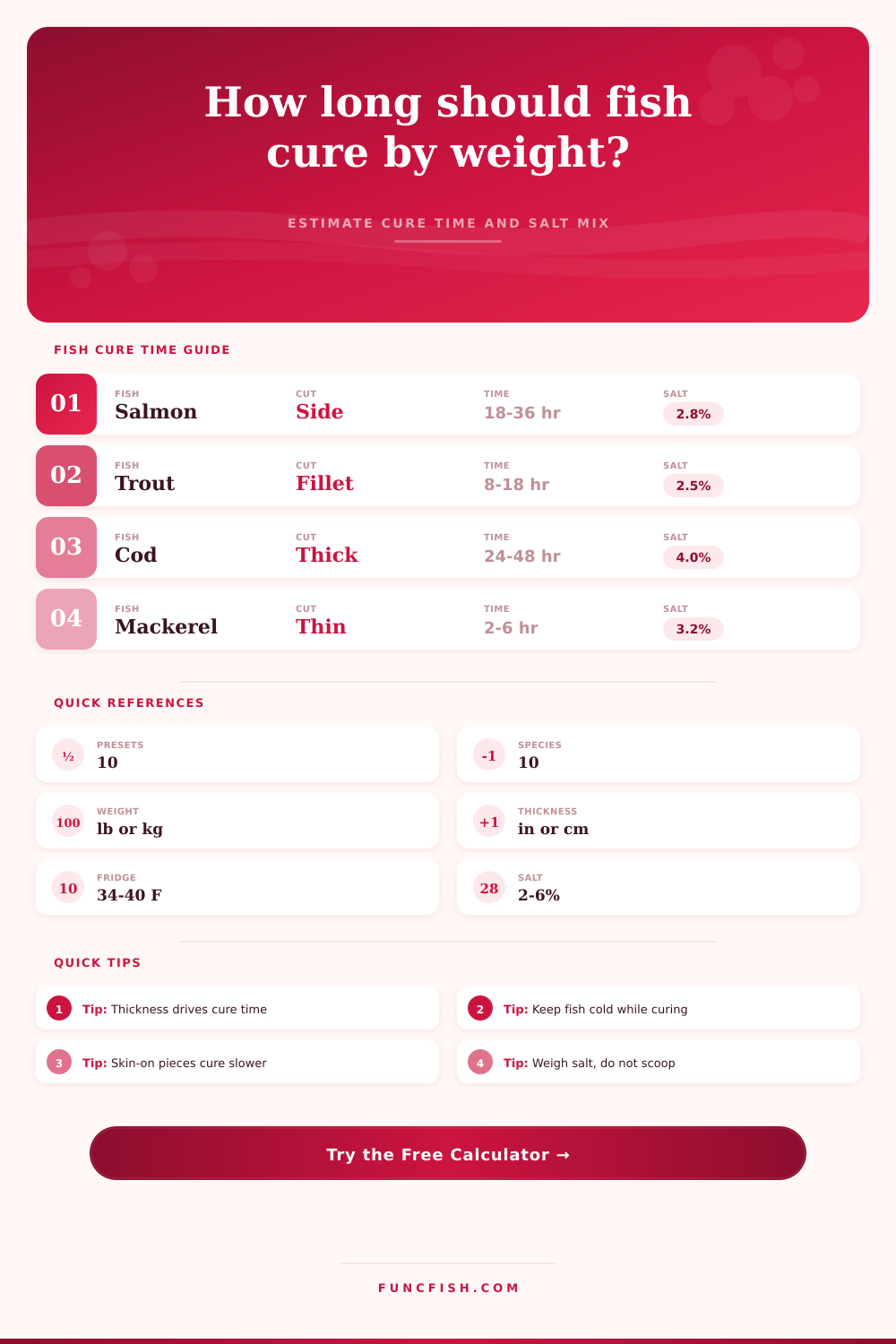
| Salmon or steelhead | 2.6% to 3.5% | 1.05x | 8% to 16% | Rich sides, gravlax, slicing cure |
| Trout or char | 2.4% to 3.2% | 0.85x | 7% to 14% | Smaller fillets and light cures |
| Cod, haddock, pollock | 3.2% to 5.0% | 0.95x | 10% to 20% | Lean white fish that firms quickly |
| Mackerel or sardine | 3.0% to 4.5% | 0.70x | 8% to 15% | Thin oily fish with short cure windows |
| Tuna loin | 2.5% to 4.0% | 1.18x | 6% to 12% | Dense loins and thick back straps |
| Halibut or flatfish | 2.8% to 4.0% | 1.00x | 8% to 15% | Firm broad flakes and thick portions |
| Snapper or sea bream | 2.8% to 4.0% | 0.92x | 8% to 15% | Moderate lean reef fish fillets |
| Catfish | 3.0% to 4.2% | 0.90x | 9% to 16% | Moist fillets with mild texture |
| Bass or panfish | 2.8% to 4.0% | 0.78x | 7% to 14% | Small fillets and fast batch cures |
| Walleye or perch family | 2.8% to 3.8% | 0.82x | 7% to 14% | Lean freshwater fillets |
| Cure style | Base time | Thickness rate | Common salt range | Texture target |
|---|---|---|---|---|
| Quick surface cure | 1 hour | 2.2 hr per cm | 2.0% to 3.2% | Light edge seasoning |
| Light dry cure | 4 hours | 4.2 hr per cm | 2.2% to 3.2% | Soft center, clean edge |
| Balanced dry cure | 6 hours | 6.2 hr per cm | 2.8% to 4.0% | Sliceable, still moist |
| Gravlax style cure | 8 hours | 7.0 hr per cm | 2.5% to 3.5% | Silky rich salmonid texture |
| Firm slicing dry cure | 10 hours | 8.5 hr per cm | 3.2% to 4.8% | Firm, tighter flakes |
| Heavy salt box cure | 12 hours | 9.5 hr per cm | 4.0% to 6.0% | Firm preserved-style pieces |
| Wet brine cure | 5 hours | 4.8 hr per cm | 3.0% to 5.0% | Even salting with less edge crust |
| Smoke-prep cure | 8 hours | 7.5 hr per cm | 3.0% to 4.5% | Firm surface for drying |
| Thickest point | Light dry cure | Balanced cure | Firm cure | Planning note |
|---|---|---|---|---|
| 0.25 in / 0.6 cm | 3 to 6 hr | 4 to 8 hr | 6 to 10 hr | Thin strips and small oily fish |
| 0.50 in / 1.3 cm | 6 to 10 hr | 9 to 14 hr | 12 to 20 hr | Small trout or panfish fillets |
| 1.00 in / 2.5 cm | 12 to 20 hr | 18 to 30 hr | 24 to 40 hr | Typical salmon side or cod fillet |
| 1.50 in / 3.8 cm | 18 to 30 hr | 28 to 44 hr | 36 to 58 hr | Thick center cuts and loins |
| 2.00 in / 5.1 cm | 24 to 40 hr | 38 to 60 hr | 48 to 72 hr | Large blocks need more checks |
| Cure adjustment | Lower setting | Middle setting | Higher setting | Calculator effect |
|---|---|---|---|---|
| Refrigerator temperature | 32-34°F slows cure | 35-39°F baseline | 40-42°F shorter margin | Changes timing and caution flag |
| Skin status | Skinless faster | Skin-on baseline | Stacked slower | Adjusts salt contact area |
| Cut shape | Small pieces faster | Single side baseline | Loins slower | Adjusts penetration distance |
| Salt percentage | 2% delicate | 3% balanced | 5% firm | Higher salt speeds texture change |
| Turning schedule | No turn | Turn halfway | Every 12 hours | Improves evenness of the cure |
💡Cure planning tips
Measure the thickest point: two fillets with the same weight can cure very differently when one is a thin side and the other is a dense center cut.
Use weight percentages: weighing salt and sugar against the fish weight keeps small trout fillets and large salmon sides on the same predictable scale.
Then you panic; you’ve overcured some of your fish. It’s firm and translucent, like dried-out raw steak. You take a bite. Before you taste anything, there’s that telltale whack of salt in your mouth. It’s not ruined, exactly, but this is no longer a delicate piece of fish, destined to be an appetizer.
Why? Because at home, most of us is guessing. We’re judging our time solely by weight. How much is it? That answers your question about how much salt to use. And how thick is it? That’s the answer to how long. Get those confused and you’ll have wasted good fish faster than anything else. All you do is enter your measurements and let the calculator do the math for you, no more guessing on conversions or coefficients.
How to Use the Curing Calculator
The result is an estimate broken down into three parts: Time, Mix Weight and Moisture Loss. But don’t confuse that time with a hard deadline. Consider it a target zone. You’re aiming to get just enough salt penetration to firm up the proteins while still leaving some of the juice-rich flavor inside. Stop too soon, however, and the center may remain raw. Push too far, and you could end up with something as dry as jerky (a tell-tale sign of over-curing).
It’s all about thickness. A half inch thick piece of trout can weigh as much as an inch thick piece of salmon. Yet, the salt only travels from the outside in. It doesn’t travel inward to the heart of the meat immediately. That is exactly why the tool wants to know the thickness of the thickest part. Measure there. Everything else will cure quicker along the perimeter. Cure based off the thickest part and you have even curing. Cure based on average and you’ll be under curing in the center. It’s a subtle difference but a world of difference.
Texture also varies among species. Walleye and cod are white, lean fish; whereas mackerel and salmon are oily. Oil forms a barrier and resists salt penetration, although it happens somewhat slower. A species factor is built into the calculator to account for this. Without something to impede the salt, lean fish become firmer fast. That’s why you’ll notice different recommendations for how long to soak various species. A side of salmon will turn to rubber if left in the cure as long as a cod fillet of equal thickness. You can get away with more salt in leaner fish because there’s less richness to offset saltiness. Oily fish requires a lighter hand.
Temperature is the quiet variable. Your 37-degree F refrigerator is not the same as a 42-degree F refrigerator. Chemical reactions is faster when warmer and that includes the decomposition of flesh. The safe window shrinks as it gets warmer. The calculator takes temperature into account and adjusts time accordingly. Err on the side of caution. There’s nothing wrong with leaving fish in the cure for another hour. Once fish have begun to dry out, you can’t add moisture.
There’s one more wrinkle (pun intended). Skin. Salt doesn’t get into skin very well. You can do a skin-on cure, but since salt has to move around that edge and then work its way up or down the flesh, it takes longer. Removing the skin makes the curing faster. Even scoring the skin to help that along isn’t quite like removing it. With the tool you’ll choose how you want your thing set up and it will tweak the time estimate.
So, if you have multiple pieces in a tray they will all be curing at different rates. What’s exposed will cure faster then what is rubbing against other fish. Make them all uniform. Turning them over halfway through cures also evens things out. No need for the bottom half to end up a solid lump of salt when the top is tasteless.
You’ll also lose moisture. Dehydration is part of curing, and yes, you will lose some weight during that process. Expect it, because the calculator accounts for your loss and lets you know how much the final product should weigh. Not waste. Concentration. As the water evaporates, the flavors intensify. That’s why a good cure will taste more like fish then even fresh fish ever can.
Don’t hurry the end. Look at the texture when the timer sounds. Gently touch it. It should be soft but with some resistance left in it. Is it hard like wood? It is too long. Rinse it lightly if the recipe calls for it. Let it air dry. The final step is patience. Just allow it to reach the point where there is a film on the surface.
What’s a pellicle? That’s the thin layer of cured protein that forms as the meat dries. On a smoked product, it holds the smoke. It will keep the flesh intact while stored.
Besides the salt, what else is curing all about? It is about control. You’re bringing a piece of raw fish to preservation. Usually it’s only a matter of inches from right to wrong and it’s those inches that can make or break success; that’s the thickest part of the fish; trust the numbers.