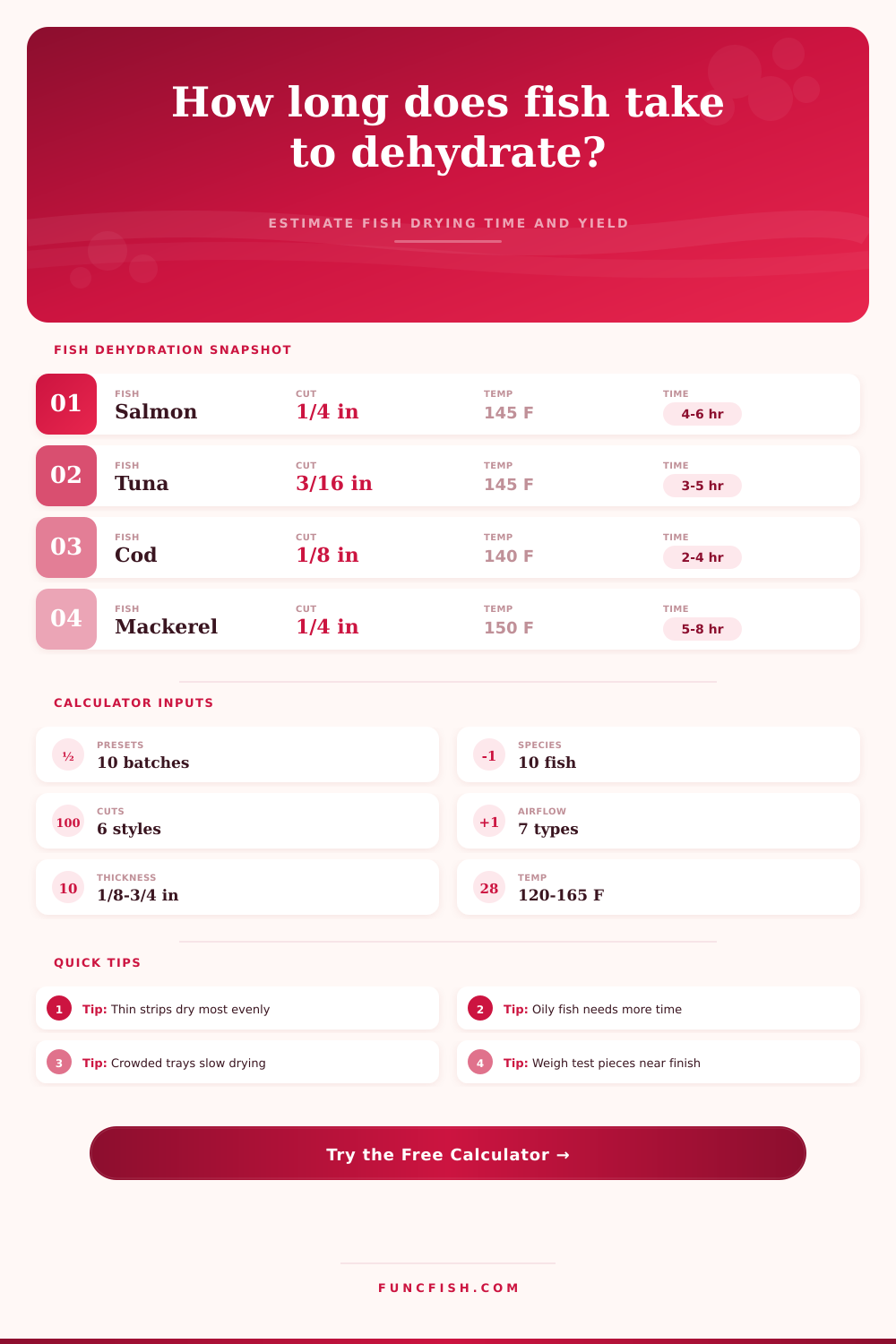
Fish Dehydration Time Calculator
Estimate fish dehydration time, finished yield, water removal, tray loading, and finish checkpoints from species moisture, fat level, strip dimensions, dehydrator airflow, temperature, humidity, and target dryness.
📌Dehydration presets
⚙Fish and dehydrator inputs
This estimator models drying time from geometry, moisture loss, airflow, and tray loading. Use verified fish-dehydration food-safety targets for your process and equipment.
Fish dehydration estimate
Calculation breakdown
📊Species and material grid
Salmon
Tuna
Cod
Mackerel
Mesh Tray
Silicone Mat
Wire Rack
Solid Liner
📘Reference tables
| Species profile | Typical moisture | Fat effect | Drying note |
|---|---|---|---|
| Salmon or steelhead | 62-66% | Slower, oily | Allow extra finish checks for rich belly pieces. |
| Tuna or bonito | 68-72% | Moderate, lean | Dense loins need even slicing for predictable time. |
| Cod or pollock | 78-82% | Fast, lean | High water loss creates lower finished yield. |
| Mackerel or bluefish | 58-64% | Slow, oily | Oil slows surface drying and extends the window. |
| Catfish | 72-76% | Moderate | Wet surfaces add time unless drained thoroughly. |
| Walleye or perch | 76-80% | Fast, lean | Small nuggets dry quickly but can over-firm. |
| Piece thickness | Metric thickness | Typical 145 F time | Best target |
|---|---|---|---|
| 1/8 in flakes | 3 mm | 2-4 hours | Firm dry chips |
| 3/16 in strips | 5 mm | 3-5 hours | Lean jerky |
| 1/4 in strips | 6 mm | 4-7 hours | Pliable jerky |
| 3/8 in belts | 10 mm | 6-10 hours | Thicker chew |
| 1/2 in chunks | 13 mm | 8-13 hours | Nugget batch |
| Airflow setup | Relative speed | Loading sensitivity | Calculation use |
|---|---|---|---|
| Rear-fan cabinet | Fast | Medium | Baseline home dehydrator setting. |
| Stacked round dryer | Medium | High | Rotate trays to reduce vertical differences. |
| Convection oven vented | Medium-slow | Medium | Door vent and rack spacing matter. |
| Screen rack fan air | Slow | Low | Humidity has a larger effect at low heat. |
| Low-air warm cabinet | Slowest | High | Use a wider time buffer for dense batches. |
| Finish target | Estimated final moisture | Texture cue | Checkpoint timing |
|---|---|---|---|
| Snack-dry | 32-36% | Pliable, soft center | Start checking at 65% of estimate. |
| Jerky-dry | 24-28% | Bends before cracking | Start checking at 75% of estimate. |
| Firm dry | 18-22% | Edges crack lightly | Start checking at 82% of estimate. |
| Very dry | 13-17% | Low moisture, dense chew | Start checking at 88% of estimate. |
💡Calculation tips
Thickness tip: A few thicker pieces can control the whole batch. Enter the average thickest pieces and pull thinner pieces earlier if needed.
Loading tip: The tray-loading adjustment rises quickly when fish exceeds about 0.7 lb per square foot of open tray area.
The process begins with a fillet of salmon and a knife, which cuts it up into even pieces. Soy sauce go over the fish. It gets loaded onto the tray. A few hours later, you pop open the dehydrator.
Moist in the middle. Hard around the edges. Anyone who has attempted homemade jerky knows what that look like. Whether it’s the physics of your dehydrator or the geometry of your fish, more often than not, the issue is not the recipe but the physics itself.
How to Dry Fish Properly
That’s where the calculator come in. You can track airflow and moisture loss without any guessing. A chaotic process becomes a predictable schedule.
Thickness is the most important variable you control, but you also has to account for things like fat content, marinade type, and tray loading. Even two piece on the same tray will dry at different rates, a half-inch chunk won’t cook more better than a quarter-inch strip. Why? Because it takes time for water to reach outer layer where evaporation occurs. And the farther it has to go, the longer it take. As you can see in the reference table, this also affects the time scale.
Being consistent is more important then being exact. Cut evenly and set the timer; then walk away. If you cut unevenly (say, some pieces are thicker than others), just yank out the thinner ones when they’re done and let the thicker ones finish up. Typically you’ll end up with one of those batches that’s half dust and half sashimi.
Another type of drag is created by fat. Fat-rich fish (like salmon bellies or mackerel) retain moisture better then lean fish (such as cod). Lean fish loses water quickly because nothing stops evaporation. Oil coating the muscle fibers slows evaporation of water vapor and prolongs retention of moisture. It takes longer at a bit warmer temp to cook out all the way through. You can’t handle salmon bellies like cod without them spoilling in the bag within weeks. Knowing what the fish are will allow you to know how much to expect.
When you cut up lean fish, most of it is water; it shrinks A LOT when drying. The oily fish maintains their shape well, so you get more final product per pound of fish.
The magic happens without being seen: airflow. In the cabinet with the rear fan, a single consistent flow goes over each tray so everything dries evenly. With the round stacker dehydrator, there are areas of fast drying (near the fans) and slower drying (further away). Since different hardware will affect how quickly things dry, the calculator will adjust the time accordingly. It is based off what device(s) you have.
It will also take into account how many items are loaded per tray. The more items you load onto a tray, the less airflow each piece will get. Air won’t escape, so moisture can’t evaporate. That evaporation gets trapped and absorbs back into the next item. So leaving some space between items isn’t optional for great drying, it’s required.
Adding marinades to the equation complicates things further. Because there’s extra water, it takes longer for the surface to dry out since the liquid must evaporate first. If a sticky sugar glaze is used, it could of burn before the inside cooks through safely. Draining the fish well before loading it saves hours of runtime. Loading up without draining fish can result in wasted hours of cook time.
It allows you to enter the type of marinade you’re using and will adjust the initial moisture load accordingly. So that way, you won’t just judge doneness by time alone. Texture is the only real metric here. Jerky should bend but not crack. When the food reaches that level of flexibility, you know there’s still enough moisture left to be both chewy and safe.
Catching fish requires both knowing what to do and when. Drying fish does too. Your eyes are the map and your fingertips is the GPS. Use math to set your expectations, but use your fingers and nose to decide when it is done.
You don’t just want dried out fish. You want preserved taste that lasts. When you learn how long to dry it, what air flow to use, and what thickness to choose, the fresh fish you caught will become a packable snack for months to come. A quick meal becomes a snack you can carry in your pocket.