🧊 Fish to Ice Ratio Calculator
Calculate exactly how much ice you need to keep your catch fresh based on weight, duration, and conditions
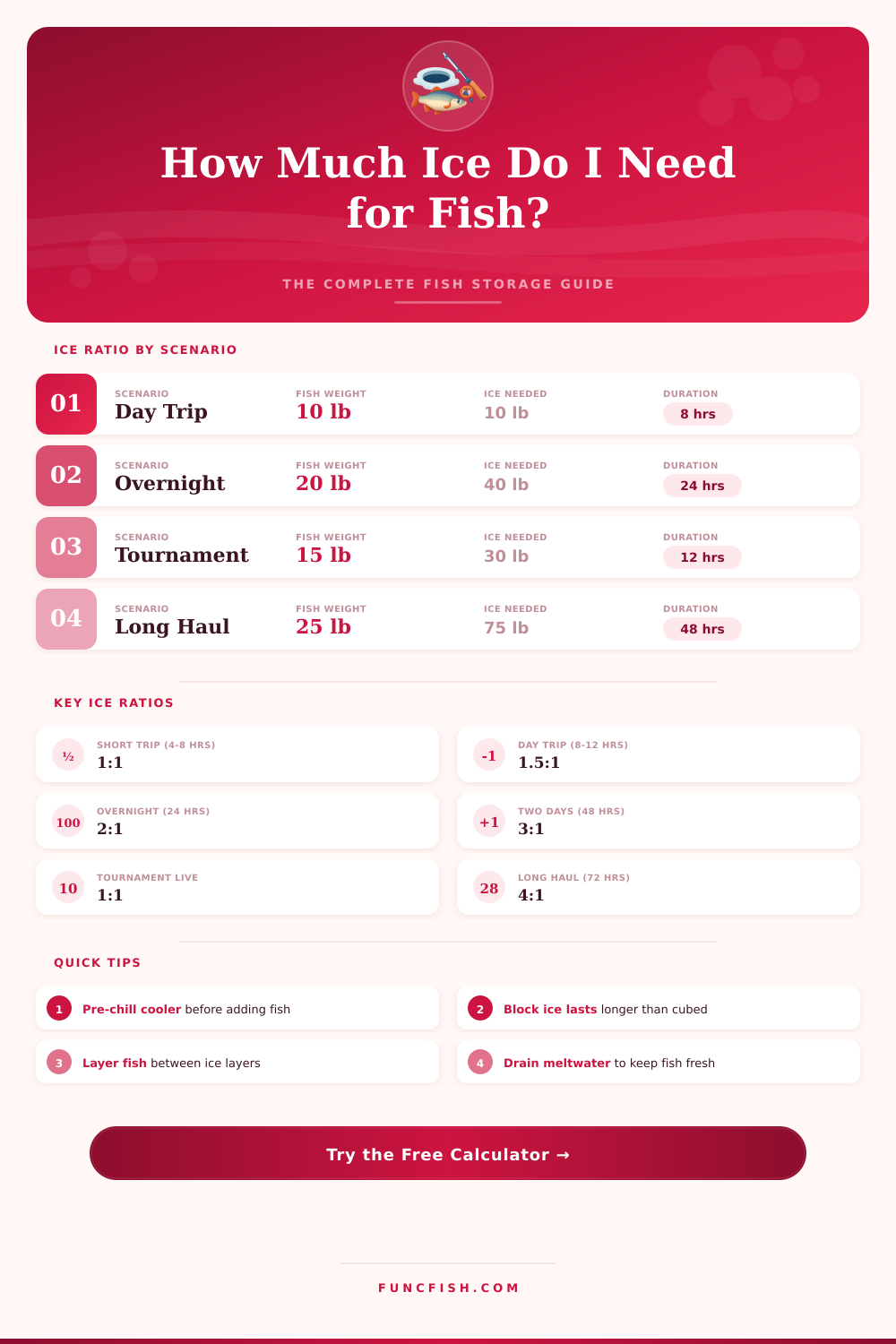
| Duration | Base Ice Ratio (Ice:Fish) | Hot Weather Ratio | Block Ice Equivalent | Notes |
|---|---|---|---|---|
| 1-4 hours | 1:1 | 1.5:1 | 0.75:1 | Minimum for any trip |
| 4-8 hours | 1:1 | 1.75:1 | 0.8:1 | Standard day trip |
| 8-12 hours | 1.5:1 | 2:1 | 1:1 | Full day outing |
| 12-24 hours | 2:1 | 2.5:1 | 1.5:1 | Overnight trip |
| 24-48 hours | 3:1 | 4:1 | 2:1 | Multi-day trip |
| 48-72 hours | 4:1 | 5:1 | 3:1 | Long haul transport |
| 72+ hours | 5:1 | 6:1 | 3.5:1 | Use dry ice supplement |
| Species | Avg Weight | Typical Catch Weight | Ice Needed (8 hrs) | Storage Method |
|---|---|---|---|---|
| Largemouth Bass | 2-6 lb (0.9-2.7 kg) | 10-20 lb (4.5-9 kg) | 10-20 lb (4.5-9 kg) | Gutted or whole |
| Striped Bass | 5-20 lb (2.3-9 kg) | 20-60 lb (9-27 kg) | 20-60 lb (9-27 kg) | Gutted, gills removed |
| Rainbow Trout | 0.5-3 lb (0.2-1.4 kg) | 3-15 lb (1.4-6.8 kg) | 3-15 lb (1.4-6.8 kg) | Gutted immediately |
| Walleye | 1-5 lb (0.45-2.3 kg) | 5-20 lb (2.3-9 kg) | 5-20 lb (2.3-9 kg) | Whole or filleted |
| Catfish (Channel) | 2-10 lb (0.9-4.5 kg) | 15-40 lb (6.8-18 kg) | 15-40 lb (6.8-18 kg) | Whole or skinned |
| Bluegill / Panfish | 0.25-1 lb (0.1-0.45 kg) | 2-8 lb (0.9-3.6 kg) | 2-8 lb (0.9-3.6 kg) | Whole on ice |
| Mahi-Mahi | 5-30 lb (2.3-13.6 kg) | 20-80 lb (9-36 kg) | 20-80 lb (9-36 kg) | Gutted, bled quickly |
| Red Snapper | 2-15 lb (0.9-6.8 kg) | 10-40 lb (4.5-18 kg) | 10-40 lb (4.5-18 kg) | Whole on ice |
| Ice Type | Melt Rate | Cooling Speed | Best For | Efficiency vs Cubed |
|---|---|---|---|---|
| Cubed Ice | Medium (6-8 hrs) | Good | General use, day trips | Baseline (1.0x) |
| Block Ice | Slow (12-24 hrs) | Moderate | Long trips, large coolers | 1.3x more efficient |
| Crushed Ice | Fast (3-5 hrs) | Excellent | Quick chilling, fillets | 0.8x less efficient |
| Dry Ice | Very slow (24-48 hrs) | Excellent | Long transport, freezing | 2x more efficient |
| Flake Ice | Fast (4-6 hrs) | Excellent | Seafood, full coverage | 0.9x |
| Nugget / Pellet | Medium (5-7 hrs) | Very Good | Versatile, good contact | 0.95x |
To reach good quality, it matters to get the right amount between fish and ice. The exact amount of ice changes based on the situation. For example, for 100 kg fish caught in 30°C, you need 34 kg ice.
That gives about 3:1 amount of fish to ice.
How Much Ice Do You Need for Fish
The amounts adjust depending on the climate. In tropical areas you commonly use 1:1 amount for fishing with ice. In temperate climates, 1:2 amount works for trips up to 18 days.
If you use insulated tanks, in tropics the amount water-ice-fish is 1 kg water : 2 kg ice : 6 kg fish. In temperate climate, it is 1 kg water : 1 kg ice : 4 kg fish. Other recommendation shows 1:1 ice-fish in tropics, while in temperate areas and insulated carts it is 1 kg ice : 2 kg fish.
When you store fish in containers, drums or boxes, cover it with ice in at least 6 inches during the trip. The fish-ice amount is 1:1 in winter and 1:2 in summer. Sometimes you mention ice-to-fish between 1/3 and 1:1.
Between the fish and compartment walls lay layers ice thick at least 5 cm. That helps to protect the lower layers against weight of upper layers.
A skipper can load 2000 kg ice to be safe. It matches with 1.3:1 ice-fish amount, a bit more than the usual minimum. That amount takes around 4 m³ in the fish hold when the ship goes fish.
You commonly lay two bags fish for every bag ice. Normal 50-gallon bag stores 10 buckets each 5 gallon ice and 10 fish when full. If you use half of the bag for extra 20 fish, that gives 2.5 gallon each fish.