🌡️ Fish Lake Water Temperature Calculator
Find optimal fishing conditions by species, depth, and season — with °F / °C conversion
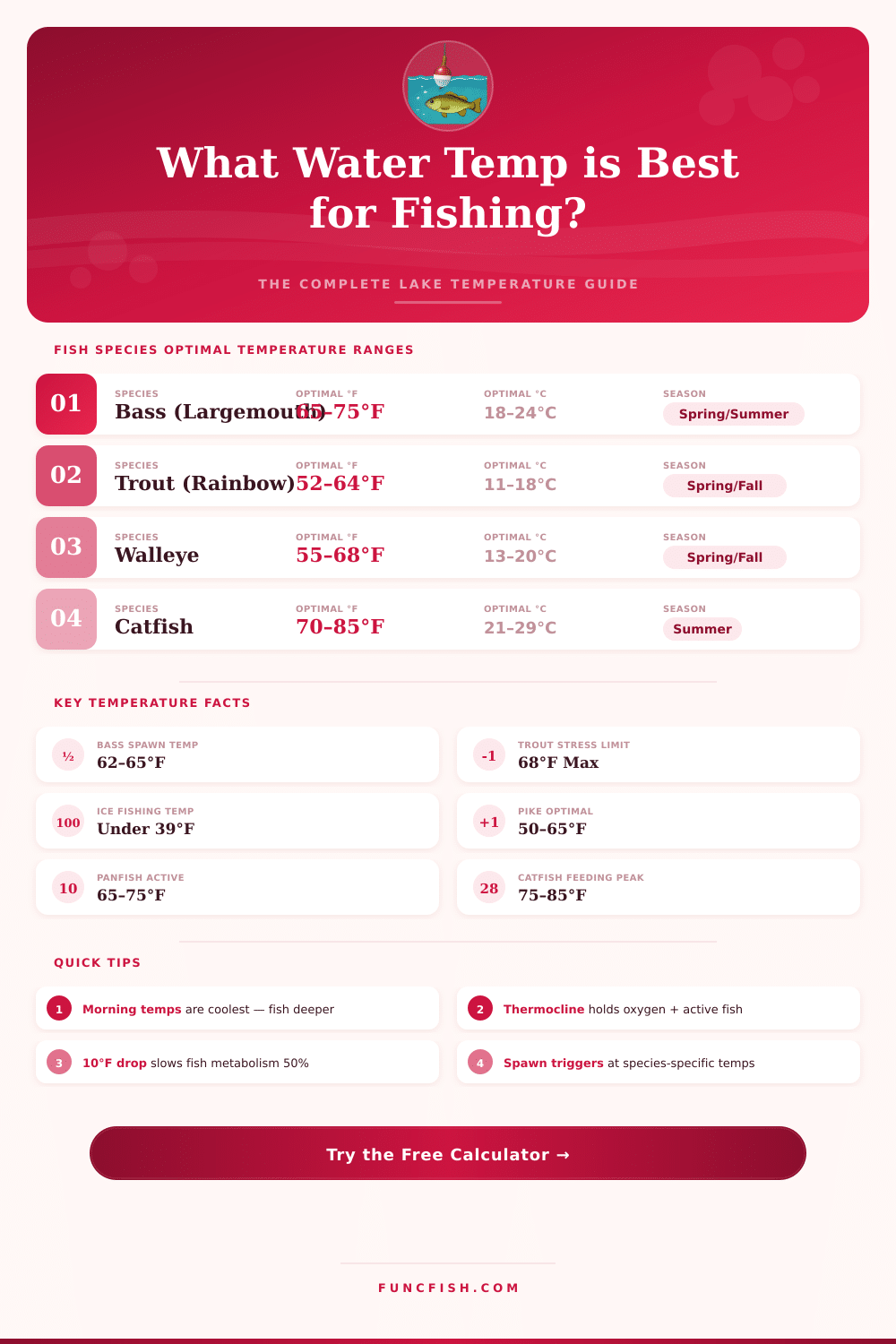
| Species | Optimal °F | Optimal °C | Stress Above | Feeding Activity | Spawn Trigger |
|---|---|---|---|---|---|
| Largemouth Bass | 65–75°F | 18–24°C | 90°F / 32°C | Excellent in range | 62–65°F |
| Smallmouth Bass | 60–72°F | 16–22°C | 85°F / 29°C | Excellent in range | 58–62°F |
| Rainbow Trout | 52–64°F | 11–18°C | 68°F / 20°C | Peak under 65°F | 44–50°F |
| Brown Trout | 50–65°F | 10–18°C | 72°F / 22°C | Peak under 68°F | 46–54°F |
| Walleye | 55–68°F | 13–20°C | 80°F / 27°C | Good dawn/dusk | 42–50°F |
| Northern Pike | 50–65°F | 10–18°C | 75°F / 24°C | Active in spring | 40–46°F |
| Channel Catfish | 70–85°F | 21–29°C | 95°F / 35°C | Night feeding peak | 70–75°F |
| Crappie | 65–75°F | 18–24°C | 85°F / 29°C | Excellent in range | 58–65°F |
| Bluegill / Panfish | 65–80°F | 18–27°C | 90°F / 32°C | Active all day | 67–70°F |
| Chinook Salmon | 42–52°F | 6–11°C | 65°F / 18°C | Aggressive in cold | 48–58°F |
| Yellow Perch | 58–72°F | 14–22°C | 80°F / 27°C | Good under ice too | 44–50°F |
| Muskie | 60–72°F | 16–22°C | 80°F / 27°C | Active summer | 48–56°F |
| Surface Temp (°F) | Thermocline Depth (ft) | Thermocline Temp (°F) | Deep Zone (°F) | Best Fish Zone |
|---|---|---|---|---|
| 85–90°F | 8–15 ft | 72–78°F | 55–65°F | Just above thermocline |
| 75–84°F | 12–20 ft | 68–74°F | 58–68°F | Thermocline edge |
| 65–74°F | 15–25 ft | 60–68°F | 52–62°F | Mid-depth structure |
| 55–64°F | None / Weak | N/A | 45–55°F | Shallow to mid-depth |
| Below 50°F | None | N/A | 33–45°F | Shallow warm pockets |
| Condition | Surface Adjustment | Fish Behavior Impact | Recommended Depth |
|---|---|---|---|
| Sunny / Clear (Midday) | +3 to +6°F | Fish move deeper | +5 to +10 ft deeper |
| Partly Cloudy | +1 to +2°F | Moderate activity | Mid-depth |
| Overcast | No change | Fish more active | Shallower |
| After Heavy Rain | -2 to -5°F | Actively feeding | Shallow inflows |
| Pre-Storm | -1 to -3°F | Feeding frenzy | Shallow |
| Dawn | Coolest of day | Trout / walleye peak | Shallow |
| Midday (Summer) | Hottest of day | Bass / catfish deep | Thermocline |
| Evening | Cooling | Feeding resumes | Shallow to mid |
The temperature of lake water is much more important than what many folks think. It affects everything, from the comfort of swimming to the behaviour of fish and their places of stay. Also the level of settled oxygen in the water depends on the temperature which is key for all aquatic life.
In 2024, the temperature of lake water at three feet depth reached 68°F almost a week sooner than in prior years. Although that could promise more comfortable swimming, it also points that the deep blending, that transports oxygen to the bottom of the lake, stops more soon. That happens because fish require oxygen to live, and warm water can not keep as much oxygen.
Why Lake Water Temperature Matters
If the water becomes too warm and the oxygen declines, the fish get sick and become inactive.
During the summer, lakes form layers. The upper layer stays warm, usually between 65 and 75 degrees. In the middle layers the temperature drops.
One calls those gaps between layers temperature splits. Big and deep lakes usually have clearer splits. In winter, the bottom of the lake actually is warmer, and many fish stay down below.
Water is densest at 38 degrees, so the deepest water commonly stays around that temperature, even if the surface freezes. Fresh water at the bottom of deep lakes stays around 4°C no matter what the air temperature is.
Many lakes pass through a turnover of there water layers during seasonal changes. When the summer passes to winter, the usual chills of air and the decrease of heat from the sky, especially overnight, work. The surface water cools and becomes denser than the water under it.
Fish are cold-blooded, so they slow in cold water. The same happens if the water becomes too warm. Knowing the desired temperature range for intended fish makes a big difference.
For instance, rainbow trout should not be caught when the water reaches 70 degrees. Species like salmon, trout and pike should be left in peace when the water passes certain limits, especially in slow flows with little oxygen. Some species last until 80 degrees, but only if that does not last more than 24 to 48 hours.
Water keeps its temperature more well than air thanks to its density. So, if the water was 74 degrees during the day, overnight it can stay quite warm so that fish move from depth to less deep parts. For one lake, the surface temperature averaged 67.8 degrees, while the long mean was 61.9 degrees.
What shows that the lake kept almost six degrees more heat at the surface. Also the size of thelake matters. A little lake like Skaha, with only 20 square kilometers, warms and cools differently than a huge lake like Okanagan, with around 350 square kilometers.