Fish Stock Bones Quantity Calculator
Estimate the quantity of fish bones, starting water, aromatic trim, reduction allowance, strainer loss, and pot capacity for a planned fish stock batch.
📌Stock batch presets
⚙Stock quantity inputs
This calculator plans bone quantity from finished stock volume. It adjusts for material type, cut condition, extraction style, reduction, strainer holdback, and an optional collection margin.
Fish stock bones estimate
Calculation breakdown
🧪Species and material grid
Lean Whitefish
Flatfish
Trout
Salmon
Snapper
Catfish
Panfish
Pike
📊Bone rate reference tables
| Stock style | Base bone rate | Typical simmer | Best use |
|---|---|---|---|
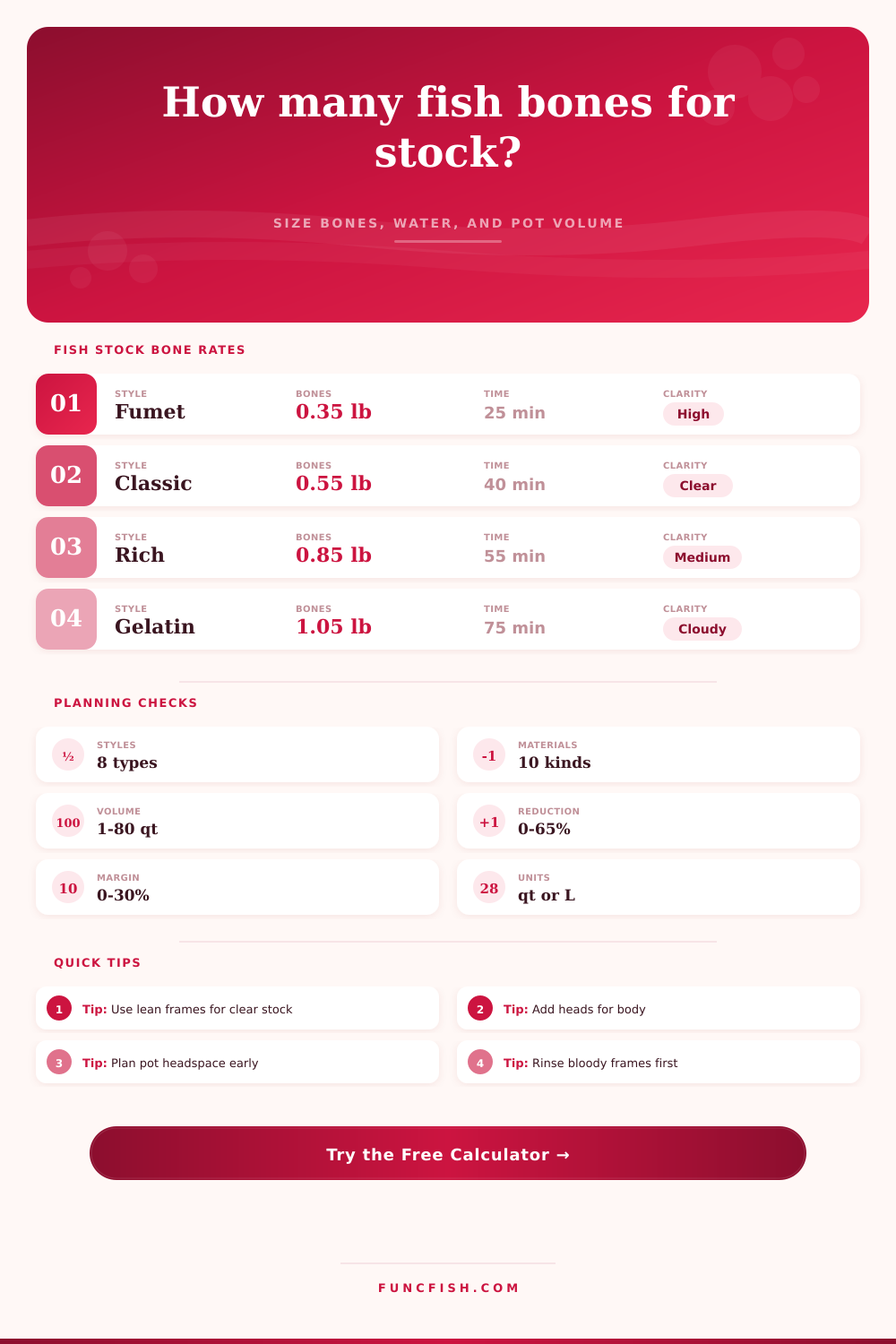
| Light fumet | 0.35 lb per qt / 0.17 kg per L | 20 to 30 minutes | Delicate clear stock |
| Classic clear stock | 0.55 lb per qt / 0.26 kg per L | 35 to 45 minutes | General fish stock |
| Balanced sauce base | 0.70 lb per qt / 0.33 kg per L | 45 to 55 minutes | Medium body sauces |
| Rich reduction base | 0.85 lb per qt / 0.40 kg per L | 50 to 65 minutes | Reduced base stock |
| Gelatin-rich body stock | 1.05 lb per qt / 0.50 kg per L | 65 to 80 minutes | Head and collar body |
| Lean clarified stock base | 0.48 lb per qt / 0.23 kg per L | 25 to 40 minutes | High clarity batches |
| Material | Rate factor | Clarity tendency | Planning note |
|---|---|---|---|
| Lean whitefish frames | 1.00 | High clarity | Baseline for clean stock calculations |
| Flatfish bones | 0.94 | High clarity | Efficient extraction from thin frames |
| Trout or char frames | 1.06 | Medium clarity | Softer bones with mild body |
| Salmon frames and collars | 1.18 | Lower clarity | Strong flavor and richer body |
| Snapper or reef fish bones | 1.12 | Medium clarity | Dense heads and firm frames |
| Catfish heads and frames | 1.20 | Lower clarity | Heavier head bone and skin collagen |
| Panfish frames | 1.08 | Medium clarity | Small frames need collection margin |
| Mixed clean fish bones | 1.05 | Variable clarity | Use for sorted freezer batches |
| Cut condition | Extraction factor | Water displacement | When to choose |
|---|---|---|---|
| Whole frames | 0.94 | 0.30 qt per lb | Backbone and ribs kept intact |
| Chopped frames | 1.00 | 0.32 qt per lb | Baseline surface area for stock |
| Heads and collars included | 1.10 | 0.38 qt per lb | Gelatin and collar pieces included |
| Ribs and spines only | 0.88 | 0.26 qt per lb | Lean frames without heads |
| Fine trim scraps mixed in | 1.04 | 0.28 qt per lb | Small clean trimmings in the batch |
| Frozen frame blocks | 0.92 | 0.34 qt per lb | Compacted frozen frames |
| Finished volume | Classic bones | Start water | Pot target |
|---|---|---|---|
| 2 qt / 1.9 L | 1.1 lb / 0.5 kg | 2.7 qt / 2.6 L | 4 qt / 3.8 L |
| 4 qt / 3.8 L | 2.2 lb / 1.0 kg | 5.3 qt / 5.0 L | 8 qt / 7.6 L |
| 8 qt / 7.6 L | 4.4 lb / 2.0 kg | 10.6 qt / 10.0 L | 14 qt / 13.2 L |
| 12 qt / 11.4 L | 6.6 lb / 3.0 kg | 15.9 qt / 15.0 L | 22 qt / 20.8 L |
| 20 qt / 18.9 L | 11.0 lb / 5.0 kg | 26.5 qt / 25.1 L | 36 qt / 34.1 L |
💡Stock quantity tips
Weigh the frame bag: The most reliable batch input is the total weight of clean bones available, then compare it with the calculator's bone target before adding water.
Separate strong fish: Run oily, dark, or very head-heavy material as its own preset instead of averaging it into a delicate clear-stock batch.
Fish stock are not the same as chicken broth. Treated more like poultry remains, the fish frames will produce a bitter, cloudy liquid. The bones will quickly release their flavor and gelatin but they will also break down into a cloudy mess unless you manage ratio of bones to water. Managing the relationship between these two ingredients is what makes all the difference between a muddy stock and a clear fumet. It’s less about intuition different than it is discipline.
Most home cooks believe that more bones mean more flavor, but this is only true until the stock turn cloudy or greasy. Whitefish frames with lots of lean meat pull clean-flavor out off broth, quickly. Heavy heads or oily fish don’t work like that. Their dense strength can overwhelms a lightly flavored stock if used in large quantities and not cooked long enough.
How to Make Good Fish Stock
Once you choose your material, the calculator on this page do the math for you. No more guessing if your snapper heads will complement or overtake your light bisque. But what kind of bone? That’s the first question to answer before starting cooking.
Vigorous boiling will make the stock cloudy. Don’t let fish stock boil furiously. Collagen dissolves in warm water; that’s why it’s simmered gently until collagen come out of the bones. Vigorous boiling churns up fats and protein in the liquid, that clouds the broth. And it makes it taste unpleasantly harsh. Professional cooks usually limit fish stock simmering to thirty or forty minutes. If they simmers it longer, they risk extracting bitter elements from the bones.
On this page, the tool accounts for how clear (or not) you prefer your stock. You use less time and fewer bones for a clearer consomme. Using more bones mean a longer cooking time and a rich base for a hearty chowder. There’s no free lunch here: transparency versus body.
There’s one other variable: volume of water. Bones is porous, so they do absorbs some water. (You may want to pour in just two inches over the bones, but if you do that, you’ve got a thick slurry situation.) Start out with too little water, and instead of infusing the liquid, the bones will steam. To solve that problem, the calculator takes into account the displacement: it’ll tell you exactly how much water you should of begin with so there’s enough liquid to float the solids without drowning them.
And then there’s the matter of reduction. Want to simmer the stock until it becomes concentrated? Better start with extra water, more than what you’d like as a finished product. Otherwise, it’s going to get dry and burn the bones.
The secondaries are aromatics. Celery, onions, and carrots contributes a subtle sweetness in the background. Don’t overpower it. Remember, this is all about the fish. If you load up the pot with mirepoix, you will mask the subtle flavors of the ocean’s delicacies. Typically, just a quick trim will suffice. This is also accounted for in the calculator. This prevents you from turning your seafood stock into vegetable soup.
A practical consideration is pot size. Fish stock is foamy. You want some headroom. If you overfill it, the foam will overflow the pot’s rim and make a mess. It will also cause the liquid to cool unevenly, uneven cooling leads to uneven extraction. The tool uses your ingredient to calculate a minimal pot size. It’s a straight-forward safety check. Think of it as ‘don’t pour fish stock into a saucepan’ insurance.
Respect the ingredient. Fish bones is delicate. They’re not as structurally sound as, say, pork bones or beef knuckles. You need to approach them gently and with exact measurements. Get the ratio correct, and you’ll wind up with a clear broth that improves whatever it touches. It is clean. It is subtle. It tastes like the sea. That is where the good cook ends and the great cook begins. Let the bones do their job: start with the math; then trust your palate.