Fish Stocking Cost Calculator
Estimate stocking quantity, species mix, survival buffer, delivery, holding, and labor for ponds, lakes, forage boosts, and ornamental water.
📌Stocking presets
⚙Stocking inputs
Stocking cost forecast
Full breakdown
📋Species package reference grid
Bass Pond
Forage Base
Catfish
Trout
Koi Display
Tilapia
Walleye
Bream Mix
📊Stocking rate and cost tables
| Package | Common mix | Rate per acre | Typical fish size | Planning use |
|---|---|---|---|---|
| Bass + bluegill | 5% bass, 60% bluegill, 35% forage | 500-1000 fish | 1-4 in | New balanced ponds |
| Forage boost | Fathead minnows and shiners | 500-2000 fish | 0.5-2 in | Predator support |
| Channel catfish | Single species or mixed pond | 100-500 fish | 4-8 in | Harvest stocking |
| Rainbow trout | Single seasonal stocking | 100-500 fish | 6-10 in | Cool water action |
| Koi display | Koi with limited goldfish | 8-24 fish | 5-12 in | Ornamental water |
| Tilapia | Mixed sizes when legal and suitable | 100-400 fish | 3-6 in | Warm forage control |
| Walleye + perch | Walleye with yellow perch | 75-250 fish | 2-6 in | Predator supplement |
| Hybrid bream | Hybrid bluegill plus catfish | 300-800 fish | 2-5 in | Feeder pond plan |
| Fish size | Cost factor | Survival factor | Holding water | Best planning note |
|---|---|---|---|---|
| Fry / 0.5 in | 0.35x | Lower | 0.03 gal/fish | Needs larger buffer |
| Small fingerling / 1-2 in | 0.70x | Moderate | 0.05 gal/fish | Good forage option |
| Fingerling / 3-4 in | 1.00x | Standard | 0.10 gal/fish | Balanced default |
| Advanced / 5-7 in | 1.85x | Higher | 0.25 gal/fish | Fewer losses |
| Adult / 8-12 in | 3.80x | Highest | 0.65 gal/fish | Display or instant action |
| Transport method | Base charge | Distance charge | Handling factor | Best fit |
|---|---|---|---|---|
| Pickup bags | $15 | $0.00/mi | 1.00x | Small local orders |
| Local truck delivery | $85 | $1.35/mi | 1.04x | Routine pond stocking |
| Oxygen bags shipped | $130 | $0.85/mi | 1.08x | Fingerling shipments |
| Hauling tank service | $220 | $2.20/mi | 1.12x | Large or adult fish |
💡Planning checks
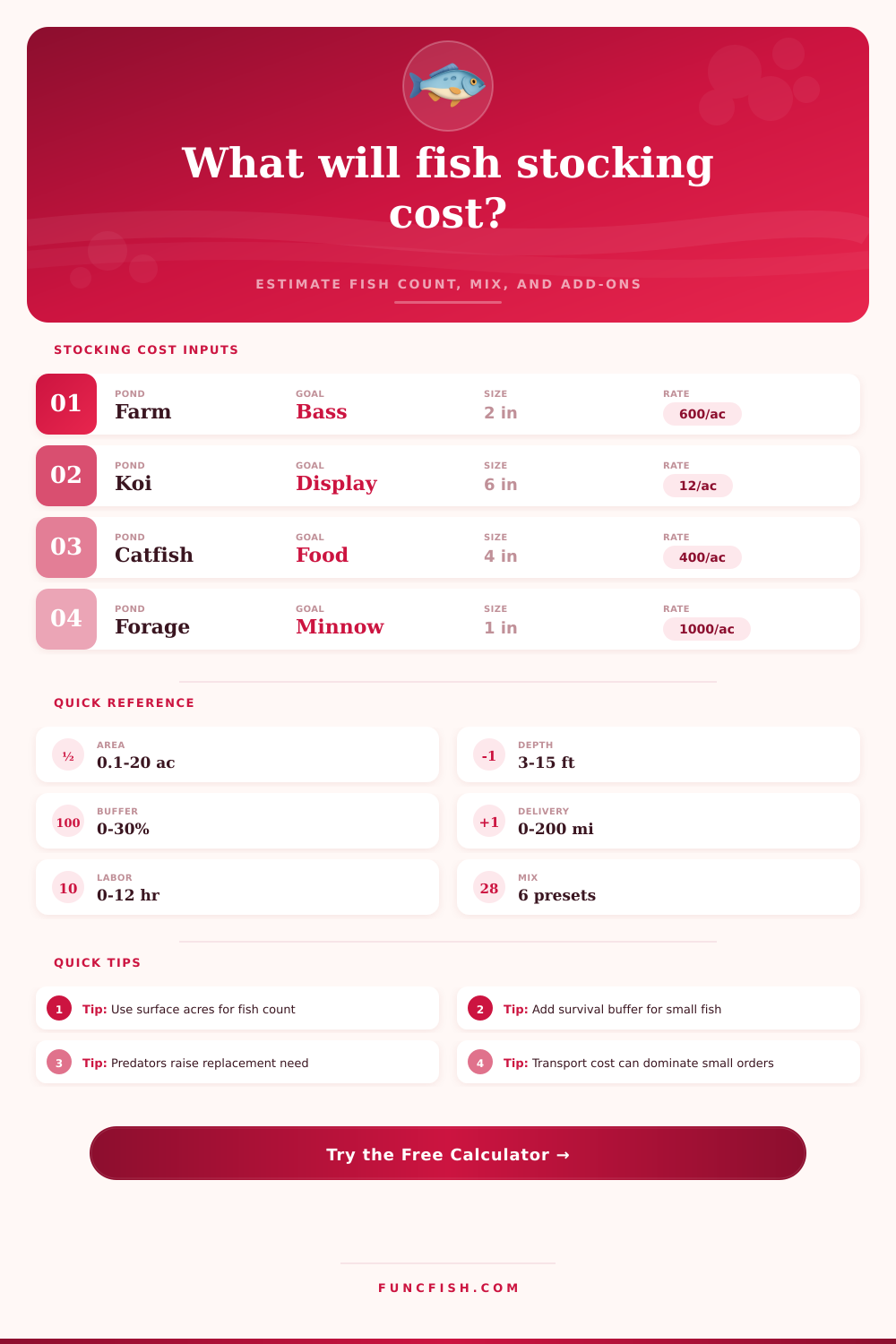
Tip: Surface acreage drives most stocking counts. Depth affects volume, transport risk, and carrying capacity, but density quotes are usually per surface acre.
Tip: Small fish are cheaper per head but need a stronger survival buffer when predators, heat, or uncertain water quality are part of the release plan.
Planning a pond or an lake requires you to think about the type of species of fish that you want to keep in the fish pond. Planning a pond or a lake will also require that you consider the total cost of the fish that you plan to purchase (including the cost of there delivery to your pond). Many people envision their dream pond and the type of fish that will live in the pond; they will then use the number of acre of the pond to calculate the number of fish that should live in the pond.
However, many do not consider how the cost of the fish may differ based off the size of the fish or the way in which people are to be transport to the pond. Another of the factor to consider is the area of the surface of the pond. The area of the pond will determine how many fish will live in the pond; dividing the number of fish by the area of the pond in acres is calculate the stocking rate of the fish.
Planning Fish Costs for Your Pond
The depth of the pond is more less important to determine how many fish will live in the pond. However, the depth of the pond is an important factor in determining how many fish the pond can support; both deep and shallow pond may contain the same number of fish that are planned for the pond, but the shallow pond may not be able to support those same number of fish as the deep pond. The reason for this is that the shallow pond may heat to higher temperature during the summer, or may have different population of predators that can impact the number of fish that can live in the pond.
The size of the fish that are to be purchased can also impact the total cost. Small fish cost less money than large fish; however, small fish have higher loss rate during there first few weeks in the pond. Large fish cost more money; however, their higher survival rates allow them to provide more faster results (if placing the pond into display for viewing or for fishing activities).
The pond fish cost calculator that is available permit users to select the size class and survival percentages of the fish that they wish to order. Based upon these selections, the calculator will provide the total cost of the fish; in addition, it will also illustrate how the potential number of predator and the quality of the ponds water can impact the survival rates of the fish. Transporting the fish can be a difficult task and often cost more money than the fish themselves.
Costs can be correlated to the distance that the fish are to be transported, the type of delivery truck that the driver will use to transport the fish (oxygen bags and hauling tank increase cost), the distance of the transport of the fish, and the “delicacy” of the fish that are to be transported. The cost calculation tool can be used to provide an overview of the different transport option for the fish; this allows users to determine the total cost of the fish and their delivery to the pond. In addition to the cost of the fish themselves, the number of people and the supplies that is required to release the fish into the pond will impact the total cost.
An individual will be required to be on-site to release the fish into the pond. The fish will need to become acclimated to the ponds water. Depending upon the condition of the ponds water, additional tubs, salt, or holding tank may be required in addition to the cost of the fish.
Each of these step is essential to protecting the money that was spent purchasing the fish and delivering them to the pond. If these steps are skipped, it is possible that additional fish will have to be purchased for the following year; the cost of these replacement fish will cost more money then if the fish had been released into the pond in accordance with the initial plan. The type of species of fish that are to live in the pond will impact the total number of fish that is required for the pond, as well as the price of each fish.
For instance, if the pond is to contain both bass and bluegill fish, the cost of the fish will be spread out over both species. Using a forage boost will require a large number of small and inexpensive fish to be add to the pond. Species of fish like ornamental koi and display goldfish will require low densities of fish in the pond since the cost of each of these fish species is so high.
A common mistake for those who are building there plan for the pond is to believe that the cost of the fish that is quote to them initially is the total cost that will be associated with the purchase and delivery of those fish. Factors in the environment that contribute to the survival of the fish (water readiness, weather, predators) may impact the total outcome of the addition of these fish to the pond. The “planning buffer” percentage that is featured within the cost calculation tool will ensure that the cost of the fish will not have to be purchased in excess of what is quoted to the pond owners.
Although it may seem difficult to reach an exact dollar amount for the purchase of the fish, the cost of the transport of the fish, the survival of the fish after they are delivered, and the labor to release the fish into the pond, it is possible to gain a better understanding of how these cost relate to one another. When a user is familiar with the cost of each of these factors, it is easy to adjust the plan for the pond prior to placing an order for the fish. Once the pond owner has understood these costs, it is also possible to make a decision about whether the cost will suit the type of pond that you wish to create and the result that you want to achieve with the fish in your pond.
You should of checked the prices more carefully before buying. Its important to be sure.