Fish Thawing Time Calculator
Estimate how long frozen fish needs in the refrigerator, sealed cold water, or microwave defrost based on weight, thickness, package style, and starting temperature.
📌Scenario presets
⚙Thaw settings
Thawing forecast
Full breakdown
📋Method reference grid
Refrigerator
Cold Water
Microwave
Countertop
📐Fish thickness and package references
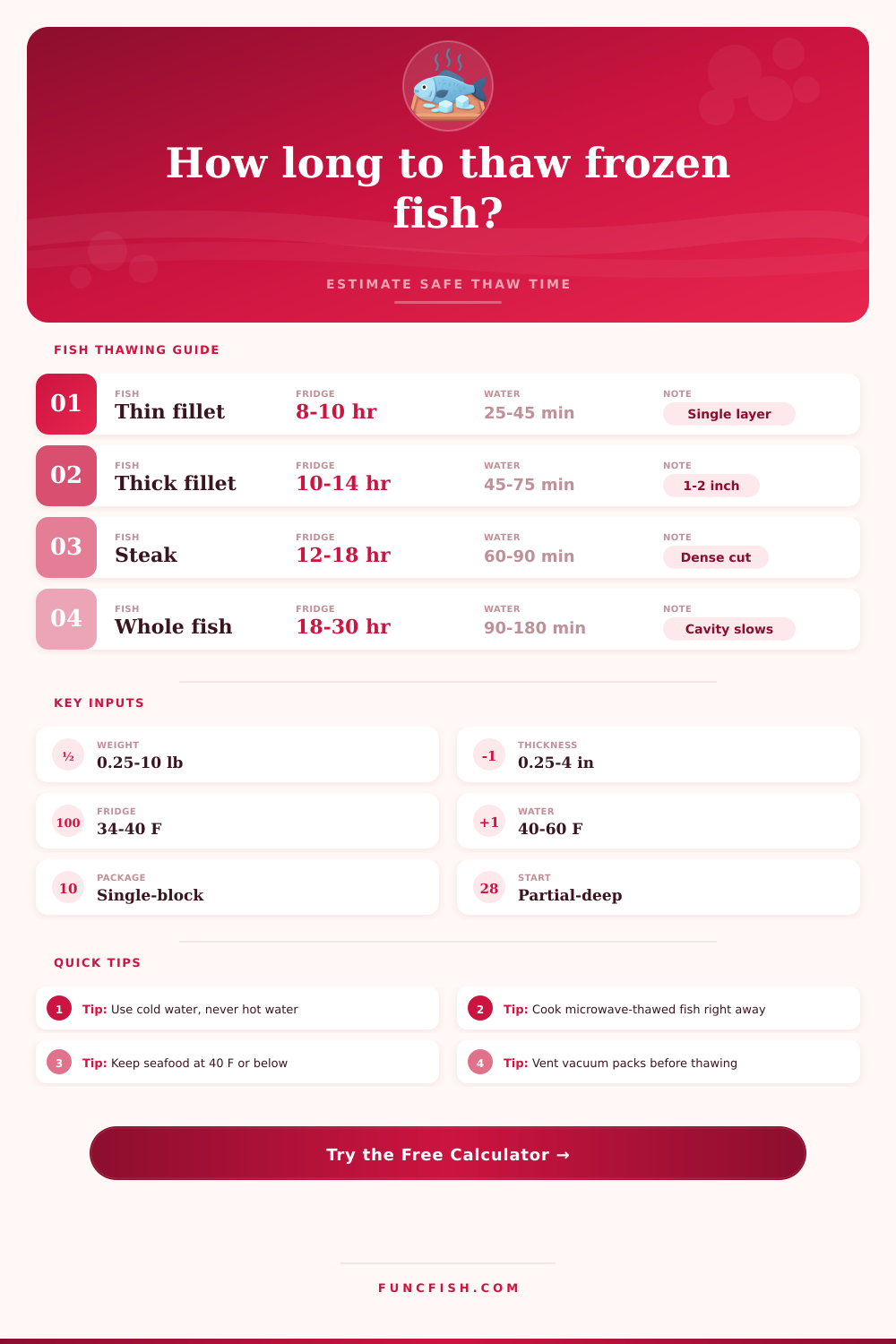
| Fish shape | Typical thickness | Fridge planning range | Cold water range |
|---|---|---|---|
| Thin fillets | 0.25-0.75 in / 0.6-1.9 cm | 6-10 hours | 20-45 minutes |
| Thick portions | 0.75-1.5 in / 1.9-3.8 cm | 10-16 hours | 45-90 minutes |
| Fish steaks | 1-2 in / 2.5-5.1 cm | 12-20 hours | 60-120 minutes |
| Whole dressed fish | 1.5-4 in / 3.8-10.2 cm | 18-36 hours | 90-240 minutes |
| Frozen block | 1-3 in / 2.5-7.6 cm | 14-30 hours | 90-210 minutes |
| Package style | Thaw speed factor | Handling note | Calculator effect |
|---|---|---|---|
| Single layer pouch | 0.92x | More surface area | Fastest package setting |
| Loose pieces in bag | 0.86x | Separate pieces thaw fast | Shorter time estimate |
| Vacuum-sealed pouch | 1.08x | Vent before fridge thaw | Small time increase |
| Stacked portions | 1.25x | Middle pieces thaw slower | Adds planning time |
| Ice-glazed block | 1.55x | Ice shell absorbs heat | Largest package penalty |
| Paper or tray wrap | 1.16x | Air gaps insulate | Moderate penalty |
| Temperature condition | Recommended range | Calculator action | Safety note |
|---|---|---|---|
| Refrigerator thaw | 34-40°F / 1-4°C | Normal estimate | Keep at 40°F or below |
| Cold water thaw | 40-60°F / 4-16°C | 30-minute checks | Fish must stay sealed |
| Microwave defrost | Low defrost power | Short cycles plus rest | Cook immediately after |
| Room temperature | Not a thaw method | Flags unsafe | Do not thaw on the counter |
💡Thawing checks
Tip: If fish is vacuum packed, open or vent the package before refrigerator thawing, then keep the fish covered and cold.
Tip: For cold-water thawing, keep fish in a leak-proof bag, use cold water, and cook it right after thawing.
When planning a meal that includes frozen fish, you must determine how long the frozen fish will take to thaw. The time it takes for the frozen fish to thaw will not be a fixed number; it will depend on two factors: the shape of the frozen fish and the packaging of the frozen fish. These two factors will change the speed at which the frozen fish thaws.
Additionally, the starting temperature of the frozen fish and the thawing method will also play an role in the thawing speed of the fish. You can use the calculator to enter these specifics so that the calculator can provide you with an estimate of the cooking time for your fish. Due to the science of how ice holds heat, the frozen fish will take time to thaw completely.
How Long It Takes to Thaw Frozen Fish
The outer layer of the frozen fish will thaw first. However, the center of the frozen fish will remain frozen until it is given enough heat to begin to thaw. A thin fillet of fish will thaw at a different rate then a thick steak of fish due to the surface area of the fish.
The thicker the fish steak, the less amount of surface area that the heat will have to work with to thaw the fish. Additionally, if someone vacuum-sealed the fish, it will take longer for that fish to thaw due to the limiting amount of air around the fish. If the fish was packaged in stacked portions, it will also take longer to thaw because the inner portions of the frozen fish are insulated from the outside world.
There are several methods for thawing your frozen fish. Placing the fish in the refrigerator will ensure that it stays in a safe temperature while thawing. However, it will take longer for the fish to thaw if you choose to thaw the fish in the refrigerator.
Another option is to thaw the fish in cold water. The fish must remain in a leakproof bag, and you should change the water regularly to keep the fish in a safe temperature. The last option is to use the microwave to defrost the fish.
While this process will take the least amount of time to defrost your fish, the fish must be cooked right away after defrosting because the fish could reach a dangerous temperature. Another essential factor in the defrosting of the fish is the temperature. If the refrigerator holds a warmer temperature than recommended, the safe window for the fish will change.
If the water changes from cold to warmer than recommended, bacteria will begin to grow on the fish. These factors can be accounted for in the calculator to provide a more accurately estimate for how long it will take for the fish to reach the necessary temperature to be cooked. The style in which someone packaged the fish will also affect how quickly it thaws.
If someone pre-glazed the fish with ice before being frozen, it will take longer to defrost. Fish in loose packages will defrost more quicker than fish in ice-glazed packages. Additionally, if the fish came in packages that stack on top of each other, it will take longer for the fish to defrost due to the insulated fish in the middle of the packages.
These factors are included in the calculator so you dont have to remember the different effects that packaging can have on the defrosting time of your fish. Another factor that will affect the defrosting time is the starting state of the fish. Fish that was stored near the door of the freezer may be closer to room temperature than the frozen fish that was stored in the center of the freezer.
The warmer the fish is, the less time it will take for it to defrost. If the fish is colder than others, it will take more time to defrost. You can select the start state of the freeze in the calculator to account for this factor.
Based off your needs, you can set the priority of defrosting the fish. If you want the fish to stay in the best condition possible, it will take longer for it to defrost. However, if you need the fish ready soon, you can set the priority to reflect that in the calculator.
Many people make several mistakes when defrosting their fish. Placing the fish out on the counter will cause the fish to defrost on the outside while the center remains frozen. Additionally, if the fish is vacuum sealed, the same vacuum seal that preserves the fish will also prevent water from getting to the fish when defrosting it in the fridge.
Using this calculator will help you to avoid these mistakes. Once you have the estimate from the calculator, you must ensure that the frozen fish is stored correctly until you are ready to cook the fish. If you defrosted the fish in the refrigerator, you can use the fish within 1 to 2 days.
If the fish was defrosted in cold water or the microwave, it should be cooked on the same day that you defrosted the frozen fish. Using this calculator will ensure that you know when the fish will be ready to cook and that you can plan your meal accordingly.