Fish Transport Cooler Count Calculator
Estimate how many coolers you need for a catch by combining packed fish weight, ice volume, cooler capacity, ambient heat, trip duration, and species sensitivity.
📍Transport presets
⚙Cooler count inputs
Transport cooler result
Calculation breakdown
🧊Cooler and species planning grid
Often fits a small bass, trout, walleye, or panfish catch when fish are cleaned or the ice ratio stays moderate.
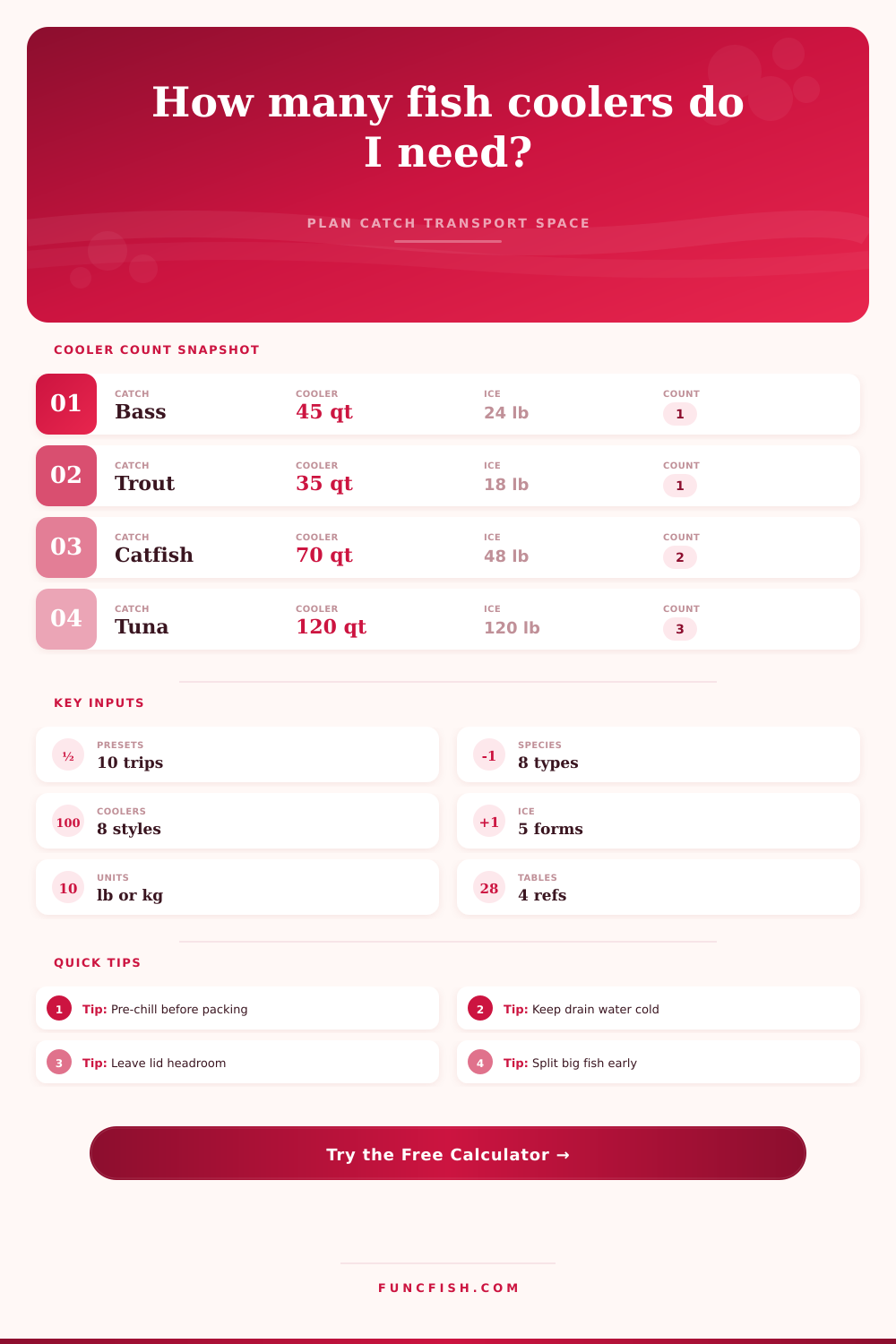
A practical size for mixed freshwater limits, catfish, inshore fish, and longer warm-weather drives.
Useful when long fish, bagged loins, or a high ice-to-fish ratio would crowd smaller coolers too quickly.
For sensitive fish or long hot transport, plan near equal ice and packed fish weight before adding headroom.
Crushed ice packs tightly around fish, chills fast, and usually takes less cooler volume than loose cubes.
Bagged fillets use cooler volume efficiently, but they still need enough ice surface to stay uniformly cold.
Leaving space protects lid closure, top ice coverage, drain position, and air circulation around bags.
A near-ice slurry target keeps fish firm during transport without freezing most whole freshwater catches.
📊Cooler capacity references
| Nominal cooler | Usable at 80% | Typical packed catch | Best match | Watch point |
|---|---|---|---|---|
| 25 qt / 24 L | 5.0 gal / 19 L | Small fillets plus ice | Kayak, bank, panfish | Whole fish crowd fast. |
| 45 qt / 43 L | 9.0 gal / 34 L | Moderate mixed catch | Bass, trout, walleye | Large fish may need diagonal room. |
| 70 qt / 66 L | 14.0 gal / 53 L | Heavy freshwater catch | Catfish, salmon, inshore | Carry weight can exceed comfort. |
| 120 qt / 114 L | 24.0 gal / 91 L | Offshore or group catch | Tuna loins, big salmon | Needs enough ice on top. |
| Species profile | Bulk packing density | Chill sensitivity | Good ice style | Planning note |
|---|---|---|---|---|
| Trout, char | 4.9 lb/gal whole | High | Crushed or slurry | Small temperature mistakes show quickly. |
| Bass, walleye | 5.2 to 5.6 lb/gal whole | Medium | Layered cubes | Use enough top ice after the run. |
| Catfish | 5.8 lb/gal whole | Medium-low | Cube and block mix | Dense fish add carry weight fast. |
| Tuna, offshore fish | 6.4 lb/gal loins | High | Slurry or crushed | Split fish across boxes for faster chill. |
| Ice format | Approx weight per gal | Chilling speed | Volume effect | Best use |
|---|---|---|---|---|
| Cubed ice | 4.8 lb / 2.2 kg | Moderate | Bulky | General day trips. |
| Crushed ice | 5.4 lb / 2.4 kg | Fast | Efficient | Layering through whole fish. |
| Block plus cubes | 6.2 lb / 2.8 kg | Slow start | Compact | Long holds with cube contact. |
| Ice slurry | 7.3 lb / 3.3 kg | Very fast | Dense | Whole fish and insulated tubs. |
| Transport condition | Time range | Ambient range | Suggested margin | Cooler habit |
|---|---|---|---|---|
| Short ramp run | Under 2 hr | Under 75 F | Lean or normal | Pack top ice before driving. |
| Warm day drive | 2 to 8 hr | 75 to 95 F | Conservative | Open once, then keep closed. |
| Overnight hold | 8 to 24 hr | Variable | Conservative | Use block reserve below top ice. |
| Offshore unload | 4 to 18 hr | Hot deck | Premium | Split heavy fish across boxes. |
💡Cooler packing tips
Layer for contact: The calculator assumes ice touches the fish. Add a bottom layer, pack fish in thin layers, and finish with top ice.
Protect the cold space: Pre-chill the cooler, shade it during the drive, and avoid opening the lid unless you are adding fish or ice.
When it comes time to bring that fish home, most of us find out our dreams of big one end there. Whether it’s a dozen bass or two catfish, now thermal physics turns into a personal issue. A couple degrees increase in temperature can be the dividing line between a great meal and a soggy disappointment.
Not only do you need room for the fish in the cooler but also you need enough cold mass to counteract the heat generated on the ride home. Once you input your trip length and what species you will be catching, the page’s calculator do all the work figuring out weight and volume needed. You won’t have to guess if your ice is working.
How to Keep Your Fish Cold
Heat transfer doesn’t concern itself with your organization scheme. It concerns itself with time and surface area. It won’t care if you stack whole fish on top of one another or not. The air spaces between their bodies insulate them from the ice, the inner fish in the pile will warm quickly since the ice isn’t right next to them. The tool accounts for how you pack the fish.
Whole fish occupy more volume compared to they weight than do fillets. That’s important because the volume is what you’re competing for inside the cooler walls. Because catfish are so heavy and dense, you might believe that they will be easy to cool down. They’re not. Their density holds onto heat stubbornly. You’ll need more ice weight per pound of fish than you would for a lighter species such as trout.
The format gives you the most value. The store sells cubed ice, so people default there. Cubed ice is bulky. It takes up lots of space in the box with large voids between each cube. Since it is larger and has less surface area exposed to the warm water in the box, it also melts more slow.
For packing efficiency, crushed ice is best. It fills all those gaps around the fish. It’s touching more surface area. It chills the catch quicker. And it takes up less of your cooler volume.
The table on the page lays it out well. It shows how much each type of ice weigh per gallon. So if you can get crushed ice, you may be able to get away with one less cooler. That’s a big margin on a hot day.
But how long do you have? Holding a family dinner overnight vs. Running home from the lake for two hours make all the difference. You can add up the heat gain. For every time you lift that lid, you’re dumping cold air and inviting heat in.
The calculator will ask you how many times you think you’ll open the lid. Tell the truth. Open it once because you hear a noise? Open it five times while waiting for dinner to cook? You’re going to add hours of thermal stress. That’s where the “margin” setting comes into play. A lean margin accommodates a quick, cool ride home. A “premium” margin gives you a quality texture after a long run. It’s not about choosing one over the other; there is only a right answer for you, depending on how much risk you are comfortabley taking.
You must prechill your cooler. Warm ice on warm fish in a warm cooler equals no deal. Your cooler’s walls needs to be cold before you put the fish in. Cooling down plastic cooler walls takes a ton of energy. If the cooler walls are warm, they will prevent the ice from cooling things down right away. Waiting for them to cool down or adding a little warm water can help. Once it’s cold then add your ice. Next, add your fish. Then add some more ice. The key is getting rid of air. Air kills even temps.
The unspoken price of transport is weight. Sixty-plus pounds is a lot to lift for a fully packed cooler. Eighty? That’s a helluva’ lot of weight to heave into the back of a pickup. Your estimated carry load per cooler determines whether you’ll use several smaller coolers, or purchase a larger wheeled cooler. One that won’t move an inch when it’s full? You’d rather have two manageable boxes. Your back will know how much. Math knows what is least.
So in the end, keeping fish cold is a matter of managing energy. The fish is breaking down and emitting heat. The water itself is radiating heat from the sun. You are also combating the heat from the air. Your inputs reflect your seriousness regarding this fight. Treat the cooler as a storage bin and get storage-bin results. Treat it as a temperature buffer and get table-quality fish. It’s a small thing, but it matters. Plan for the heat you expect, not the heat you should of hoped for.