🌡️ Fishing Barometric Pressure Calculator
Determine fish activity levels based on barometric pressure, trend, species, and water conditions
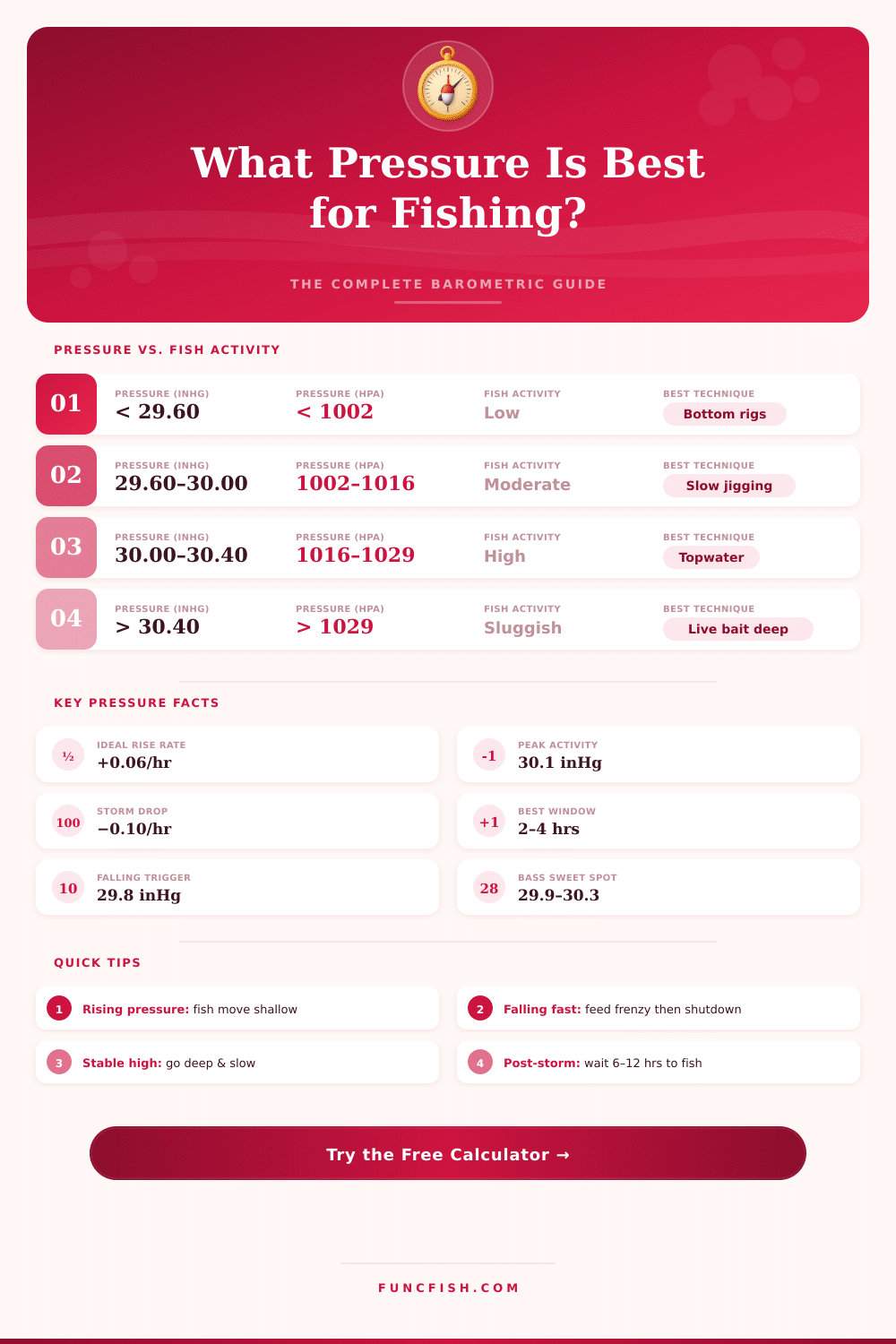
| Pressure (inHg) | Pressure (hPa) | Activity Level | Trend Effect | Recommended Technique |
|---|---|---|---|---|
| < 29.50 | < 999 | Very Low | Falling Fast | Deep slow presentations |
| 29.50 – 29.80 | 999 – 1009 | Low / Pre-storm Feed | Falling | Aggressive topwater, crankbaits |
| 29.80 – 30.00 | 1009 – 1016 | Moderate | Stable / Slight Fall | Mid-depth jigging |
| 30.00 – 30.20 | 1016 – 1023 | Good | Stable / Rising | Topwater, shallow cranks |
| 30.20 – 30.40 | 1023 – 1029 | Excellent | Rising | All techniques, active bite |
| > 30.40 | > 1029 | Sluggish | Stable High | Live bait, finesse deep |
| Species | Optimal Pressure (inHg) | Sensitivity | Preferred Trend | Best Depth (ft) |
|---|---|---|---|---|
| Largemouth Bass | 29.9 – 30.3 | High | Rising | 5 – 15 |
| Smallmouth Bass | 30.0 – 30.4 | High | Stable / Rising | 8 – 20 |
| Rainbow Trout | 29.8 – 30.2 | Very High | Rising Slowly | 3 – 12 |
| Walleye | 30.0 – 30.3 | Medium | Stable | 10 – 25 |
| Catfish | 29.5 – 30.0 | Low | Falling | Bottom |
| Panfish / Bluegill | 29.8 – 30.3 | Medium | Rising | 4 – 10 |
| Crappie | 30.0 – 30.4 | Medium | Stable / Rising | 6 – 15 |
| Northern Pike | 29.7 – 30.1 | Medium | Falling / Stable | 5 – 20 |
| Salmon / Steelhead | 29.9 – 30.3 | Very High | Rising | 3 – 15 |
| Striped Bass | 29.8 – 30.2 | High | Rising | 5 – 30 |
| Redfish | 29.7 – 30.1 | Medium | Stable / Falling | Shallow Flats |
| Rate of Change | inHg / 3 hrs | hPa / 3 hrs | Fish Behavior | Bite Window |
|---|---|---|---|---|
| Rising Fast | > +0.18 | > +6.1 | Move shallow aggressively | 0 – 2 hrs |
| Rising Slowly | +0.06 – +0.18 | +2 – +6.1 | Active feed, shallow bite | 2 – 6 hrs |
| Stable | ±0.06 | ±2 | Predictable, pattern fishing works | All day |
| Falling Slowly | –0.06 – –0.18 | –2 – –6.1 | Feed frenzy then tapering | 1 – 3 hrs |
| Falling Fast | > –0.18 | > –6.1 | Initial burst then shutdown | 0.5 – 1.5 hrs |
barometric pressure simply said is the mass of the air that surrounds us. Maybe it seems like a weird weather word, but it really affects the behavior of fish. If one understands it, anglers can catch more fish, especially in cold seasons.
What counts as normal? Stable barometric pressure sits around 29.92 to 30 inches of mercury at sea level. The usual range is between 28.5 and 30.5 inHg.
How Air Pressure Affects Fish and Fishing
Values between 29.70 and 30.40 inHg are thought to be ideal for fishing, because fish are most active in that range. Just a small change of pressure, only some cents of inch, can alter the activity of fish.
Here is the reason why fish react to quick pressure changes. Almost all fish have swim bladders, which are organs filled with gas and help them stay floating without sinking or rising too much. Those bladders feel even small changes of pressure.
When the barometric pressure drops, the pressure on the body of fish goes down, so the bladder expands. That can create discomfort and alter the moves of the fish. High pressure presses the swim bladder and can push the fish to feel full and sad, which makes it lazy.
Anglers sometimes call that “lockjaw“.
High pressure commonly means clear skies and dry conditions. Those sunny days with blue sky and no clouds are sometimes called “bluebird days“. Good for spending time outside, but bad for fishing.
Fish simply are not active when the water is calm and the sky clear. Under 30 inHg usually gives better fish activity.
Falling pressure is the moment when everything gets exciting. Low pressure systems bring cold temperatures, winds and storms. As storms approach, the pressure drops from high too low.
Fish feel that drop, and many species become more active and start to eat before the storm arrives. The hours just before the front passes is commonly the best time to be on the water. Falling pressure causes more activity among baitfish also, which attracts bigger fish to move.
The best strategy is to fish soon before the pressure starts to drop or around 24 hours after a low pressure system passes. When the barometer returns to normal range, fish often become active again, and that can open big chances. After the front passes and the pressure rises, bass and other species pull back andhide in cover.
Even so there is no single ideal pressure that ensures success. Many fish are caught in both high and low pressure. The time of day also matters a lot.
Most anglers simply go to fish when they can, and that is the wisest approach.