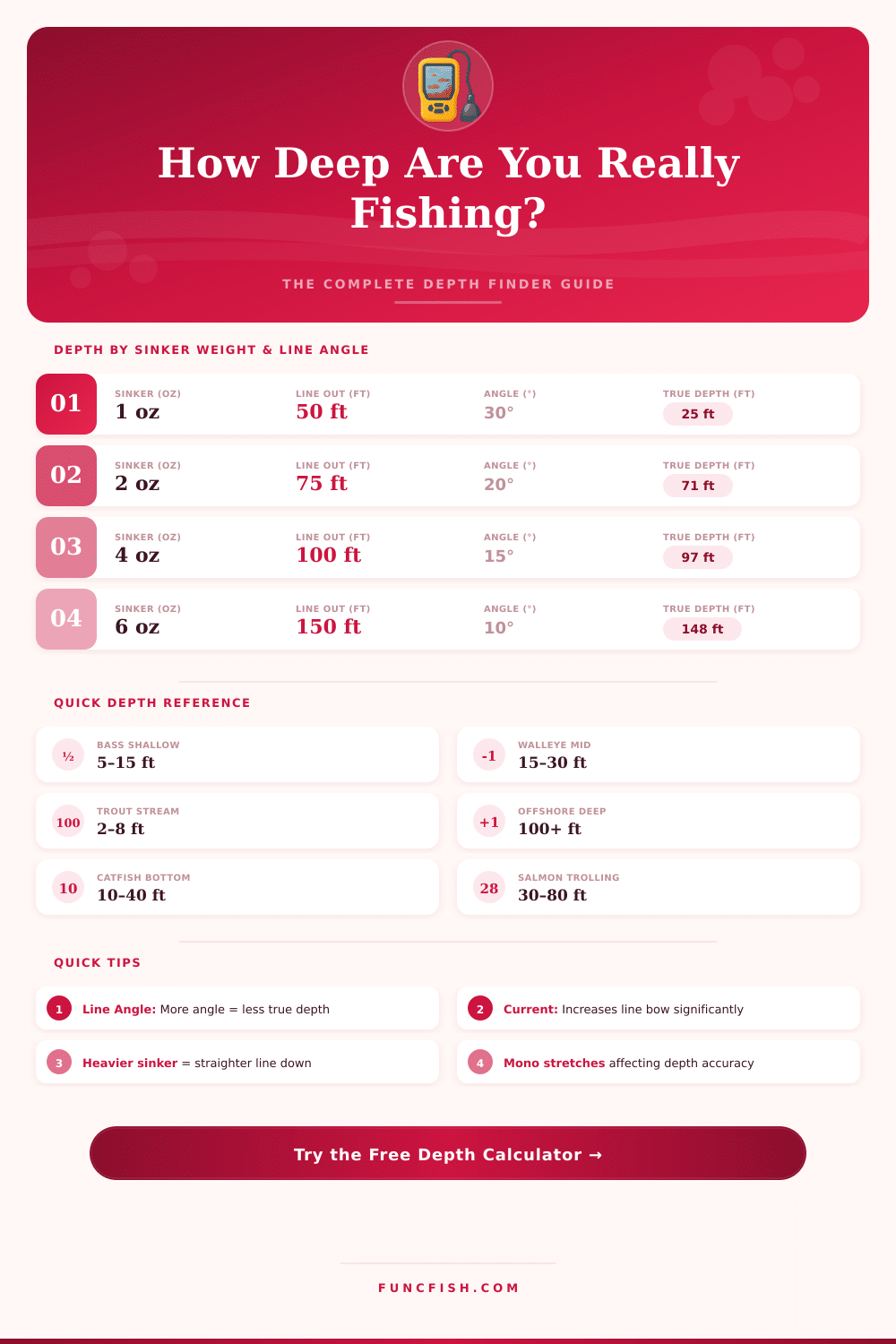
🎣 Fishing Depth Finder Calculator
Calculate true fishing depth based on line length, angle, current, and sinker weight
| Line Type | Stretch | Sink Rate | Depth Factor | Best Use | Diameter (20 lb) |
|---|---|---|---|---|---|
| Monofilament | 25–30% | Slow | 0.75–0.85 | General, drifting | 0.016 in / 0.41 mm |
| Fluorocarbon | 10–15% | Medium | 0.85–0.92 | Leaders, clear water | 0.015 in / 0.38 mm |
| Braided Line | <5% | Neutral | 0.70–0.80 | Jigging, sensitivity | 0.009 in / 0.23 mm |
| Wire Line | <1% | Fast | 0.95–0.98 | Deep trolling | 0.020 in / 0.51 mm |
| Lead Core | <3% | Very Fast | 0.90–0.96 | Trolling deep | 0.035 in / 0.89 mm |
| Copper Line | <2% | Fast | 0.92–0.97 | Great Lakes trolling | 0.022 in / 0.56 mm |
| Species | Typical Depth Range | Metric Equivalent | Recommended Sinker | Line Test | Technique |
|---|---|---|---|---|---|
| Largemouth Bass | 5–20 ft | 1.5–6 m | 1/4–1/2 oz | 10–17 lb | Texas/Carolina rig |
| Walleye | 15–35 ft | 4.5–11 m | 1/4–3/4 oz | 6–12 lb | Jigging / Bottom bounce |
| Rainbow Trout | 3–15 ft | 0.9–4.5 m | 1/16–1/4 oz | 4–8 lb | Drift / Float |
| Channel Catfish | 10–40 ft | 3–12 m | 1–4 oz | 17–30 lb | Bottom rig |
| Striped Bass | 10–60 ft | 3–18 m | 2–8 oz | 20–50 lb | Trolling / Jigging |
| Chinook Salmon | 30–100 ft | 9–30 m | 8–16 oz | 20–50 lb | Downrigger / Lead core |
| Lake Trout | 40–120 ft | 12–37 m | 4–12 oz | 20–30 lb | Deep jigging / trolling |
| Northern Pike | 5–25 ft | 1.5–7.5 m | 1/4–1 oz | 17–30 lb | Casting / Trolling |
| Redfish / Red Drum | 1–15 ft | 0.3–4.5 m | 1/4–1 oz | 12–20 lb | Inshore bottom |
| Yellowfin Tuna | 50–200 ft | 15–60 m | 4–16 oz | 50–80 lb | Deep dropping / jigging |
| Sinker Weight | Metric | Approx. Angle (calm) | True Depth (ft) | True Depth (m) | Efficiency % |
|---|---|---|---|---|---|
| 1/4 oz | 7 g | 35°–40° | 63–77 ft | 19–23 m | 63–77% |
| 1/2 oz | 14 g | 25°–30° | 77–87 ft | 23–27 m | 77–87% |
| 1 oz | 28 g | 15°–20° | 87–94 ft | 27–29 m | 87–94% |
| 2 oz | 57 g | 10°–15° | 94–97 ft | 29–30 m | 94–97% |
| 4 oz | 113 g | 5°–10° | 97–99 ft | 30–30.5 m | 97–99% |
| 8 oz | 227 g | 2°–5° | 99–100 ft | 30–30.5 m | 99–100% |
Fishfinders are one of those devices that genuinely change the way you fish on the lake. At the base of it, they use sound in various forms, which allows boaters to estimate the Fishing Depth of the water and see what hides under the surface. It helps to identify whether under the boat lies rock or a ridge, if the bottom is hard or soft, and whether there are small fish or the hunted prey.
Basic fishfinders also avoid risk of running aground which genuinely pleases.
How Fishfinders Help You Fish
The part of the setup that sends and catches sound waves is called a transducer. Those transducers adapt to different depths and targets, and they commonly decide about the success of the whole effort. Some of them install through the body of the boat, set to the edge or even attach by means of a suction cup.
Portable fishfinders of average price come with a suitcase for transport, that protects the battery and cables, together with a transducer that one easily can lose in the water.
One finds many possible models. The Garmin Striker 4 shows reliable basic fishfinder with color screen, that gives more data than most need. Humminbird produces devices with advanced multi-beam sound, that casts two, three or even six sound waves to cover more complete territory with more accuracy than usual fishfinders.
Combinations of Lowrance with map tools bid marine GPS and sound in one unit. The module Garmin GSD 25 reaches a Fishing Depth of 5,000 feet, designed for serious journeys in distant seas.
Some fishfinders include readings of temperature and identification of fish. Fishfinders usually draw a curve with depth-marks on one side and time on the second. The screen slips to present what happens under the transducer in the current moment.
When the boat sits or stays, signals of fish no longer move. Instead, they appear as flat strokes as fish swim in and out of the sound zone.
Average fishfinders hardly work in shallow water, but lateral scanning helps well hear. Lateral sound can search area a bit away on any side of the boat, finding holes, stones and plants even in only some feet of depth. Sound that looks forward offers another useful tool, pointing the distance and Fishing Depth of fish before the bow.
Fishfinders help to locate the wanted depth, structures and slopes. A steep bottom slope commonly gives good results. Modern models fit mapping vast regions and allow marks for fishing, so that one can return to interesting underwater spots.
Even cheap transducers faithfully point the depth. The Reelsonar iBobber forms a portable wireless Bluetooth option with depth until 135 feet and more than ten hours of battery, compatible with apps for iOS and Android. Because it floats on its own, kind of like Fishin Buddy in your pocket, it is the simplest setup.
No matter the expense, understanding the Fishing Depth and shape of thebottom genuinely changes everything.