🎣 Fishing Drag Setting Calculator
Calculate the ideal drag pressure for any species, line type, and fishing scenario
| Species | Typical Weight | Rec. Line Test | Drag Setting (lb) | Drag Setting (kg) |
|---|---|---|---|---|
| Panfish (Bluegill, Crappie) | 0.25–1 lb / 0.1–0.45 kg | 2–6 lb | 0.5–1.5 lb | 0.2–0.7 kg |
| Trout (Stream) | 0.5–3 lb / 0.2–1.4 kg | 4–8 lb | 1–2 lb | 0.5–0.9 kg |
| Bass (Largemouth) | 2–8 lb / 0.9–3.6 kg | 10–17 lb | 2.5–5.6 lb | 1.1–2.5 kg |
| Walleye | 2–6 lb / 0.9–2.7 kg | 8–14 lb | 2–4.6 lb | 0.9–2.1 kg |
| Pike / Muskie | 5–25 lb / 2.3–11 kg | 17–30 lb | 4.3–10 lb | 1.9–4.5 kg |
| Catfish | 5–40 lb / 2.3–18 kg | 20–50 lb | 5–16.5 lb | 2.3–7.5 kg |
| Striped Bass (Inshore) | 5–30 lb / 2.3–13.6 kg | 15–30 lb | 3.75–10 lb | 1.7–4.5 kg |
| Redfish / Red Drum | 3–20 lb / 1.4–9 kg | 12–20 lb | 3–6.6 lb | 1.4–3 kg |
| Yellowfin Tuna | 20–150 lb / 9–68 kg | 50–100 lb | 12.5–33 lb | 5.7–15 kg |
| Marlin / Sailfish | 50–500 lb / 23–227 kg | 80–130 lb | 20–52 lb | 9–23.5 kg |
| Line Type | Stretch | Drag Adjustment | Knot Strength | Best For |
|---|---|---|---|---|
| Monofilament | 15–30% | Standard (baseline) | 80–95% | General freshwater, surf |
| Fluorocarbon | 5–15% | Reduce 5–10% | 75–90% | Clear water, leader material |
| Braided Line | 0–3% | Reduce 10–15% | 85–95% | Sensitivity, deep water |
| Copolymer | 10–20% | Reduce 5% | 80–92% | Bass, walleye, general use |
| Wire Line | Near 0% | Reduce 15–20% | N/A (crimp) | Deep trolling, sharks |
| Lead Core | 5–10% | Reduce 10% | N/A (loop) | Depth-controlled trolling |
| Reel Class | Typical Line Test | Max Drag (lb) | Max Drag (kg) |
|---|---|---|---|
| Ultralight Spinning (1000–2000) | 2–6 lb / 1–3 kg | 4–8 lb | 1.8–3.6 kg |
| Light Spinning (2500–3000) | 6–12 lb / 3–5.5 kg | 8–15 lb | 3.6–6.8 kg |
| Medium Spinning (4000–5000) | 10–20 lb / 4.5–9 kg | 15–22 lb | 6.8–10 kg |
| Heavy Spinning (6000–8000) | 20–40 lb / 9–18 kg | 22–33 lb | 10–15 kg |
| Baitcaster (Low Profile) | 10–20 lb / 4.5–9 kg | 12–20 lb | 5.4–9 kg |
| Baitcaster (Round) | 14–30 lb / 6–13.6 kg | 20–30 lb | 9–13.6 kg |
| Conventional (Medium) | 20–50 lb / 9–23 kg | 25–40 lb | 11.3–18 kg |
| Conventional (Heavy / Big Game) | 50–130 lb / 23–59 kg | 40–100 lb | 18–45 kg |
Correct the tension of the drag in fishing is ranked between those things that can help or ruin a whole trip for fishing. This system cares about the tension of the line, and it is important because it protects the line against breaking because of the force of a caught fish, while giving better control. For Setting it, turn the knob or the disc on the reel.
In the inside of the reel, metal washers together with felt or carbon fiber plates work as sliding plates. When you tighten the Setting of the drag, those washers press one to the other, which requires bigger force for their motion. At disc type of drag in fly reels, turn the knob clockwise to tighten it, while turn counterclockwise to loosen.
How to Set the Drag on a Fishing Reel
The main goal of Fishing Drag consists in allowing the line to release itself before it will break. Strong fish will resist and will run, and good drag allows it to take line without snapping it. Later the angler slowly reels it in.
Here can last a bit of time sometimes, but this is wear the joy of fishing lies. The secret is that you use the line and the rod to tire the fish from the water, protect by means of the drag and the gear and the fish, and then by means of the reel retrieve line when the fish allows.
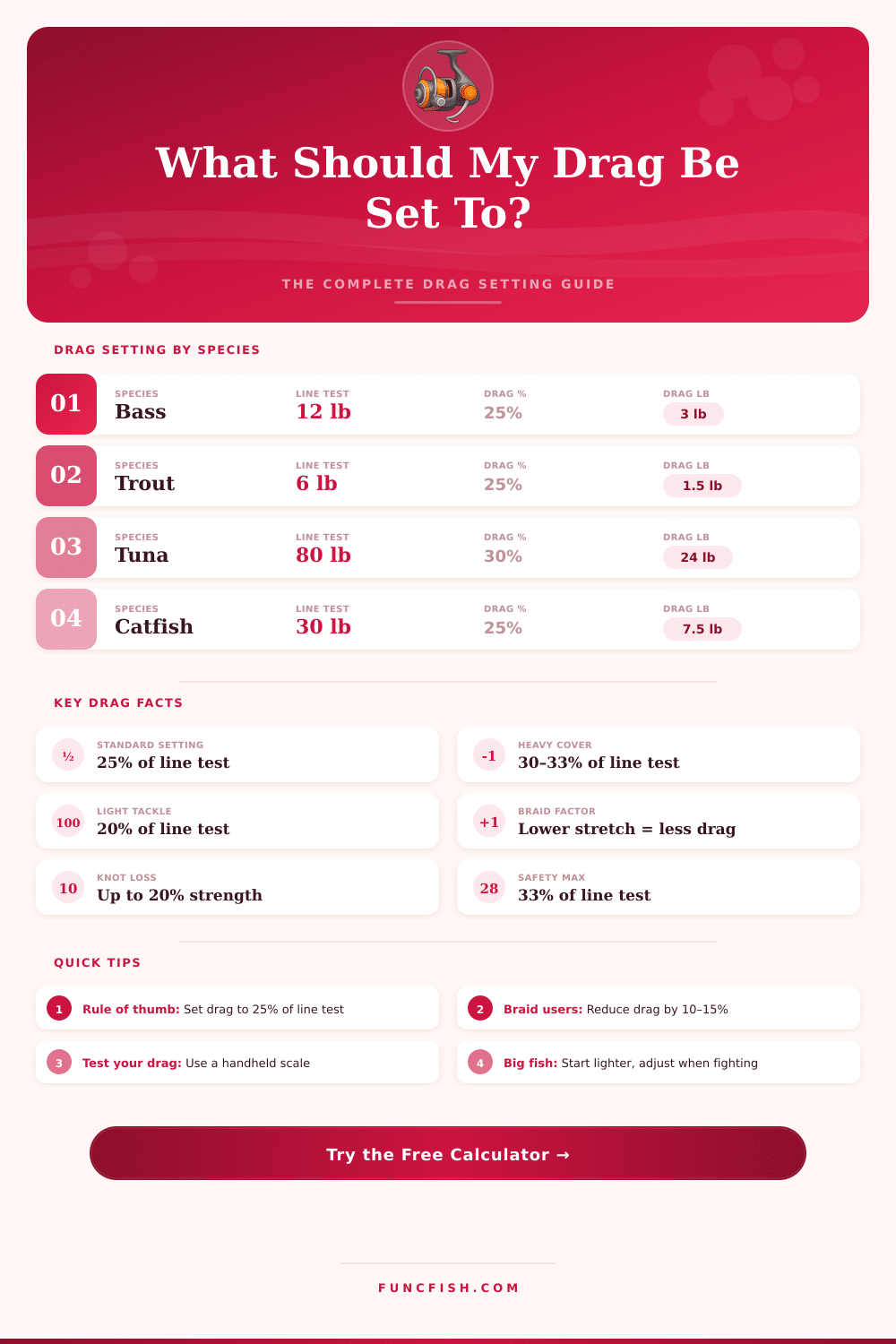
Common advice consists in Setting the drag to one-quarter to one-third of the maximum strength of the line. Like this, for 20-pound test line, it should reach around 6 to 7 pounds. One can also think of that as about 25 to 30 percent of the rated force of the line.
For 12-pound test line that gives around 3 pounds of drag pressure as a safe starting point.
The simple way to set drag at a spinning reel or baitcasting reel is to draw the line directly from above the reel by hand. Take the line only directly from the reel and try to draw it with as much force as the intended fish would use. Then turn the drag so that a bit of line exits at that tension.
Even so, Setting by hand is not fully exact. A more exact method includes use of a spring scale. Hook the scale to the end of the line, hold the rod like you are fighting a fish and let someone pull while you watch the reading.
Set with small changes until the scale shows the wanted pressure, while the line moves.
When a lot of line is leaving, the real drag actually grows, because the width of the line around the spool shrinks. That is worth remembering during long fights. Also, the drag system usually is not made forchanges during fishing, so that could cause damage.
If you tie the line to a pole without any drag, big fish probably will not be caught. But with the same line on a reel with well set drag, one can catch fish at double or even four times the pound test weight. Here truly lies the value of knowing how to set drag.