🛶 Fishing Kayak Weight Capacity Calculator
Calculate your safe load limit, performance load, and available gear weight for any fishing kayak
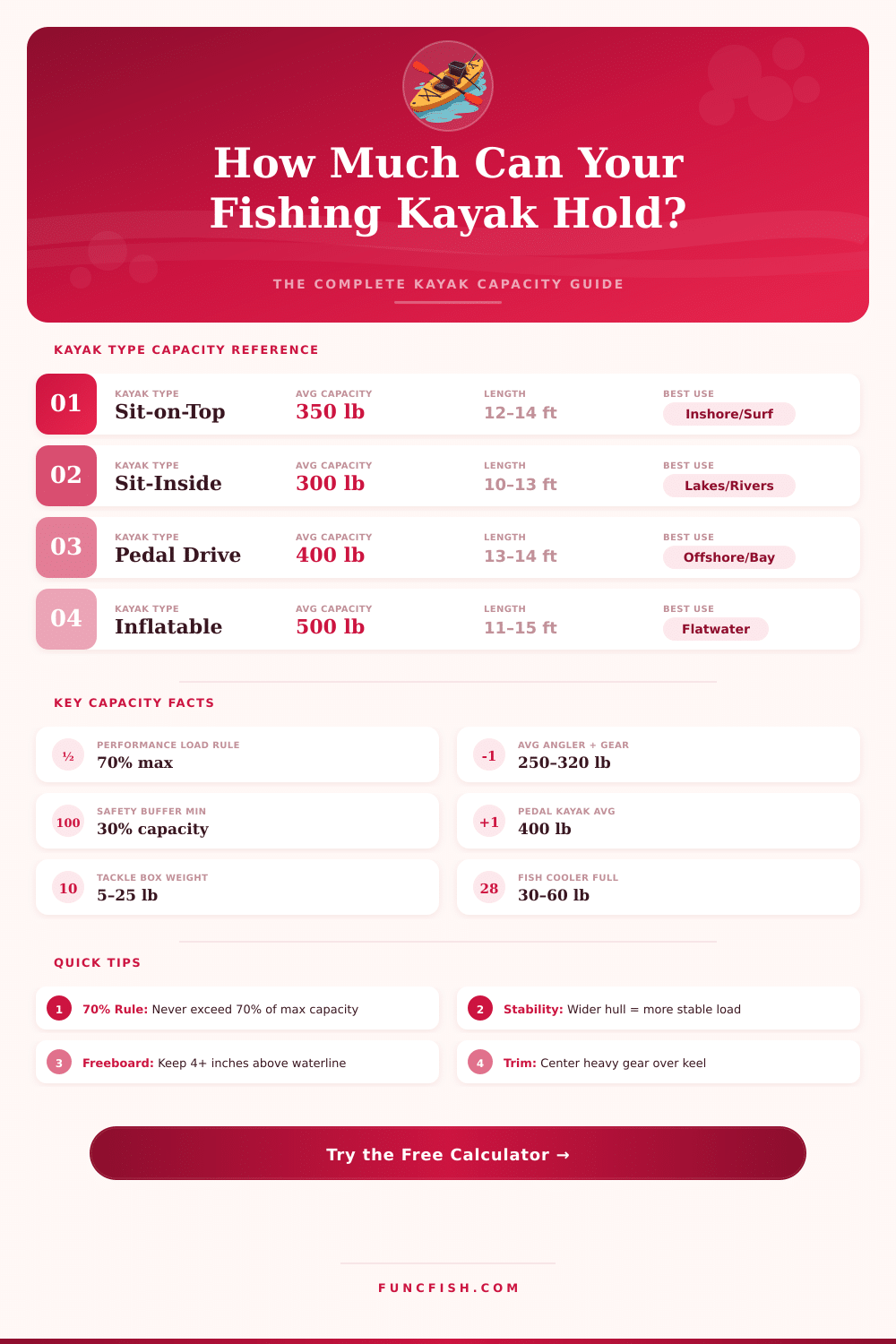
| Kayak Type | Avg Max Capacity (lb) | Avg Max Capacity (kg) | Typical Length (ft) | Rec. Safety Load (lb) | Best Conditions |
|---|---|---|---|---|---|
| Sit-on-Top | 350 | 159 | 11–14 | 245 | Inshore, Surf, Lakes |
| Sit-Inside | 300 | 136 | 10–13 | 210 | Rivers, Lakes, Cold |
| Pedal Drive | 400 | 181 | 12–15 | 280 | Bay, Offshore, Inshore |
| Inflatable | 500 | 227 | 11–15 | 350 | Flatwater, Rivers |
| Tandem (2-Person) | 550 | 249 | 14–18 | 385 | Lakes, Bay, Inshore |
| Stand-Up Fishing | 450 | 204 | 12–15 | 315 | Calm Flatwater |
| Hybrid/Crossover | 375 | 170 | 11–14 | 263 | Versatile All-Water |
| Species | Keep Weight (lb) | Keep Weight (kg) | Cooler Needed |
|---|---|---|---|
| Largemouth Bass | 5–15 | 2–7 | Small (20 qt) |
| Catfish | 15–40 | 7–18 | Large (48 qt) |
| Walleye | 8–20 | 4–9 | Medium (36 qt) |
| Trout | 3–10 | 1–5 | Small (20 qt) |
| Striped Bass | 10–30 | 5–14 | Large (48 qt) |
| Flounder | 5–15 | 2–7 | Medium (30 qt) |
| Panfish/Crappie | 2–8 | 1–4 | Small (16 qt) |
| Gear Item | Typical Weight (lb) | Typical Weight (kg) |
|---|---|---|
| Rod & Reel Combo | 1–2 | 0.5–0.9 |
| Tackle Box (Full) | 10–25 | 5–11 |
| Anchor + Rope | 8–15 | 4–7 |
| Life Jacket (PFD) | 2–3 | 0.9–1.4 |
| Cooler (Empty) | 8–25 | 4–11 |
| Ice (Per Quart) | ~2 | ~0.9 |
| Fish Finder Unit | 2–5 | 0.9–2.3 |
| Paddle | 2–4 | 0.9–1.8 |
| Standard | Load Factor | Best For | Freeboard Maintained | Notes |
|---|---|---|---|---|
| Recreational (70%) | 0.70 | Casual fishing, lakes | 4–6 inches | Most commonly recommended |
| Performance (80%) | 0.80 | Experienced paddlers | 2–4 inches | Reduced stability margin |
| Touring (75%) | 0.75 | Day trips, multi-tackle | 3–5 inches | Good balance of load & safety |
| Fishing Specific (65%) | 0.65 | Live wells, heavy gear | 5–8 inches | Best for rough/offshore water |
Fishing kayaks usually weigh more than average kinds of kayaks. An average single kayak has a weight of around 35 pounds, but fishing models commonly reach 120 pounds or even more. Most kayaks fall between 20 and 80 pounds although some types easily pass 100 pounds.
That difference in weight is clear, especially during loading and unloading from a car.
Fishing Kayak Weight and Moving Tips
The main trouble with heavy kayaks is getting it to the car and moving it. Pedal fishing kayaks range from less than 50 pounds to more than 150 pounds. Extra gears and batteries expand the weight even more.
Before buying, one should consider where and how one plans to move their kayak.
Kayaks with pedal-drive have many benefits, even though they add weight, costs and time for loading and unloading at the fishing spot. Pedal systems sometimes seem more harmful than useful. Some anglers simply want to reach the water in only three or four minutes.
In low marsh areas pedal tools commonly create more trouble than support, because one still must paddle, hence the weight matters alot.
Kayaks broader and stable, that allows anglers to stand, enjoy popularity between newcomers. However such stable fishing kayaks also are heavy. With fishing kayaks everything is a compromise.
A sample stable fishing kayak with pedal-drive, trolling motor and added gear weighs almost 160 pounds. Open deck kayaks widely are quite heavy, but that weight brings reliability.
A lightweight kayak, like the Old Town Kingfisher, has around 45 pounds and one can drag, carry and load it easily. The contrast between a 70-pound body and a 100-pound body surprises. During solo trips with bad spots in launching, the weight becomes the main factor.
The Hobie Lynx weighs 40 pounds, which makes it ideal because of that reason.
Fishing kayaks are built to carry more gear and have a load limit of 400 to 500 pounds. Inflatable kayaks with there good floating also reach 300 to 500 pounds. Use the rule of thumb: stay under 75 to 80 percent of the listed load limit for safety.
No industry standard exists about how makers count the limit. For a kayak with 400 pounds, 80 percent gives 320 pounds for practical use. Passing the limit does not always cause sinking, but it reduces stability.
Kayak carts help to move heavy kayaks, so thatone must not carry them by hand.