
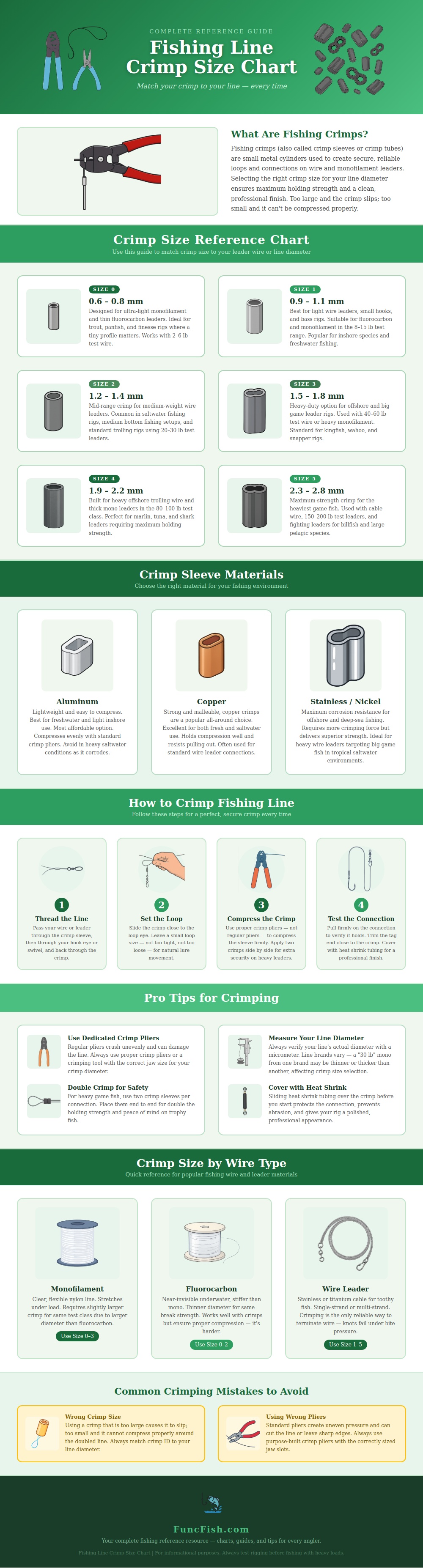
A fishing crimp is a small metal tube that help to create secure loops and knots along a wire or leader material. Fishing crimps work by compressing around a doubled fishing line. If the crimp that are used is too large for the line, the crimp will slide along the fishing line.
If the crimp that is used is too small for the line, the crimp will not adequate close around the doubled fishing line. If the crimp does not adequately grip the fishing line, the crimp will fail and you’ll lose the fish. Therefore, the size of the crimp that is used must match the diameter of the fishing line.
How to Choose and Use Fishing Crimps
The size of the fishing crimp must change according to both the weight of the fishing line that is being used and the type of fish that you are targeting. For thin monofilament lines that are used for species like panfish or trout, you should use very small fishing crimps that fit 2 to 6 pound test fishing line. For 8 to 15 pound test leader lines that are used for bass, you should use mid-sized fishing crimps.
For 20 to 30 pound test leader lines that are used for saltwater fish, medium-sized crimps should be used. For 40 to 60 pound test wire leaders, heavy duty fishing crimps should be used. For 80 to 200 pound test lines that are used for large fish like tuna or marlin, the largest fishing crimps should be used.
Each size of fishing crimp has an inner diameter that is size to fit specific types of fishing line. In addition to the size of the fishing crimp, the material of the crimp is important to ensure that it resist corrosion when exposed to water. Aluminum crimps are inexpensive and easy to compress, but tend to corrode quick if exposed to saltwater.
Therefore, you should only use aluminum crimps in freshwater environments like lakes and rivers. Copper crimps are malleable and you can use them in both freshwater and saltwater environments. Stainless steel and nickel crimps is rust resistant and can be used in saltwater environments, but require more force to compress.
Therefore, you can select each of these materials based off the type of water in which the fishing will occur. In addition to the size and material of the crimp, the technique of how the crimp is applied will determine if the crimp create a strong connection. You should thread the leader through the crimp, loop it around the hook or swivel, and then thread the leader back through the crimp.
You should pull the leader to create a loop before the crimp is compressed. Use dedicated crimping pliers to ensure that the crimp is compressed even. Household pliers may crush the crimp if used.
For very heavy fishing lines, two crimps can be use side by side within the leader. After the crimp is compressed, the line should be tugged on to ensure that the crimp create a strong connection. Different types of fishing lines require different considerations when crimps are used.
Monofilament lines are stretchy and often have a thicker diameter than other lines, so slightly large crimps should be used for monofilament lines. Fluorocarbon lines are stiff but easy to crimp, but can be difficult to fully compress. Wire leaders made of materials like braided stainless steel lines are reliant upon crimps alone because any knot will unravel along the line.
Size charts are provided for each type of fishing line so that the angler can correctly select the size of the crimp based upon the type of line being used. Mistakes can be made in the use of fishing crimps. For instance, one mistake is to guess at the size of the fishing crimp by sight instead of using the provided size charts and measuring the diameter of the fishing line.
Another mistake is to use household pliers instead of dedicated crimping pliers. Lastly, leaving the loop of the crimp too loose or over-compressing the crimp may damage the fishing line. To avoid these mistakes, every crimped connection should of be test by tugging on the fishing line before going fishing.
If the size of the fishing crimp is matched to the diameter of the fishing line, and the crimp is used according to the techniques describe, the crimp will create a secure connection between the line and the hook or swivel.