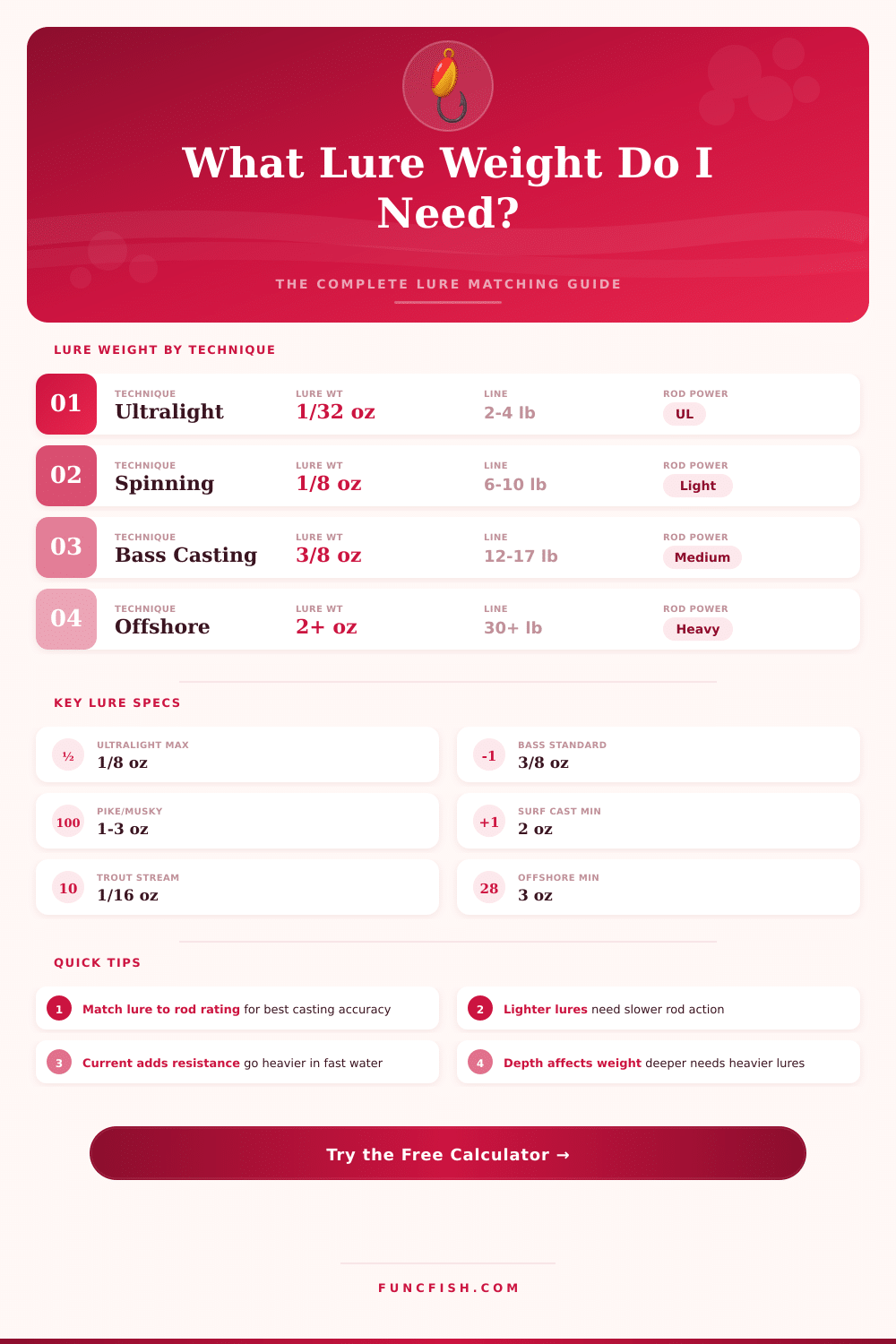
🎣 Fishing Lure Weight Calculator
Match lure weight to your rod power, line strength, water depth & technique for optimal casting performance
| Species | Typical Weight | Lure Wt (oz) | Lure Wt (g) | Line (lb) | Rod Power |
|---|---|---|---|---|---|
| Bluegill / Panfish | 0.1–0.5 lb | 1/64–1/16 | 0.4–1.8 g | 2–6 | Ultralight |
| Trout (stream) | 0.5–3 lb | 1/32–1/4 | 0.9–7 g | 4–8 | UL – Light |
| Largemouth Bass | 1–10 lb | 3/16–3/4 | 5.3–21.3 g | 10–17 | M – MH |
| Smallmouth Bass | 1–6 lb | 1/8–1/2 | 3.5–14.2 g | 8–14 | ML – M |
| Walleye | 1–8 lb | 1/8–1/2 | 3.5–14.2 g | 8–14 | ML – M |
| Northern Pike | 3–20 lb | 1/2–2 | 14.2–56.7 g | 15–30 | MH – H |
| Musky | 5–40 lb | 1–4 | 28.3–113 g | 30–80 | H – XH |
| Channel Catfish | 2–20 lb | 1–3 | 28.3–85 g | 20–40 | H |
| Striped Bass | 5–40 lb | 1–4 | 28.3–113 g | 20–50 | MH – H |
| Redfish / Red Drum | 3–30 lb | 1/2–2 | 14.2–56.7 g | 15–30 | M – H |
| Snook | 3–20 lb | 1/4–1 | 7–28.3 g | 15–30 | M – MH |
| Mahi-Mahi | 5–50 lb | 1–6 | 28.3–170 g | 30–80 | H – XH |
| Lure Type | Typical Weight (oz) | Typical Weight (g) | Effective Depth | Best Current | Best Rod Action |
|---|---|---|---|---|---|
| Crankbait (shallow) | 1/4–3/4 | 7–21 g | 0–8 ft | Slow–Moderate | Moderate |
| Crankbait (deep dive) | 3/4–2 | 21–57 g | 10–25 ft | Slow–Moderate | Moderate |
| Jig / Jighead | 1/16–3 | 1.8–85 g | 5–50 ft | Any | Fast |
| Spinnerbait | 1/4–1 | 7–28 g | 1–15 ft | Slow–Moderate | Fast |
| Swimbait | 1/4–4 | 7–113 g | 5–30 ft | Slow–Moderate | Moderate–Fast |
| Topwater Plug | 1/4–1 | 7–28 g | Surface | Calm–Slow | Extra Fast |
| Soft Plastic Rig | 1/8–1 | 3.5–28 g | 1–40 ft | Any | Fast |
| Spoon / Metal | 1/4–6 | 7–170 g | 5–100 ft | Any | Fast |
| Fly / Streamer | 1/64–1/8 | 0.4–3.5 g | 0–10 ft | Slow–Fast | Slow–Moderate |
| Line Strength | Min Lure (oz) | Max Lure (oz) | Min Lure (g) | Max Lure (g) | Ideal Use |
|---|---|---|---|---|---|
| 2–4 lb | 1/64 | 1/8 | 0.4 | 3.5 | Panfish, small trout |
| 6–8 lb | 1/16 | 1/4 | 1.8 | 7.1 | Trout, perch, crappie |
| 10–12 lb | 1/8 | 1/2 | 3.5 | 14.2 | Bass, walleye |
| 14–17 lb | 3/16 | 3/4 | 5.3 | 21.3 | Bass, pike, walleye |
| 20–30 lb | 1/2 | 2 | 14.2 | 56.7 | Pike, striper, redfish |
| 30–50 lb | 1 | 4 | 28.3 | 113 | Musky, large saltwater |
| 50–80 lb | 2 | 8 | 56.7 | 227 | Offshore, tuna, mahi |
| 80+ lb | 4 | 32 | 113 | 907 | Big game, marlin |
The weight of the bait can confuse newcomers in fishing but here the main point, it only matters a bit, when one counts, that can take and ensure, that the gear works as desired.
Each fishing rod has limits about the weight, that it fits to bear and cast well. Here what commonly calls the power of the rod. One builds them for separate tasks, and the note about fishing lure weight shows exactly, what stays in the safe range.
How Bait Weight Changes Casting and Rods
Spinning gear works more well with lightweight bait and fine line, during baitcasting rods work with average until heavy gear.
Bait in the centre of the weight range of your rod usually give the longest cast distance and allow, that the line do his task. You will notice, that rods work best, when one casts somthing in the middle until upper part of the pointed range. If it falls too low, the distance fails.
Flood the limit risk to break the rod. Some more expensive rods become difficult, when one passes the advice. They simply do not work.
Less costly rods can handle that, but that does not make it good practice.
How does one judge the bait? It is always the whole weight of the bait itself. That affects and the maximum cast distance, and the activity of the bait.
Naturally, many fishers can cast with too heavy gear. But when the excitement of the fishing mingles with adrenaline, difficult launching creates temptation, and then rods can brake quickly. Lay 48 gram bait on rod for 35 grams push almost 40 percent above the limit.
Cast succeed, but the risks of mighty launching can break it entirely.
The kind of fish and the place of fishing changes everything also. Casting from bank beside little lake for panfish and little bass? One ounce bait works for the task.
Turning to deeper water or needing bigger distance? Quarter ounce baits give more accuracy. With lightweight bait, one wants clear line and a guide, heavy line slows the move and block the bait from the right sinking.
The weight also affects, how the bait move during the retrieve. Heavier baits need faster rhythm, to keep steady rhythm in stop-go methods or hesitant moves. Entirely other cause is fly fishing.
The fly itself almost do not weigh. The line bears all weight, that lays the fly over there, where it must go.
Here where it gets subtle: there is no real standard for how one tests the ratings of rods. Rod marked for 3/8 until 1 ounce can feel different than another with same note. One method, that helps, is multiply your cast weight by three, to find, what feels right in talk fishing, jigging and bottom work.
One can add weights to baits, but one must fit that to his own fishing style. Keepthat all in the mind, before go to the water.