🎣 Fishing Rod Thread Wrap Length Calculator
Calculate exact thread length needed for guide wraps, handle wraps & decorative rod wraps
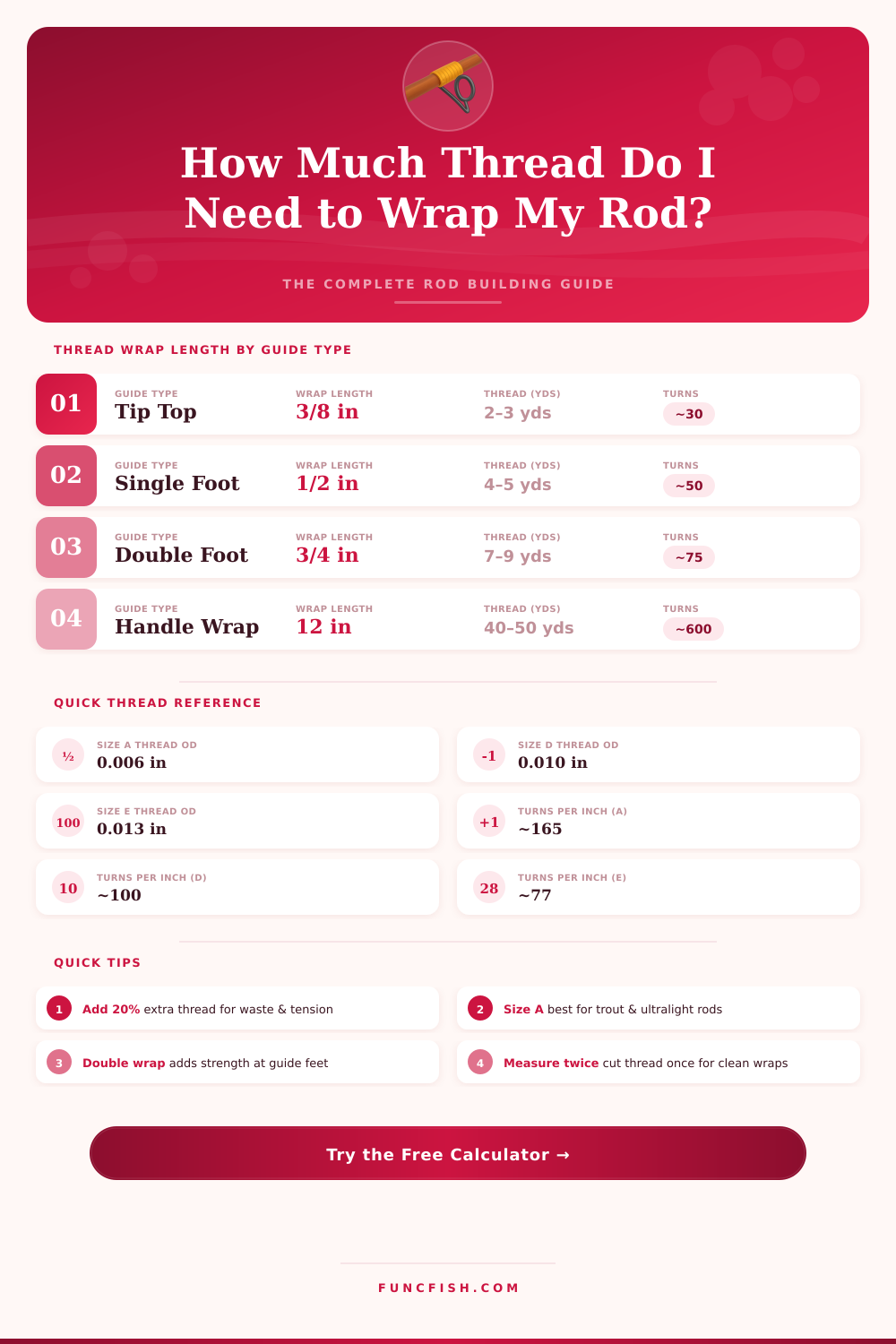
| Rod Type | Guide Foot | Typical Wrap (in) | Typical Wrap (mm) | Guides (avg) | Thread Rec. |
|---|---|---|---|---|---|
| Ultralight Trout | Single | 1/2 in | 12.7 mm | 8–10 | Size A |
| Spinning Bass | Single/Double | 5/8 in | 15.9 mm | 7–9 | Size A or D |
| Baitcast / Casting | Double | 3/4 in | 19.1 mm | 6–8 | Size D |
| Fly Rod | Single | 1/2 in | 12.7 mm | 7–9 | Size A |
| Surf Rod | Double | 1 in | 25.4 mm | 4–6 | Size D or E |
| Offshore / Trolling | Double | 1–1.5 in | 25–38 mm | 3–5 | Size E or EE |
| Handle Wrap | Handle | 10–14 in | 254–356 mm | 1 | Size A or D |
| Decorative Band | Decorative | 1/4–1/2 in | 6–13 mm | varies | Size A |
| Size | Diameter (in) | Diameter (mm) | Turns/Inch | Turns/cm | Best Use |
|---|---|---|---|---|---|
| Gossamer / 1/0 | 0.004 in | 0.10 mm | 250 | 98 | Ultralight, Fly |
| Size A | 0.006 in | 0.15 mm | 165 | 65 | Light to Medium |
| Size C | 0.008 in | 0.20 mm | 125 | 49 | Medium Rods |
| NCP | 0.008 in | 0.20 mm | 125 | 49 | Color–fast wraps |
| Size D | 0.010 in | 0.25 mm | 100 | 39 | Medium–Heavy |
| Size E | 0.013 in | 0.33 mm | 77 | 30 | Heavy, Surf |
| Size F | 0.015 in | 0.38 mm | 67 | 26 | Very Heavy |
| Size EE | 0.016 in | 0.41 mm | 62 | 24 | Offshore, Big Game |
| Target Species | Rod Power | Guide Count | Wrap Length (in) | Thread Size | Total Thread Est. |
|---|---|---|---|---|---|
| Panfish / Crappie | Ultralight | 8–10 | 3/8–1/2 in | Gossamer / A | 25–40 yds |
| Trout | Light | 8–9 | 1/2 in | Size A | 30–45 yds |
| Bass (spinning) | Medium | 8 | 5/8 in | Size A/D | 40–55 yds |
| Bass (baitcast) | Med–Heavy | 7 | 3/4 in | Size D | 45–65 yds |
| Walleye | Medium | 8 | 5/8 in | Size A/D | 40–55 yds |
| Pike / Musky | Heavy | 6 | 7/8–1 in | Size D/E | 50–75 yds |
| Catfish | Heavy | 5–6 | 1 in | Size D/E | 50–70 yds |
| Surf / Striped Bass | Heavy | 5 | 1–1.25 in | Size D/E | 60–85 yds |
| Offshore / Tuna | Extra Heavy | 4 | 1.25–1.5 in | Size E/EE | 60–90 yds |
The calculator applies a waste factor automatically. For intricate chevron or diamond patterns, manually increase to 30–40% extra. Thread tension during wrapping consumes 15–20% more than a flat measurement alone.
A double-foot guide needs two separate wraps — one for each foot. Each wrap is independent. Multiply single-foot wrap length x2 and add extra for the gap between the feet when ordering thread for double-foot guides.
Calculating an amount of thread that will be needed in the building of a rod are a necessary task for most rod builders as many builders will find themselfs out of thread before they are finished with their rods. Finding themselfs out of thread is a challenging problem for rod builders as they may end up with half-wrapped guide feet and rods that isnt finished. In order to avoid these issues with thread availability, the builder must gain an understanding of the different factors that contribute to the amount of thread that will be required in the building process of a rod.
One of the primary factor to consider in the measurement of the amount of thread that will be required in the building process is the diameter of the rod blank. The circumference of the rod blank will determine the length of every single wrap that is perform in building the rod. The rod builder must measure the diameter of the rod at the areas where the wraps will be applied to the rod.
How to work out how much thread you need for a rod
For instance, a thin rod blank with a diameter of 0.13 inches will require more wraps in a set inch measure than a thick blank with a diameter of 0.43 inches. The thicker the blank, the more an individual must wrap to make up the circumference of the rod. Thus, the rod builder must measure the average diameter of the rod to determine how much thread will be required for that rod to be built.
The style of the guides will also impact the amount of thread that is used in the building of a rod. Single-foot casting guides requires a moderate amount of thread for the production of both the front and back ramps of the guides. Double-foot boat guides will require more thread in the building of the rod due to the increased area that must be covered in building those guides.
Additionally, guides that include fly snakes will also require more wraps due to the fact that fly snake guides use more fine thread to produce the same height as the other types of guides. Finally, any rod that includes underwraps will require nearly twice the amount of thread then the amount needed for a rod that does not include underwraps. Lastly, another factor in the amount of thread that is used during the building of a rod is the type of thread that is select for use in building that rod.
Finer threads, like Nylon A or silk, requires more revolutions to reach the necesary height for the wrap. However, finer threads may require less linear yardage than thicker threads. For instance, thicker threads, like Nylon D, require fewer revolutions to complete the rod but require more thread for each individual wrap due to the larger diameter of the thread.
Each type of thread will have a different diameter and require a different number of revolutions to complete the rod proper. Another issue to account for is the amount of thread that will be wasted when building the rod. Whenever you complete a section of the rod, there will be a tag end of the thread that the builder must clip off.
Each of these tags will result in the loss of several inches of thread. Further thread will be wasted if the rod must be restarted, or if decorative trim bands and metallic accents is applied to the rod. Metallic threads can present challenges in that there may be more restarts with metallic thread than non-metallic thread.
This results in the wasting of more thread. Thus, the length of the rod alone is not a measure of how much thread is required for the rod. The best way to calculate the amount of thread required for the rod is to use averages.
The rod builder must measure the diameter of the rod at a minimum of three different spots along the guide train. Using these measurements, the builder can calculate the average diameter. With the average diameter of the rod measured, the total number of wraps of thread that will be required can be calculated.
Using these measurements, it is possible to calculate whether a single spool of thread will be enough for the rod. Following these steps will ensure that there is enough thread to complete the rod without having the thread run out before the rod is complete.