🎣 Fishing Rod Reel Seat Position Calculator
Find the optimal reel seat placement for any rod, technique, or species target
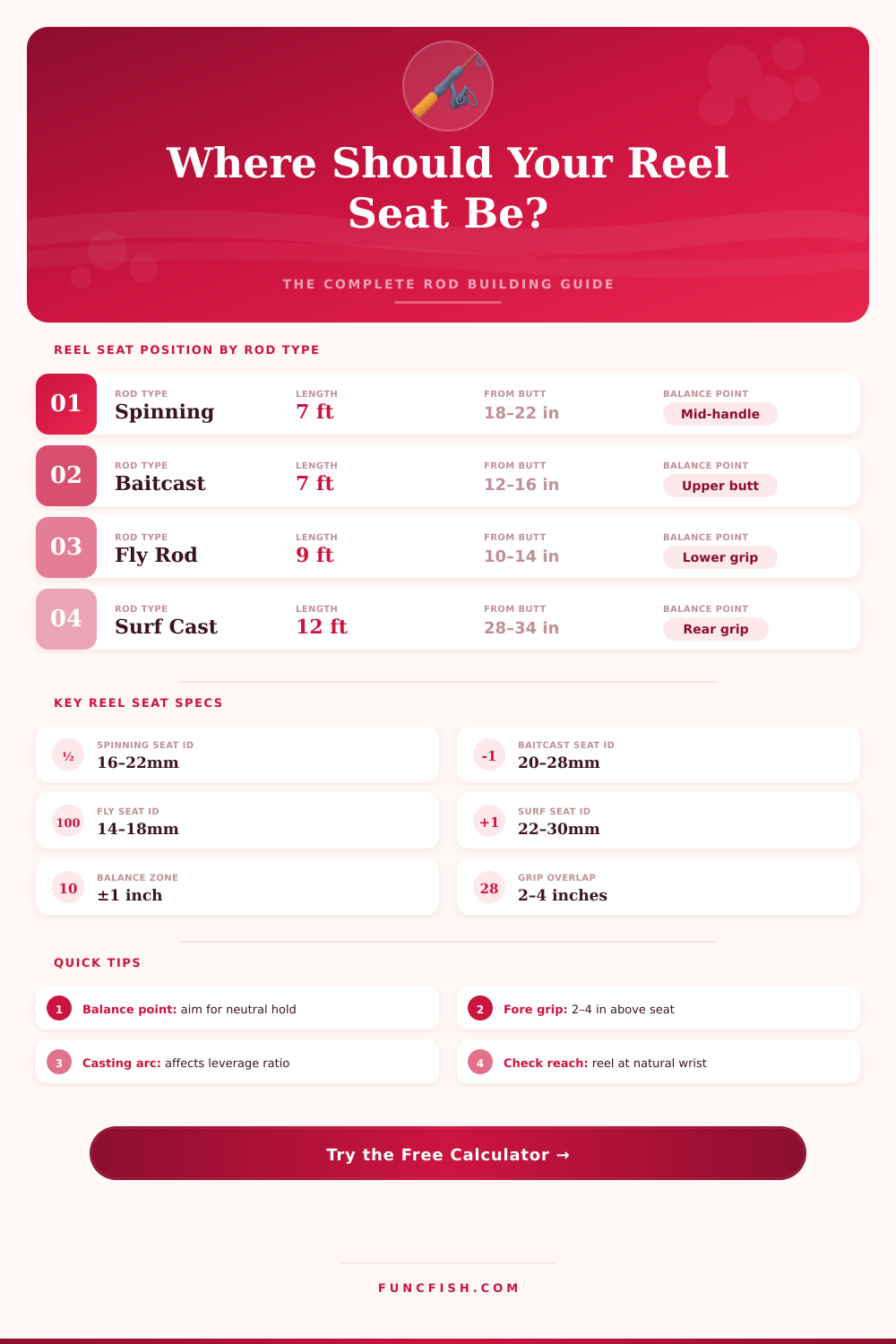
| Technique | Typical Rod Length | Seat From Butt (in) | Seat From Butt (cm) | Grip Type |
|---|---|---|---|---|
| Spinning | 6–8 ft | 16–22 in | 41–56 cm | Full cork / EVA |
| Baitcasting | 6.5–8 ft | 12–17 in | 30–43 cm | Pistol / trigger |
| Fly Fishing | 7.5–10 ft | 10–14 in | 25–36 cm | Cork half-wells |
| Surf Casting | 10–14 ft | 26–36 in | 66–91 cm | EVA foam long |
| Trolling | 6–8 ft | 14–20 in | 36–51 cm | Full EVA roller |
| Ice Fishing | 2–4 ft | 4–8 in | 10–20 cm | Short EVA |
| Reel Type | Seat ID (mm) | Rod Diameter at Seat | Typical Use |
|---|---|---|---|
| Ultralight Spinning | 14–16 mm | 14–15 mm blank | Panfish, small trout |
| Light Spinning | 16–18 mm | 15–17 mm blank | Trout, bass |
| Medium Spinning | 18–20 mm | 17–19 mm blank | Bass, walleye |
| Heavy Spinning | 20–22 mm | 19–21 mm blank | Catfish, surf |
| Baitcasting Light | 20–22 mm | 18–20 mm blank | Bass, walleye |
| Baitcasting Heavy | 24–28 mm | 22–26 mm blank | Pike, muskie, offshore |
| Fly Reel (5–6 wt) | 15–17 mm | 14–16 mm blank | Trout, panfish |
| Fly Reel (8–10 wt) | 18–20 mm | 17–19 mm blank | Salmon, saltwater |
| Species | Typical Weight | Rod Power | Seat Dist. from Butt (in) | Balance Point |
|---|---|---|---|---|
| Largemouth Bass | 1–8 lb (0.5–3.6 kg) | Medium–Heavy | 14–20 | Upper third |
| Smallmouth Bass | 0.5–5 lb (0.2–2.3 kg) | Medium | 15–19 | Mid-upper |
| Rainbow Trout | 0.5–4 lb (0.2–1.8 kg) | Light–Medium | 14–18 | Mid-handle |
| Walleye | 1–10 lb (0.5–4.5 kg) | Medium | 16–20 | Mid-upper |
| Northern Pike | 3–25 lb (1.4–11.3 kg) | Heavy | 14–18 | Upper butt |
| Catfish | 2–50 lb (0.9–22.7 kg) | Heavy–XH | 20–26 | Lower mid |
| Striped Bass (surf) | 5–60 lb (2.3–27 kg) | Heavy | 28–36 | Rear butt |
| Panfish / Crappie | 0.1–1 lb (0.05–0.45 kg) | Ultralight | 13–17 | Mid-handle |
| Salmon / Steelhead | 5–30 lb (2.3–13.6 kg) | Medium–Heavy | 18–24 | Mid-upper |
| Inshore Saltwater | 2–20 lb (0.9–9 kg) | Medium–Heavy | 18–22 | Mid-upper |
Reel seat position are another critical component of custom rod building. The position of the reel seat will determines how the rod feel when being used. The placement of the reel seat will affect the balance and comfort of the person using the fishing rod.
If the rod has the reel seat in a wrong position, the fishing rod will feel unbalance and may be uncomfortable to use. Therefore, there is many different variables that must be considered to ensure that the position of the reel seat is correct. There are many different variables to consider when setting the reel seat position.
Where to Put the Reel Seat on a Fishing Rod
One of the variables to consider are the weight of the fishing reel. Another is the weight of a lure that will be attached to the fishing rod. The casting style that the person utilize will also impact the reel seat position.
Those with a wrist-flick casting style will require a different position than those who utilize an elbow movement to cast the fishing rod. Finally, the ergonomics of the fishing rod is one of the variables to consider when setting the position of the reel seat. In order to determine the proper position of the reel seat, math must be used.
The distance from the butt of the fishing rod to the center of the reel seat, the rear grip edge, and the front hood line must be measured. By calculating these distances, the fishing rod will be able to properly balance with the fishing reel and the lure attach to the fishing rod. Additionally, if the fishing reel has a high mass, the balance point of the rod will shift forward.
Therefore, adjustment must be made to the position of the reel seat. Depending on the type of fishing that is to be performed with the fishing rod, the position of the reel seat will change. For example, a trout rod will have a short handle on the rod because the angler should place the reel seat more close to the butt of the rod.
This type of rod will use a light reel and lures, so a short handle will allow for the angler to make quick movements with there wrist. Alternatively, a bass jigging rod will have a longer handle on the rod since the reel seat should be placed further from the butt of the rod. This type of fishing rod will use heavier lures and the longer handle will provide the person fishing with more leverage in setting the jaw of the bait.
Similarly, a surf rod will have a very long handle on the fishing rod since the reel seat should be placed much further from the butt of the rod. This type of fishing rod will use a heavy reel and lure, and the long handle will allow the person fishing to use two hands in move the rod. There are a few common mistakes that can be made when placing the reel seat on a fishing rod.
One of the most common are not considering the mass of the reel. The mass of the reel will significant impact the balance of the fishing rod. Another mistake is choosing a handle for the fishing rod based off the appearance of the fishing rod instead of the function of the fishing rod.
In addition to these mistakes, people should also consider if the person wearing the fishing rod is wearing a life vest or a jacket. If the person is wearing a life vest, there will need to be enough space provide for the butt of the fishing rod to not hit the life vest. Since epoxy is a permanent material in making fishing rods, mockups should be made prior to place epoxy on the fishing rod.
Tape can be used to secure the reel seat to the fishing rod in the desired position. The reel can then be attached to the reel seat. Afterwards, the carpenter can test the fishing rod by casting the fishing rod several time to see if the fishing rod feel balanced.
If the fishing rod feels tip-heavy, the reel seat should be moved forward a small amount, such as half an inch. In contrast, if the fishing rod feel butt-heavy, the reel seat should be moved backward by a small amount. By using mockups of fishing rods and by testing them for balance, the carpenter ensure that the fishing rod has it’s reel seat in the proper position prior to the epoxy set.