Fishing Rod Transport Length Calculator
Estimate packed rod length, case interior length, tube outside length, and storage fit from rod length, section style, guide clearance, and locker dimensions.
📌Scenario presets
⚙Transport settings
Rod transport fit forecast
Full breakdown
📋Rod construction reference grid
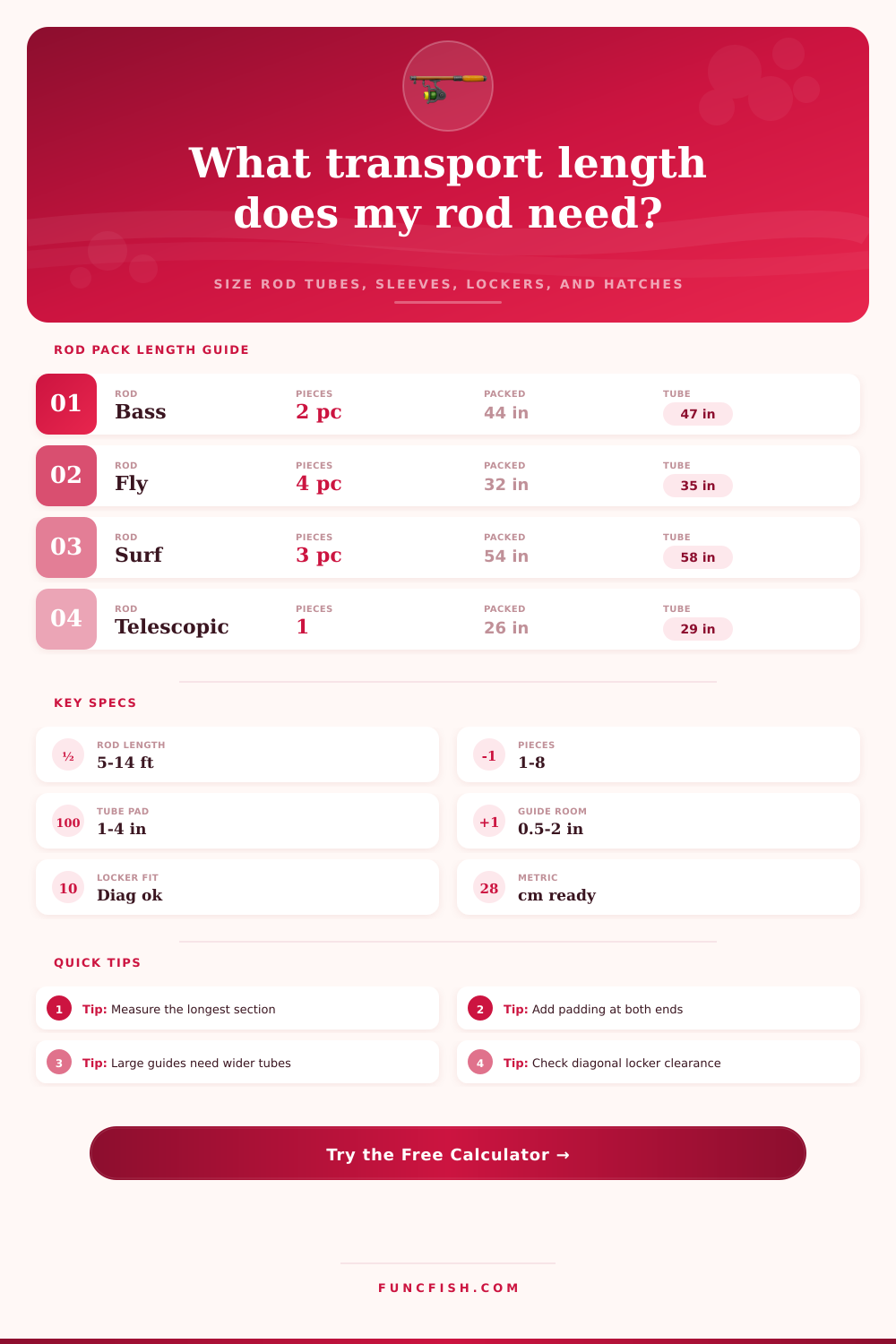
Two-piece Bass
Four-piece Fly
Surf Travel
Telescopic
📏Reference tables
| Rod style | Typical length | Pieces | Estimated transport length |
|---|---|---|---|
| One-piece bass rod | 6.5-7.5 ft | 1 | Full rod length plus guard |
| Two-piece spinning rod | 6-8 ft | 2 | About 50-53% of total length |
| Four-piece fly rod | 8-10 ft | 4 | About 26-29% of total length |
| Three-piece surf rod | 10-14 ft | 3 | About 34-37% of total length |
| Telescopic rod | 6-10 ft | 5-8 nested | About 24-32% of total length |
| Ice rod | 24-36 in | 1 | Full blank plus handle guard |
| Protection style | Length allowance | Diameter allowance | Best fit check |
|---|---|---|---|
| Rod sleeve only | 0.5-1.0 in | Guide height only | Straight length |
| Soft case | 1.0-2.0 in | Guides plus fabric | Diagonal if flexible |
| Rigid tube | 2.0-3.5 in | Guides plus shell | Tube outside length |
| Padded hard tube | 3.0-5.0 in | Guides plus foam | Cap-to-cap length |
| Multi-rod tube | 3.0-5.5 in | Rod count stack | Diameter and length |
| Tip guard bundle | 1.0-2.5 in | Tip guard width | Tip clearance |
| Storage space | Primary limit | Useful measurement | Calculator note |
|---|---|---|---|
| Car trunk | Opening length | Diagonal cargo span | Needs turn-in margin |
| Boat locker | Inside straight run | Lid opening width | Rigid tubes need more room |
| Kayak hatch | Hatch mouth | Hull interior diagonal | Short tubes fit best |
| Backpack | Pack side height | External lash length | Soft cases tolerate angle |
| Travel tube | Tube cap length | Guide diameter stack | Use packed section length |
💡Practical checks
Tip: Measure the longest rod section after the pieces are separated. Ferrules, tip tops, and offset handles often make one section longer than simple length divided by pieces.
Tip: For rigid tubes, compare outside cap-to-cap length with the storage diagonal, then subtract a turn-in margin so the tube can actually be loaded.
When you transport fishing rod from a house to the water, you must consider the pack length of the fishing rods. The packed length of fishing rods is the measurement of the fishing rods once they is disassembled. This measurement is important because if the fishing rods is too long for the trunk of the car or the locker in which you plan to store the rods, the trunk or locker lid will not close or shut.
Thus, the packed length of the fishing rods is a critical measurement for fishers so that they can ensure that the fishing rods will fits into the vehicle or storage container. The packed length of fishing rods is not the same than the total length of the fishing rods that is printed on the blank of the fishing rod. The packed length of the fishing rod is determined by measuring the longest single section of the fishing rod once it is disassemble.
How to Measure the Packed Length of a Fishing Rod
In addition to the length of the fishing rod, the packed length also includes the length of the ferrule that project past the blank of the fishing rod. Additionally, offset handle and oversized tip-tops can add to the packed length of the fishing rod. The fishing rod case length calculator requires you to input the total length of the fishing rod, the number of piece of which are to be stored in the case, and the size of the largest guide on the fishing rod.
Such information will change the packed length of the fishing rod by several inch. Furthermore, the protection that you use for your rods will also impact the packed length and diameter of the fishing rods. If you use a thin sleeve to store your fishing rods, it will add very little to the length of the fishing rods.
However, if you use a padded hard tube, it will add both length and diameter to the fishing rods. If you store multiple rods in a single travel tube, the diameter of the travel tube must be large enough so that the guides on one of the fishing rods do not crush the guides on the other fishing rod. The fishing rod case length calculator will ask for the number of fishing rods that will be stored in the case to determine the minimum diameter of the case.
Additionally, the tool will require the measurement of the storage space to compare the length of the fishing rods to both the straight length and the diagonal length of the storage space. The diagonal length is important because the travel tube can be angled in relation to the storage space to allow for the fishing rods to fit into the storage compartment. Environmental factor may also impact whether the fishing rods will fit into the storage space.
The fishing rod may fit into the locker in the fishing store when it is dry, but the locker lid may swell due to the humidity in the air and the fishing rod may no longer fit into the locker. The travel tubes may change in size if the cap of the travel tube is dented, as it might happen when travelling on an airplane. Furthermore, if the fishing rods have telescopic portion, there is a chance that sand or grit entered the joints of those rods while travelling.
Such grit may prevent the rods from collapsing to their pack length. You can refer to the reference tables on the page to which this paragraph was posted. These tables include the typical pack ratios for fishing rods of different style, and they show how much extra length the different types of protective gear for fishing rods will add to the length of the fishing rods.
While these tables can be helpful, they should not be the only information that you use when calculating the packed length of your fishing rods. A fishing rod may include an extra-long fighting butt or a stripping guide that may be tall above the guides that is accounted for in the reference tables. When calculating the packed length of the fishing rods, people often make mistake.
One of the most common mistake is using the length of the fishing rod while it is still assembled. Another common mistake is not accounting for the length of the end cap of the travel tubes. One could also make the mistake of not considering the true dimension of the storage space for the fishing rods.
Many storage space, including the trunks of cars, lockers, and kayaks, are not made in the shape of perfect rectangle. Thus, it is a good idea to take five minutes to measure the storage space in which you intend to store the fishing rods to ensure that the travel tube will fit into that space. Ensuring that the length of the fishing rods when packed, the dimension of the case into which the rods will be stored, and the length of the storage space along the diagonal all match will ensure that the fishing rods will arrive at their destination without issue.
Any discrepancy between these three measurement will be discoverable well before you leave the house with the fishing rods. By taking the time to make these measurement in advance, you can ensure that your fishing rods remain intact and that you are on schedule for your fishing trip.