Fly Backing Capacity Calculator
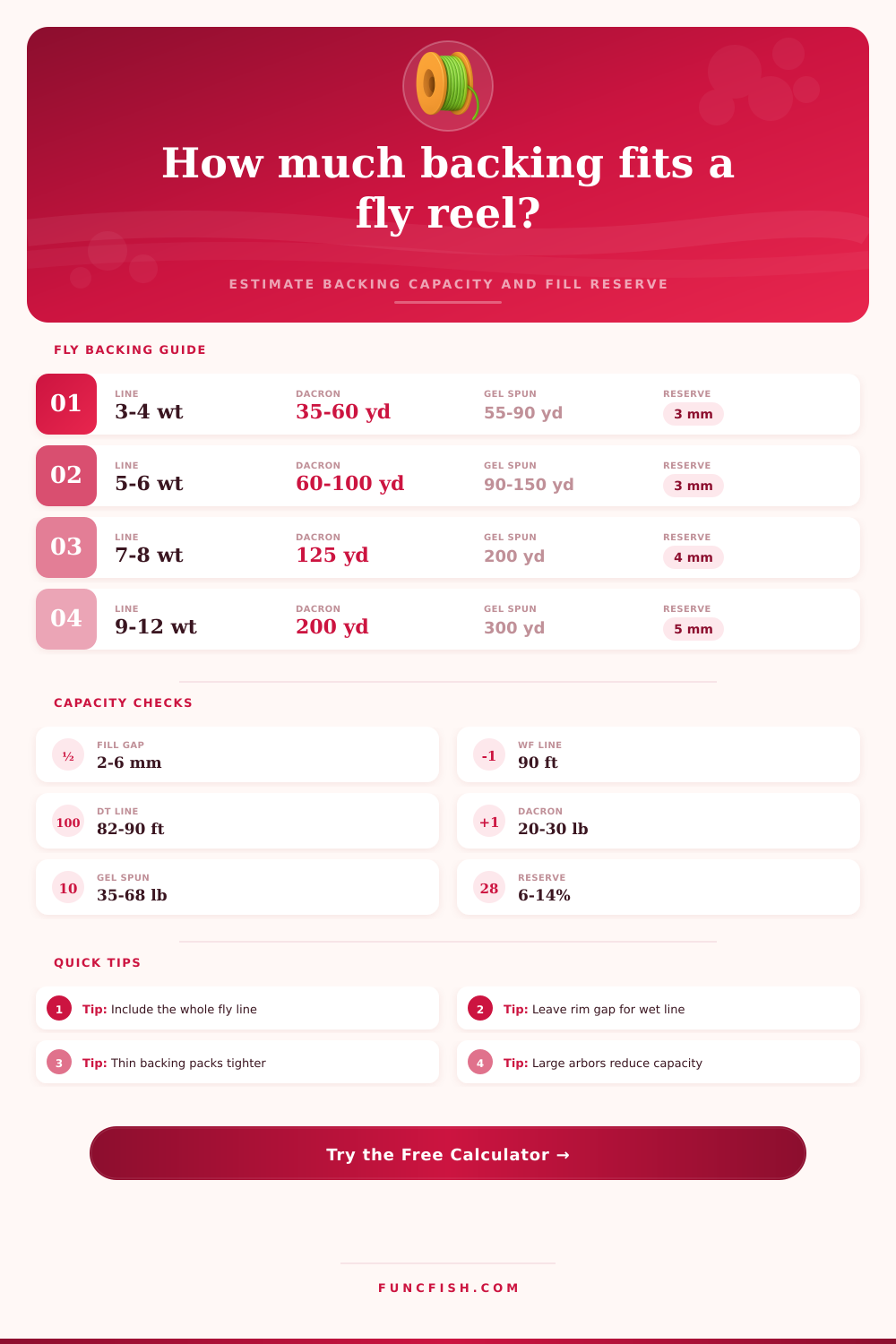
Estimate how much backing fits behind a fly line by modeling reel spool volume, arbor size, rim clearance, fly line volume, backing diameter, packing tension, and target species reserve.
📌Fly backing presets
⚙Reel, line, and backing settings
Measure the inside usable rim diameter, not the outside reel frame.
Large arbors retrieve faster but remove backing volume.
Leave more gap for limp tropical lines, loose wraps, and wet running line.
Use a larger average for double tapers, sink tips, and heavy saltwater lines.
Optional cross-check: use the reel maker rating for the same line weight when available.
Fly backing capacity results
Calculation breakdown
🧵Backing material data grid
20 lb Dacron
30 lb Dacron
50 lb Gel-Spun
Hollow Braid
📊Fly line volume reference table
| Fly line profile | Typical length | Volume driver | Capacity effect |
|---|---|---|---|
| Weight-forward floating | 90 ft / 27 m | Moderate head plus thin running line | Best baseline for reel labels |
| Double-taper floating | 82-90 ft / 25-27 m | Long full-diameter belly | Removes 10-25% more backing |
| Sink-tip streamer | 90 ft / 27 m | Dense front section and thicker coating | Needs extra rim gap |
| Full-sink lake line | 90 ft / 27 m | Dense coated running section | Often trims 10-20 yd backing |
| Spey head system | 100-130 ft / 30-40 m | Head plus shooting line coils | Wide spool and gap matter |
| Big-game tropical line | 100-120 ft / 30-37 m | Large head, stiff coating, loops | Use saltwater reserve setting |
🎣Species and backing reserve table
| Species or use | Line weight | Backing target | Why the reserve changes |
|---|---|---|---|
| Brook trout creeks | 2-4 wt | 25-60 yd / 23-55 m | Backing is mostly arbor fill and emergency reserve |
| Trout rivers | 4-6 wt | 50-100 yd / 46-91 m | Standard trout reels rarely need more |
| Bass and carp | 6-8 wt | 75-125 yd / 69-114 m | Warmwater fish use short hard runs and heavier line |
| Steelhead | 7-8 wt | 125-175 yd / 114-160 m | Current and long downstream runs demand reserve |
| Bonefish flats | 7-9 wt | 150-220 yd / 137-201 m | Thin backing helps keep flats reels compact |
| Tarpon and permit | 10-12 wt | 250-350 yd / 229-320 m | Long saltwater runs and boat handling delays |
| Bluewater fly | 12-16 wt | 350-600 yd / 320-549 m | Deep capacity and high strength become mandatory |
🔀Backing comparison grid
📏Spool measurement and fill table
| Measurement | Where to measure | Common mistake | Capacity impact |
|---|---|---|---|
| Rim diameter | Inside usable spool edge | Using outside reel frame | Overstates capacity |
| Arbor diameter | Bare center before backing | Measuring after old backing | Understates available volume |
| Spool width | Line lay width between flanges | Using total frame width | Overstates backing yards |
| Rim gap | Final line below spool lip | Filling flush when dry | Causes rub when wet |
| Line diameter | Average coated fly line size | Using only the running line | Leaves too much backing |
| Backing diameter | Under firm tension | Trusting pound test only | Changes capacity sharply |
💡Backing capacity tips
Model the fly line as volume, not length only. A double taper or dense sink-tip can consume much more spool room than a standard weight-forward floating line of the same length.
Leave a visible rim gap after a firm wind. Wet fly line, loop junctions, and imperfect level winding can swell the loaded pack enough to rub the frame on the water.
Every angler dreads this sound: their dry line suddenly snapping tight. More often than not, it’s not due to a weak knot or broken rod… It’s because they’ve run out of line on the spool right as the fish decides to take one last run.
That’s what backing is for, to bridge the vital space between the naked arbor and the thick bulk of fly line. It gives you room when a tarpon blows up off the deck or when a trout makes a hard downstream surge. Until you learn otherwise, though, it just seems like something you get right by feel, as if there’s some sort of magic number called “reel capacity” that tells you exactly how long your backing should be.
How to Use the Backing Calculator
Enter our backing calculator, which does all the work after you input dimensions of your spool, you’ll never have to guess at how many feet of fly line your backing eats up before the stuff begins to lay down again.
Backing is typically thought of as one single thing. It’s not. Regular, fluffy, flakey Dacron braids is thick stuff. They takes a lot of space on your spool and fill in loosely. Dense, super-thin gel-spun spectra fibers act like a brick. They pack tightly. For example, if you go from 20-pound Dacron backing to 50-pound spectra gel-spun but don’t compensate for their different diameters, you may be able to load twice the amount of line onto the reel. The chart on the page breaks that down nicely: material matters far more than pound test does when it comes to capacity. Two-hundred yards of backing or a hundred has pretty much the same strength. It take up a very different amount of space.
The biggest misconception lies with measuring the spool. Most anglers estimate or measure from the outside of the reel frame, which is either the whole reel or the arbor. That is what they does wrong. What you need are accurate measures of the inside diameter of the usable rim plus the exact width of the flanges. A millimeter one way or another doesn’t seem like that big a deal. But small errors in linear measurement turn into huge miscalculations in terms of total capacity. To make it work, you can enter those precise measurements and then it will model out the actual available space.
First it takes away the volume of the particular fly line you’re using. For example, a double-taper line take up more space than an equivalent-length weight-forward floating line, which means there is less room for backing. And then there’s the arbor. For years big arbor reels was all the rage because of their quick pickup, low coil memory and lack of tendency toward backlashes. But there’s a cost. They eliminate spool volume completely by having a large center hub. So even if it has a broad face it has less overall space to play with. The calculation takes this geometry into account and lets you know exactly what will fit in that larger central hub, including rim clearance. Because you don’t want any gap between the rim of the reel and your top loop of line. Wet line swells and loops takes up extra space. A reel packed with dry line seldom works well when it gets wet on the water.
Habit isn’t all that matters when determining your reserve target. Small stream trout don’t often run long or hard. However, a tarpon won’t hesitate to burn off two hundred yards, and they do so while adding delay time for boat handling. Bonefish will follow suit and drain line quickly as they run their hearts out. For steelhead and saltwater species in particular, you want that reserve. The calculator allows you to select a species profile and adjusts the reserve target to account for this with the Reserve Percentage, which is essentially how much extra line you have as a safety net. This lets you know whether you’re cutting it close or have enough cushion to last through a twenty minute fight.
What do you get for all this? You get an arbor pickup gain and a reserve score that tells you if you are set up right or not. If you have a large pickup gain then when the reel is loaded, it will pull back off fast. If you have a good reserve score, you know that when the fish stops, you’ll be able to come tight before you reach dry line.
When the adrenaline starts flowing, you don’t need to worry about this. You should of worried about walking away with a fish and not an excuse. Modeling exactly what you’re using lets you take the guessing out of one of the most important parts of your fly fishing rig. Keep the fish on the line, that’s it. It is luxurios to have the right gear.