Fly Leader Butt Section Length Calculator
Size the butt section length, diameter match, and first taper split for a fly leader that turns over cleanly with your rod, fly, wind, and material.
📌Scenario presets
⚙Leader settings
Butt section recommendation
Full calculation breakdown
📋Butt material reference grid
Stiff nylon mono
Standard nylon mono
Supple nylon mono
Fluorocarbon
Hard mono saltwater
Brown copolymer
Furled mono butt
Braided butt loop
📏Leader ratio reference tables
| Fly setup | Common leader length | Butt section range | Typical start diameter | Use note |
|---|---|---|---|---|
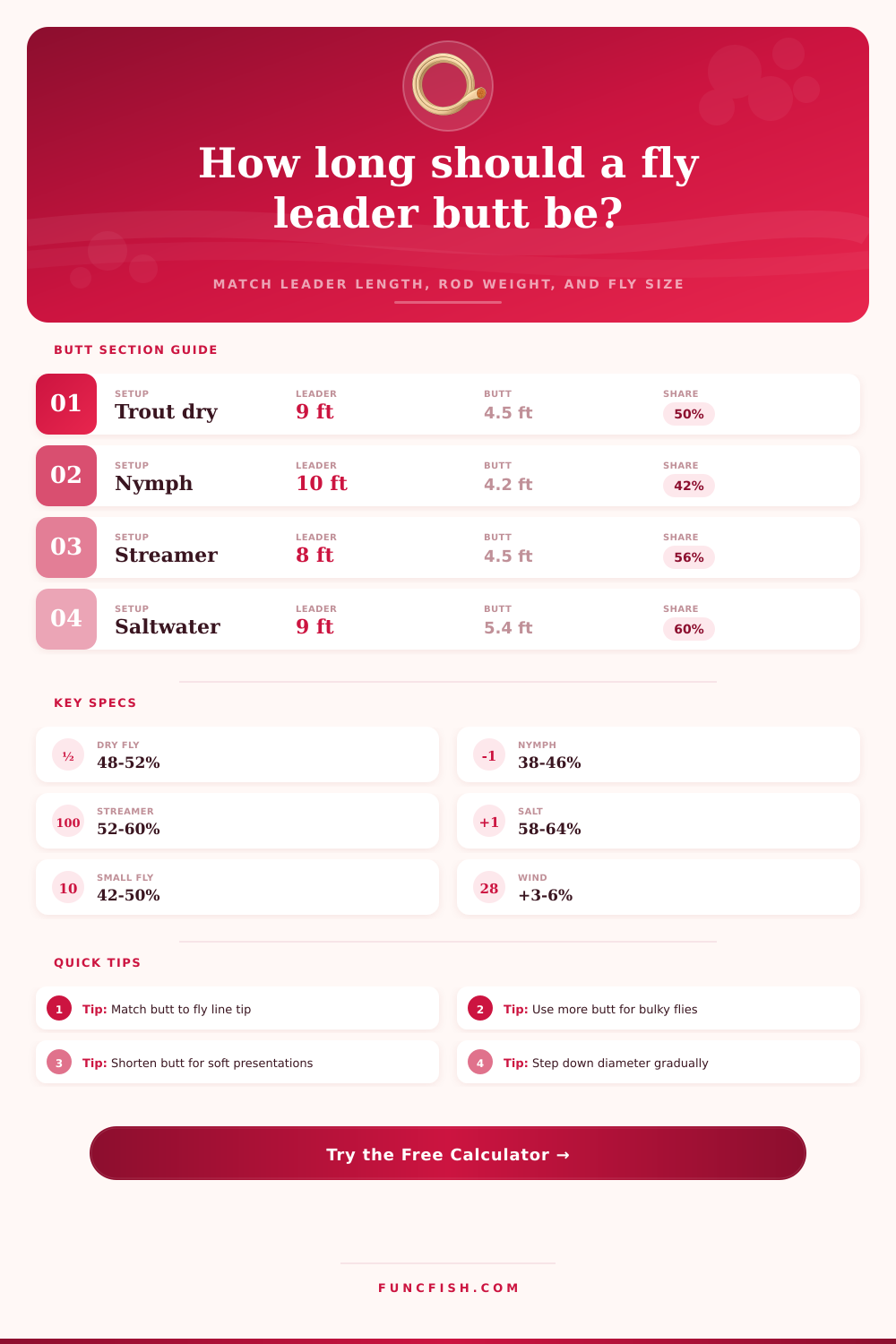
| Technical dry fly | 10-14 ft / 3.0-4.3 m | 44-50% | 0.018-0.021 in / 0.46-0.53 mm | Longer front taper, softer landing |
| General trout dry | 9-12 ft / 2.7-3.7 m | 48-52% | 0.020-0.024 in / 0.51-0.61 mm | Balanced turnover |
| Indicator nymph | 9-11 ft / 2.7-3.4 m | 40-46% | 0.021-0.025 in / 0.53-0.64 mm | Leaves room for level tippet |
| Euro nymph | 14-20 ft / 4.3-6.1 m | 28-38% | 0.014-0.018 in / 0.36-0.46 mm | Thin butt protects sag control |
| Streamer | 6-9 ft / 1.8-2.7 m | 52-60% | 0.024-0.032 in / 0.61-0.81 mm | Fast energy transfer to heavy flies |
| Bass bug | 7-9 ft / 2.1-2.7 m | 55-62% | 0.028-0.035 in / 0.71-0.89 mm | Turns over poppers and deer hair |
| Saltwater flats | 9-12 ft / 2.7-3.7 m | 58-64% | 0.030-0.040 in / 0.76-1.02 mm | Handles wind and quick shots |
| Pike / musky | 6-8 ft / 1.8-2.4 m | 60-68% | 0.035-0.045 in / 0.89-1.14 mm | Supports wire bite tippet |
| Rod weight | Estimated fly line tip | Butt diameter target | Common butt material | Best leader job |
|---|---|---|---|---|
| 2-3 wt | 0.025-0.030 in / 0.64-0.76 mm | 0.016-0.020 in / 0.41-0.51 mm | Supple nylon or copolymer | Short dry fly leaders |
| 4 wt | 0.030-0.033 in / 0.76-0.84 mm | 0.019-0.022 in / 0.48-0.56 mm | Standard mono | Technical trout leaders |
| 5 wt | 0.033-0.036 in / 0.84-0.91 mm | 0.021-0.024 in / 0.53-0.61 mm | Stiff or standard mono | All-around trout |
| 6 wt | 0.036-0.039 in / 0.91-0.99 mm | 0.024-0.027 in / 0.61-0.69 mm | Fluoro or nylon | Nymphs and light streamers |
| 7-8 wt | 0.040-0.046 in / 1.02-1.17 mm | 0.028-0.034 in / 0.71-0.86 mm | Hard mono or stiff nylon | Bass, carp, light salt |
| 9-10 wt | 0.047-0.052 in / 1.19-1.32 mm | 0.033-0.040 in / 0.84-1.02 mm | Hard mono | Saltwater and pike |
| 11-12 wt | 0.053-0.060 in / 1.35-1.52 mm | 0.038-0.046 in / 0.97-1.17 mm | Hard mono or braided | Big flies in wind |
| Adjustment | Ratio shift | Diameter shift | When to apply | Result on cast |
|---|---|---|---|---|
| Tiny dry fly | -3% | -6% | Sizes 20-26 and calm water | Less slap, softer turnover |
| Bulky fly | +4% | +8% | Foam, deer hair, poppers | More positive turnover |
| Weighted streamer | +6% | +10% | Coneheads and heavy wet flies | Loads the turnover faster |
| Calm presentation | -2% | -3% | Flat water and picky trout | Longer front taper feel |
| Windy conditions | +3% | +5% | Open banks, flats, boats | Cleaner loop turnover |
| Aggressive goal | +4% | +6% | Quick shots and big flies | Less collapse near the fly |
💡Practical calculation checks
Tip: A leader butt that starts near 60-75 percent of the fly line tip diameter usually transfers energy smoothly without a hinge at the loop connection.
Tip: If the leader kicks over too hard, reduce butt length or diameter first. If it collapses, increase butt share before shortening the total leader.
Finally, the fly drops into the water with a loud slap. Trout is holding tight in deep runs and the splash flushes them out. After reeling up and examining the leader, you ask yourself how in the world is such an aggressive presentation possible while your technique seem soft.
More times than not, it’s not your casting stroke. Your issue stems from butt section of your leader. This is the thick, rigid segment connecting your fly line straight to your fly line. Its length controls way energy travels through your rod tip to the fine tippet where the fly resides. Mess up here and you’re slapping a pebble weighted to the end of a heavy rod in the water.
How to Choose the Right Leader Butt Section
The butt section should of be thought of as middle ground; bridging the gap between finesse and brute force. Too short and all shock wave of your cast goes straight into those thin section. Before the fly has even cleared the loop, your leader whips around or collapses uncontrollably. What the fish see is a random disturbance floating past its face, not an insect slow descending on the current.
Too long and you lack the power of turnover. Because there’s so much mass to dissipate the energy, bulkier fly won’t turn over in-flight. You get a leader that folds over itself while in flight, dumping the fly onto water far earlier than desired. It becomes a balancing act of flexibility and momentum, one most anglers guess at without calculation.
Once you input your own set of circumstances into the calculator (above), it do all the work at a key moment. The first step is determining your overall leader length and rod weight. This establishes your maximum load capacity. Casting a nine-foot leader with a five-weight will be different proportion than launching a six-foot leader with an eight-weight when stripping bass.
Next, decide upon wind conditions and fly type. Both affect the aerodynamic drag on the leader’s front end. Calm conditions and a tiny dry fly call for less butt section length so you do not blow past target. A windy day or chunky streamer demands more butt to push that cast downrange.
Another consideration folks may neglect is material selection. While stiff nylon mono behaves different than supple fluorocarbon even at the same diameter, it matter for how energy is transmitted across the whole line. The tool accounts for those differences in stiffness and recommends appropriate starting diameter and length. For instance, a stiffer butt will transmit energy better, but can makes a hard knot unless properly tapered. Conversely, softer lines need a bit longer section to generate equivalent turnover because they absorbs some of the initial impulse and flex more during the cast.
This is all spelled out clearly in the reference tables on the page. You will see that saltwater applications demand much longer and thicker butt sections different than technical dry fly fishing for trout.
Now here’s where the rubber meets the road when you examine the numbers, what part of the total does each piece represent? In the case of a typical trout rod, start in middle, somewhere around fifty percent of overall leader length. Half will be the stiffer, thicker part used for backing, and the other half will be the softening taper down into the tippet. If you’re nymphing with an indicator, reduce this a bit (maybe to forty percent) so there’s more space for the straight line tippet section where you’ll detect strikes.
The takeaway here is that those percentages aren’t set in stone; they’re places to start but can change by a few percentage points within seconds based off wind conditions. When an angler gets used to making a good cast and then gets hung up he will typically adjust his grip, change his timing or both; however, most of the time it’s the gear at fault. A leader that slaps water requires either a smaller start diameter or a shorter butt section to absorb the blow. The one that collapses in the air require more bulk near the line connection to help keep the loop stable.
You can add an inch here or a segment there and trim off another inch on the fly and make the adjustment work, but you need a calculated baseline so the adjustments is not random but rather done intentionaly. It takes the guess out of leader building and makes it a precise skill.
To conclude, All in all, building a tailor made leader is all about using energy. Your butt section take your cast’s power and starts the slowing process prior to meeting your tippet. If you match this portion to your line, rod and environmental factors, then each ounce of effort becomes a seamless presentation that goes completely unnoticed by the trout. Since your leader comes and goes in a flash, it delivers your fly with only the necessary energy needed for the given scenario.