🎣 Fly Line Grain Weight Calculator
Match your fly line grain weight to rod weight, line taper, and casting style for optimal presentation
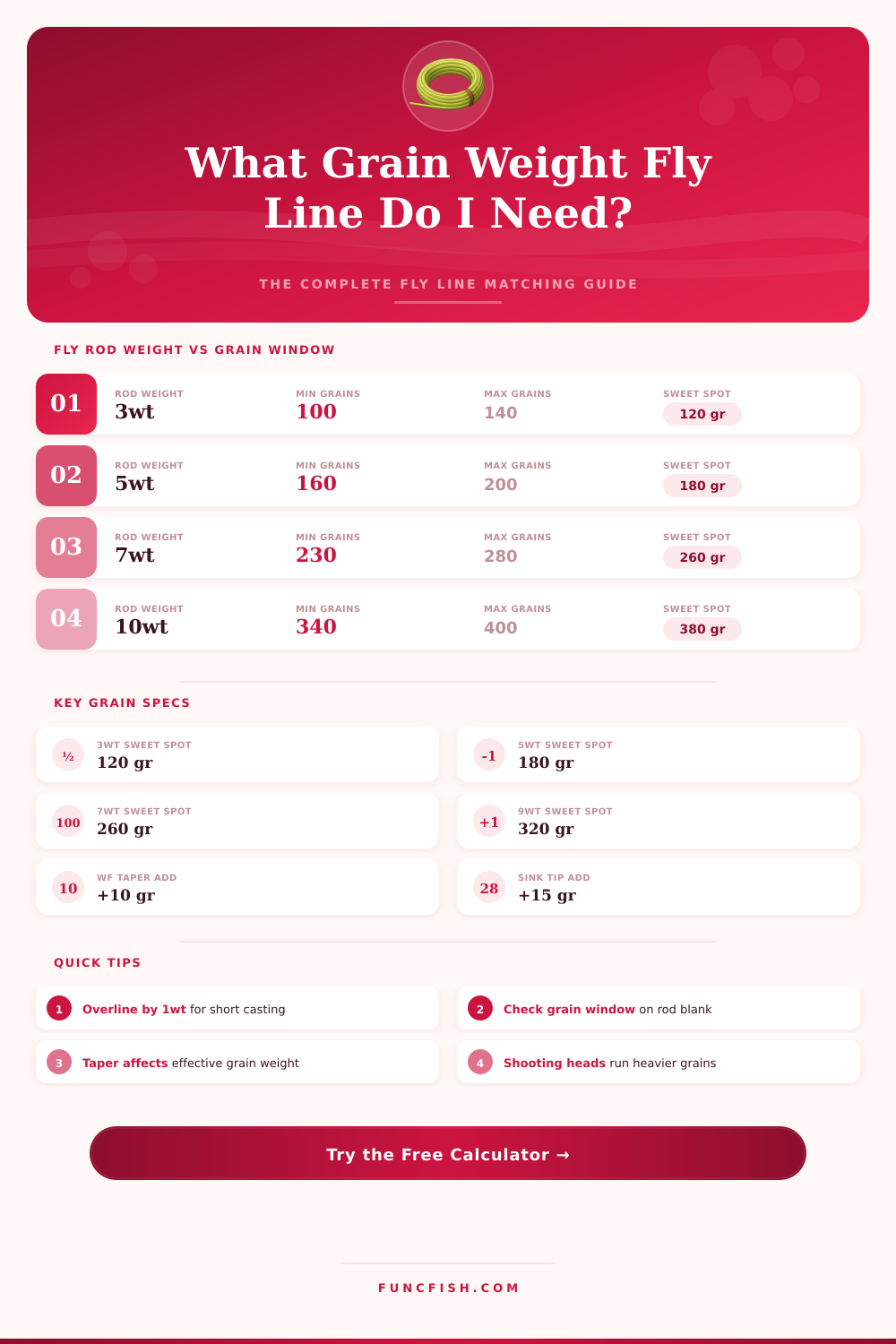
| Rod Weight | AFTMA Grains | Tolerance (±) | Min Grains | Max Grains | Metric (g) |
|---|---|---|---|---|---|
| 1-weight | 60 gr | ±6 gr | 54 gr | 66 gr | 3.89 g |
| 2-weight | 80 gr | ±6 gr | 74 gr | 86 gr | 5.18 g |
| 3-weight | 100 gr | ±6 gr | 94 gr | 106 gr | 6.48 g |
| 4-weight | 120 gr | ±6 gr | 114 gr | 126 gr | 7.78 g |
| 5-weight | 140 gr | ±6 gr | 134 gr | 146 gr | 9.07 g |
| 6-weight | 160 gr | ±8 gr | 152 gr | 168 gr | 10.37 g |
| 7-weight | 185 gr | ±8 gr | 177 gr | 193 gr | 11.99 g |
| 8-weight | 210 gr | ±8 gr | 202 gr | 218 gr | 13.61 g |
| 9-weight | 240 gr | ±10 gr | 230 gr | 250 gr | 15.55 g |
| 10-weight | 280 gr | ±10 gr | 270 gr | 290 gr | 18.14 g |
| 11-weight | 330 gr | ±12 gr | 318 gr | 342 gr | 21.38 g |
| 12-weight | 380 gr | ±12 gr | 368 gr | 392 gr | 24.62 g |
| Species | Weight Range | Rod Weight | Line Type |
|---|---|---|---|
| Bluegill / Panfish | 0.25–1 lb | 2–4wt | WF Floating |
| Trout (stream) | 0.5–3 lb | 4–5wt | WF Floating |
| Trout (large) | 3–8 lb | 5–7wt | WF / Sink Tip |
| Smallmouth Bass | 1–5 lb | 6–7wt | Bass Taper |
| Largemouth Bass | 2–8 lb | 7–9wt | Bass Taper |
| Pike / Muskie | 5–30 lb | 8–10wt | WF Floating |
| Bonefish | 2–10 lb | 7–9wt | WF Floating |
| Permit | 5–30 lb | 9–10wt | WF Floating |
| Steelhead | 5–20 lb | 7–9wt | Spey / Shooting |
| Tarpon | 20–150 lb | 10–12wt | WF Floating |
| Line Type | Head Length | Grain Adj. | Best Use |
|---|---|---|---|
| WF Floating | 28–36 ft | +0 gr | General / Dry fly |
| Double Taper | Full length | –5 gr | Delicate presentations |
| WF Sinking | 28–36 ft | +15 gr | Deep rivers / lakes |
| Sink Tip | 28–30 ft | +8 gr | Streamer fishing |
| Shooting Head | 24–35 ft | +20 gr | Distance casting |
| Spey | 50–80 ft | +60 gr | Big rivers |
| Euro Nymph | N/A | –30 gr | Technical nymphing |
| Bass Taper | 28–32 ft | +10 gr | Bulky flies / bugs |
Fly line grain weight is an measurement of the mass that is contained within the first 30 feet of a fly line. The grain weight of a fly line will determine in what way that the rod will loaded when using the fly rod to cast the line and the fly. If the grain weight of the fly line is incorrect for the rod that you’re using, the rod wont bend proper, and it will not effectively deliver the fly to the indicated target.
The American Fly Fishing Trade Association, or AFFTA, provides standard as to the grain weight of the fly line that should be used with different type of fishing rods. For example, 5-weight rods are often associated with 140 grain of mass within the first 30 feet of the fly line. Despite these standards, however, there are numerous factor that may cause an individual to deviate from these baseline weight.
How to Choose the Right Fly Line Weight
For instance, if the individual is using a heavy weight of fly, if the individual is fishing in high wind, or if the individual is using a very long leader, each of these factor will have an impact upon the grain weight of the fly line that should be used. The action of the fly rod will impact the grain weight of the line that should be used with that rod. For instance, slow action rods will require a lighter grain weight of fly line than fast action rod.
This is due to the fact that slow action rods will bend deeply into the butt section of the rod, while fast action rods require more mass to bend the rods at its tip. The taper of the fly line will also impact the weight of the line that should be used with the rod. For instance, people use double taper lines for fly lines with lighter masses, such as those used to fish for trout.
Streamer line and bass bug lines, however, will have extra mass in the front of the line to help the line cut through the air. The mass of the fly will also impact the required grain weight of the fly line. For instance, if the fly that is being used has a small mass, such as a dry fly, then the grain weight of the line will be lighter, and the length of the leader will be more long.
If the mass of the fly is much heavier, though, such as deer hair poppers or streamers, then the line will have a heavier grain weight to provide the energy necesary to move such a heavy fly. The length of the leader can also impact the grain weight of the line that is used. Leaders that are very long will allow for a smoother taper on the fly line, but leaders that are short requires more power to effectively cast the line.
Thus, a heavier grain weight should of been used for short leaders. Winds can also alter the grain weight of the line. If the line is exposed to wind, it will create resistance against the movement of the line through the air.
Additionally, the wind will make it more difficult for the line to travel through the air. Thus, if the line is cast in heavy wind, a heavier weight of line should be used for stability. Using a lighter grain weight of line in these situations will create large loop in the line, and the line will not effectively cast the line.
Many may make the mistake of only using the labels that is printed on the fly rod to determine the type of line to use. For instance, an 8 weight rod may be labeled on the rod, but if heavy flies are to be cast into the wind, an 8 weight line may be too light. Thus, in these situations, a heavier weight of line may be required than the standard 8 weight line.
Additionally, it is another mistake to use a line with a grain weight that is too heavy for the action of the rod. Such use will result in the rod feeling sluggishly when used, and the rod will be more difficult to control when the flies are being cast. In order to determine the correct grain weight of the line, it may be helpful for anglers to test different weight of lines within the acceptable weight of the rod.
Testing a shorter head of line than standard, for instance, can help to cast the line quick, but it will require more precision in the haul of the line. A longer head of line will glide more easy through the air, but will require more space when being cast. Thus, a test of each of these different types of lines may provide anglors with a better understanding of the best grain weight for the rod and flies that is being used.