Fly Tying Lead Wrap Turns Calculator
Estimate how many lead, lead-free, copper, brass, or tungsten wire turns fit a hook shank and how much weight those wraps add to nymphs, streamers, jigs, and balanced flies.
📍Preset wraps
⚙Wrap planning inputs
Lead wrap estimate
Set the fly details and calculate to see the recommended turn count.
Calculation breakdown
🛠Material comparison grid
Round Lead
Lead-Free Tin
Tungsten
Copper
📏Wire diameter and turn reference
| Wire size | Diameter mm | Typical hook range | Approx lead mg per turn on 1 mm shank | Best use |
|---|---|---|---|---|
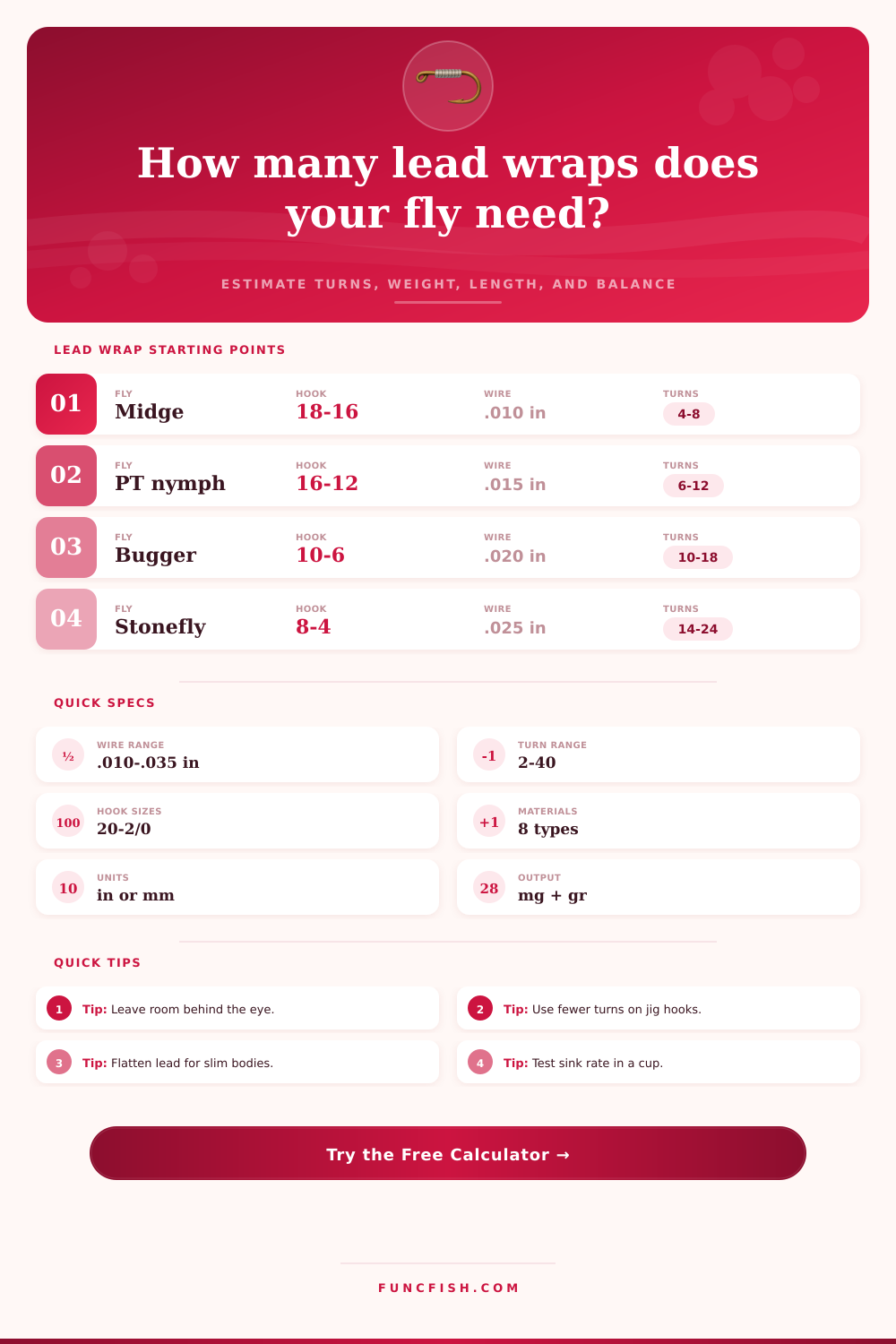
| .010 in | 0.25 mm | 20-16 | 1.8 mg | Midges, slim emergers, tiny wets |
| .015 in | 0.38 mm | 16-12 | 4.8 mg | Pheasant tails, hare's ears, scuds |
| .020 in | 0.51 mm | 12-8 | 9.6 mg | Buggers, larger nymphs, small streamers |
| .025 in | 0.64 mm | 10-4 | 16.5 mg | Stoneflies, anchor nymphs, bass bugs |
| .030 in | 0.76 mm | 8-2 | 25.1 mg | Large streamers and saltwater underbodies |
| .035 in | 0.89 mm | 6-2/0 | 35.2 mg | Big articulated flies and weighted heads |
🧶Hook shank planning table
| Hook size | Usable shank guide | Shank diameter guide | Normal wire | Wrap band |
|---|---|---|---|---|
| 20-18 | 3.0-5.0 mm | 0.25-0.35 mm | .010 in | 3-8 turns |
| 16-14 | 5.0-8.0 mm | 0.35-0.55 mm | .010-.015 in | 5-12 turns |
| 12-10 | 8.0-12.0 mm | 0.55-0.80 mm | .015-.020 in | 8-16 turns |
| 8-6 | 12.0-18.0 mm | 0.80-1.05 mm | .020-.025 in | 12-22 turns |
| 4-2 | 18.0-26.0 mm | 1.05-1.40 mm | .025-.030 in | 16-30 turns |
| 1-2/0 | 26.0-38.0 mm | 1.40-2.10 mm | .030-.035 in | 20-40 turns |
🎣Pattern starting points
| Pattern style | Common hook | Starting wire | Starting turns | Balance note |
|---|---|---|---|---|
| Zebra midge | 18-16 scud | .010 in lead or copper | 4-8 | Keep wraps short and centered |
| Pheasant tail | 16-12 nymph | .010-.015 in lead | 6-12 | Stop before the thorax bump |
| Hare's ear | 14-10 nymph | .015-.020 in lead-free | 8-14 | Dubbing hides a slightly open spiral |
| Czech nymph | 14-8 curved | .015-.025 in lead | 10-20 | Belly bias helps the fly ride correctly |
| Stonefly nymph | 10-4 2XL | .020-.030 in lead | 14-28 | Leave room for wingcase and legs |
| Woolly bugger | 10-4 streamer | .020-.030 in lead-free | 10-24 | Center wraps under chenille body |
⚖Material matching table
| Material | Density g/cc | Lead equivalent | Profile effect | Best match |
|---|---|---|---|---|
| Round lead wire | 11.34 | 1.00x | Compact and soft | Classic nymph underbody |
| Lead-free tin wire | 7.31 | 0.64x | Needs more turns | Lead-restricted water |
| Bismuth alloy wire | 9.78 | 0.86x | Close to lead | Lead-free compact ties |
| Tungsten wire | 19.25 | 1.70x | Shortest dense wrap | Euro and anchor flies |
| Copper wire | 8.96 | 0.79x | Can double as rib | Visible segmentation |
| Brass wire | 8.50 | 0.75x | Firm, slightly springy | Durable ribbed bodies |
💡Tying notes
Leave eye clearance. Reserve at least one hook-eye length near the front so thread, hackle, beads, or a whip finish do not crowd the eye.
Balance before finishing. If the calculator recommends high coverage, split the wraps into two short bands or switch to a denser material to avoid a bulky body.
Most fly tiers learn wire wrapping through trial and error. What happens? Hook eyes gets covered in tangles of metal and thread, or the body get too thick to sink. Your tying isn’t typically the issue. Rather it’s a matter of spatial reasoning, how much mass can I fit into this volume? How do I fit enough weight on a shank of fixed length without making profile too big for fish to accept?
The calculator above helps you balance those conflicting needs without guesswork. Material density This is the single variable around which everything else turn. How many turns does it take to compress a set volume into a dense enough shape to obscure the fly? For a long time lead was what everyone used. It was and still is a really dense material.
How to Wrap Wire Perfectly
It takes few wraps to make something that will be as dense as lead but won’t destroy profile of the fly. Tungsten is even denser, which can get you to the same sink rate with far less wrap. So if you’ve seen euro nymphs before they tend to be pretty skinny but heavy.
All that stuff is for the calculator when you know what materials you want to use. Just input the desired weight and it’ll calculate how many turns you need. That’s where folks mess up. They don’t think about the material density and how turns impacts the mass distribution.
Complicating matters further, there’s also hook size. As hooks get bigger, their shanks gets thicker and the usable space gets smaller at different rates from one size to the next. Hook size 14 doesn’t just have half the space of a size 8; it isn’t linear. When you put thick wire on a small shank, it takes up a bunch of space in no time at all and makes a bulbous-looking hook that blocks water flow.
That chart on the page matches the right hook range with the corresponding wire gauge so you can see how big your lead should be, and why a size 18 midge hook with.025-inch lead on it is a bad idea. Smaller hooks need thinner stuff or less wraps to achieve that delicat shape we’re looking for when mimicking tiny things.
The weight may be right but you also want to think about how it’s covered. Too much on the belly can make the fly heavier then you want and look too fake in certain spots. On the other hand, wrapping the whole belly may not look like what you are going for, even though it will give you the sink rate you want. Often times breaking up the belly wraps into two section with one closer to the eye and one farther down the shank gives a more natural profile in the water and balances out the fly better.
You can tweak your coverages so they is either full shanks (thorax only) or half shanks (covering part of the shank). This makes it easier to see where weight is being added. This helps you understand how it affects the fly’s presentation in the water column, which is key when targeting picky trout.
Anglers who use lead free options like tin and bismuth wires (more prevalent in limited water areas) has seen a revolution in what is possible at each tier. Because they’re not as heavy as lead, you’ll have to upsize the diameter or increase the number of turns to get equivalent ballast. That may not work well on small hooks when space is tight. The calculator factors in those densities so it tells you how many additional turns of tin wire compare to four turns of lead. A simple change in the input keeps your design intent aligned with the finished result instead of leaving you frustrated by a mismatch.
Your wrap style depends on how you want your fly to sit in the water. Something like a pocket-water fly should stick so that may call for more weight towards the bend (or even just in general if a heavy fly is desired). Something fished in a fast riffle may require less weight to keep it riding in the seam without digging too deep. Go after the desired sink rate and then try to hit that weight target. If you have no idea where to begin, start with a middle ground and go up or down from there based off how it sits in the water/test cup.
Then there are the subtleties of thread build and body materials. A light bodied fly will keep more wraps tight against the shank. It has a slightly smaller diameter than a resin coated or heavily dubbed body, which pushes the wire out a bit with every turn. The tool compensates for this variable too so your last guess includes all components of the build, not just the naked wire. It takes a complete view of tying a fly that honors the physics of how the thing comes together.
In summary, achieving accurate fly tying boils down to the balance between hook geometry, volume, and weight. While you’re not an engineer, you can achieve accuracy by thinking deeper than what your eyes see when wrapping. You want a natural looking fly. It should have the correct sink rate for that hook style and be balanced. Establish a base line using the calculator and adjust as you gain experience. Slim out the profile, leave some space between the eye, and listen to the numbers. If you honor the material limitations in your hands, a correctly weighted fly would of made the difference between an empty net and a full one.