Fly Tying Tail Length Ratio Calculator
Estimate fly tail length from hook shank, body length, gap clearance, pattern style, tail material stiffness, current speed, and fouling tolerance.
📌 Tail ratio presets
⚙ Hook, body, and tail inputs
Tail length result
Calculation breakdown
📊 Current material readout
Dry fly proportions often match the hook shank.
Stiffer materials support longer tails with lower fouling.
Streamer tails above 4x gap need anti-foul margin.
Includes tie-in length under the body.
🧮 Pattern comparison grid
Match shank length for mayfly balance; split stiff fibers help support the hook bend.
Shorter tails imitate wing cases, shucks, or nymphal tails without crowding the bend.
Longer movement is useful, but soft material needs gap and strand-count checks.
Tail length should clear the popper face while staying short enough to avoid short strikes.
📘 Reference tables
| Hook size | Typical shank | Typical gap | Common use |
|---|---|---|---|
| #20 | 6.0 mm / 0.236 in | 2.2 mm / 0.087 in | Midges, tiny dries, micro nymphs |
| #16 | 8.5 mm / 0.335 in | 3.2 mm / 0.126 in | Small dries, pheasant tails, soft hackles |
| #14 | 11.0 mm / 0.433 in | 4.6 mm / 0.181 in | Standard mayflies, caddis, nymphs |
| #10 | 18.0 mm / 0.709 in | 7.5 mm / 0.295 in | Large wets, buggers, small streamers |
| #6 | 30.0 mm / 1.181 in | 12.0 mm / 0.472 in | Streamers, bass flies, saltwater flats |
| 2/0 | 55.0 mm / 2.165 in | 24.0 mm / 0.945 in | Pike, musky, large salt baitfish |
| Pattern style | Base tail ratio | Best materials | Proportion note |
|---|---|---|---|
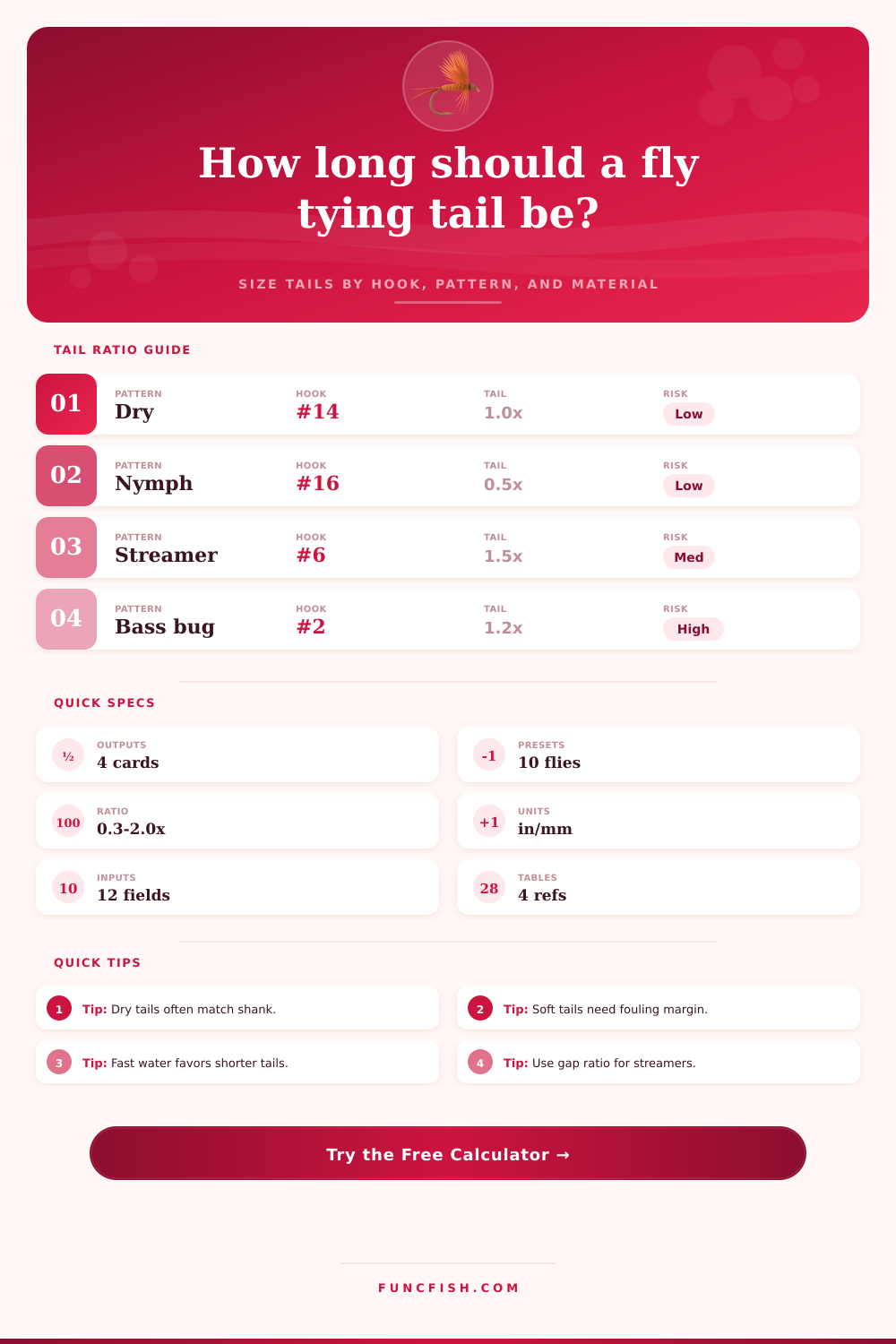
| Dry fly | 0.95-1.10x shank | Hackle fiber, microfibbets | Tail supports posture and should not overpower hackle. |
| Nymph | 0.35-0.65x shank | Pheasant tail, goose biots | Short tails keep the abdomen compact and natural. |
| Emerger | 0.45-0.85x shank | Antron, z-lon, sparse fibers | Trailing shucks are usually slim and slightly irregular. |
| Bugger | 1.10-1.45x shank | Marabou, rabbit, flash | Movement matters, but tail wrapping can ruin the swim. |
| Hairwing | 0.90-1.25x shank | Bucktail, calf tail, squirrel | Hair length forms the wing and tail silhouette together. |
| Pike streamer | 1.40-2.00x shank | Synthetic fiber, bucktail | Use stiffness and layering to protect the hook gap. |
| Tail material | Stiffness factor | Fouling factor | Use note |
|---|---|---|---|
| Hackle fibers | 0.90 | 0.55 | Excellent dry-fly support; trim by tips, not butts. |
| Microfibbets | 0.95 | 0.50 | Very consistent split tails on technical dry flies. |
| Pheasant tail | 0.62 | 0.70 | Natural taper for nymphs; avoid over-long bundles. |
| Marabou | 0.25 | 1.35 | High motion and high wrap risk when tied too sparse. |
| Rabbit strip | 0.35 | 1.55 | Strong movement; length should respect hook gap. |
| Bucktail | 0.78 | 0.78 | Good anti-foul stiffness for baitfish and salt flies. |
| Water / target | Length modifier | Action modifier | Design note |
|---|---|---|---|
| Spring creek trout | 0.92 | 0.88 | Sparse and exact proportions matter more than motion. |
| Freestone riffle | 0.98 | 1.00 | Moderate current supports normal dry and nymph ratios. |
| Stillwater trout | 1.08 | 1.10 | Longer soft tails can pulse during slow retrieves. |
| Warmwater bass | 1.12 | 1.15 | Bulk and action help, but tail strikes need a shorter check. |
| Saltwater flat | 1.05 | 0.95 | Stiff synthetic or bucktail protects the gap in wind casts. |
| Pike weed edge | 1.20 | 1.18 | Layer long material over stiffer support fibers. |
💡 Tying calculation tips
We all have had one slip through our fingers from a snarled hook. That is the moment where you set into the fish, go tight, and know something isn’t right. The hook bend buried in your own materials wraps around itself as the tail pulls up against the gap. You were able to tie a gorgeous looking fly on the vise that was just the right size for the pattern, but now it’s a mess.
There isn’t a magic number for the correct tail length, it isn’t tied to a recipe down to a millimeter. You are learning how that material will act in the water when current hits it. After you’ve selected your materials and hook sizes, enter them into the calculator above and it will do the math for you. No more guessing about converting units, coefficients and such. But what’s the purpose of entering any of that data? That’s where learning realy comes into play.
How to Choose the Right Fly Tail Length
Begin with the shank of the hook; it’s literally the backbone of the whole fly. When tying a dry fly on a size fourteen hook, the natural impulse would of been to make tail equal to shank length. That way, it has a symmetrical shape like a mayfly and doesn’t appear more long and awkward. There’s a reason that ratio is the default for the tool. It helps keep the fly balanced around its center of gravity and enables the hackle fibers to help hold up the fly well on top of water. Remember: The key is balance, so don’t go crazy making everything perfect.
The opposite are true with nymphs. Subtlety beats drama when you’re trying to imitate something that’s alive in the drift. Too-long tails increases drag and force the nymph to float higher or even spin in place. This is made clear in the reference table on the page with the smaller patterns. It illustrates exactly how much shorter the tail should be in relation to a dry fly. It is just enough to suggest anatomy but not so much as to cause turbulence.
Bass bugs and streamers require a bit more. Again, length is beneficial here as well, but for different reason. You want something that will move. For example, a rabbit strip or marabou tail requires some room to pulsate under the surface of the water. But there’s a catch (pun intended). Because these soft components have a tendency to wrap around the hook gap during the retrieve.
The calculator includes hook gap clearance. This allows it to alert you if your tail has grown beyond the physical space available on the hook. When the ratio of tail length to gap becomes excessive, the tool flags the possibility of a wrapped hook. It is a key measurement that many tiers forget about until they are trying to fish over rocks or weeds. And we all know what happens then…a missed strike and a lost fly.
The other factor is the speed of the water. Soft tails will compress on fast water and shorten up against the body of the fly. On slow water they allow their full length to stream out. This is where the tool considers your intended environment. Are you making technical, sparse presentations like in shallow spring-fed streams? Then maybe you’ll consider trimming that tail off a little just to play it safe. Or on saltwater flats or warmwater bass fishing, you have the room to go longer on the tail. Those fish is often taking it from underneath and are not as picky about perfect imitation.
And don’t forget about the bundle itself. A dozen or so fibers tied together as one behave much differently then just a single strand of hackle fiber. The more you have, the stiffer it becomes. It also provides more bulk. This increases drag, but prevents the fibers from wrapping around as much. It’s all about finding that sweet spot of not only movement, but support. It is a balance between durability and naturaly action.
The ratios are really just guidelines in the end. Tie up several different version and see how they swim in the clear pool or sink box. Use the calculator to weed it out for you and then go with what looks right. A good tail needs to complement the pattern but also complete it and not overpower it. Above all, it must get out-of-the-way when required to get fish to bite. Respect the gap, don’t get the wrap and let the water do the work.