Fly Tying Wing Length Ratio Calculator
Size fly wings from hook shank, body length, fly type, wing style, material compression, wet shrinkage, tie-in allowance, and water profile so the finished fly keeps the intended silhouette.
📌 Wing ratio presets
⚙ Hook, body, and material inputs
Wing length result
Calculation breakdown
🧵 Material adjustment grid
Crisp matched tips need little extra length and hold a clean upright shape.
Soft fibers settle when dressed, so the cut starts slightly longer.
Flare and thread compression call for a longer starting bundle.
Mobile plumes collapse in water but recover movement on the strip.
⚖ Style comparison grid
Wing tips generally meet or slightly exceed the body length for a mayfly stance.
Downwings are usually longer because they cover the abdomen and extend past the bend.
Low-profile CDC or snowshoe wings suggest a trapped insect instead of a full adult.
Longer wings create baitfish length and swimming action beyond the hook shank.
📊 Fly tying reference tables
| Fly family | Finished wing ratio | Common reference | Adjustment note |
|---|---|---|---|
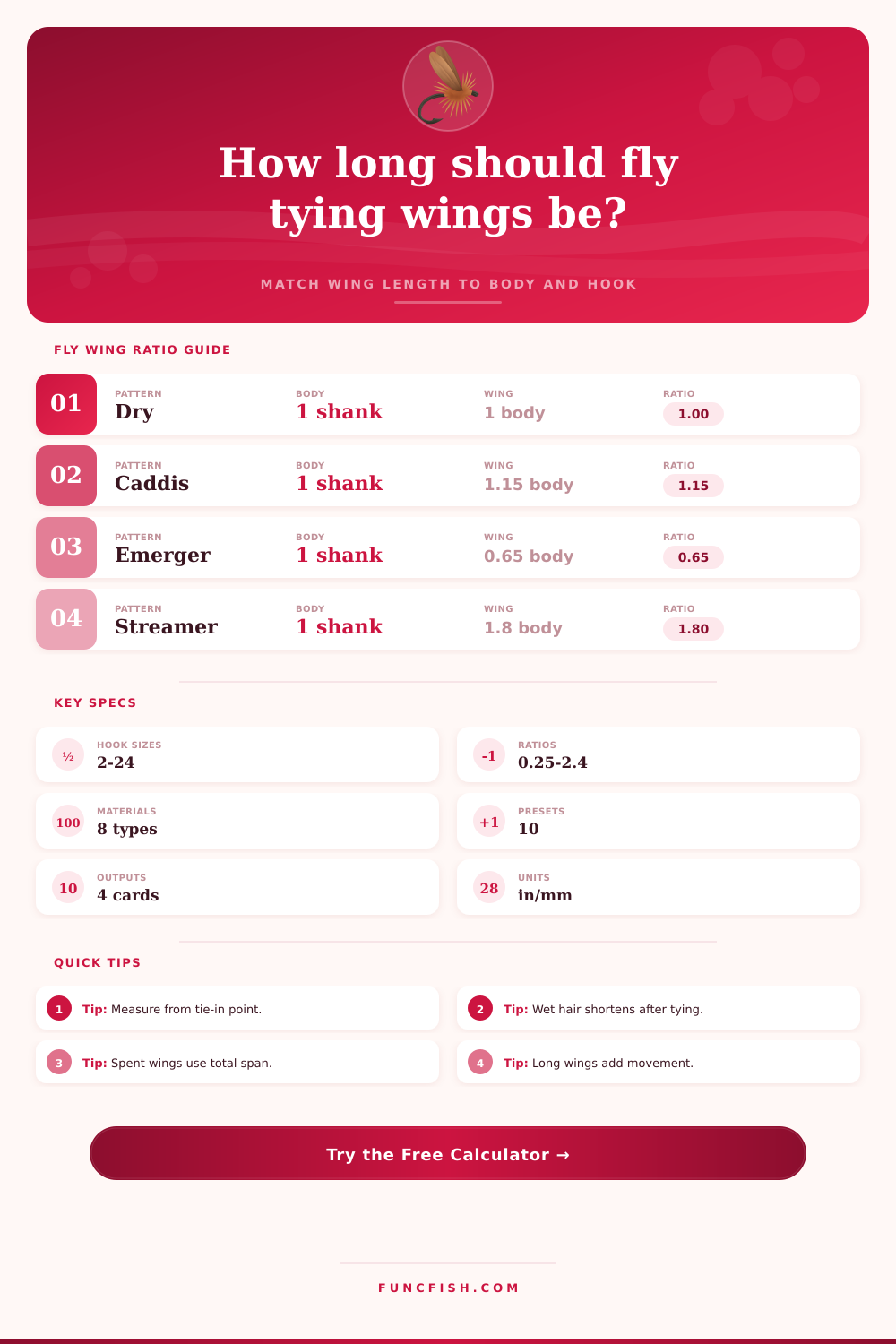
| Catskill or traditional dry | 0.95-1.05 x body | Body length or hook shank | Upright tips should look tall without tipping the fly forward. |
| Parachute dry | 0.70-0.95 x body | Post height above thorax | Shorter posts wrap cleaner and keep the hackle plane low. |
| Comparadun or sparkle dun | 0.75-0.95 x body | Fan height and span | Dense deer hair needs trimming after flare is set. |
| Elk hair caddis | 1.05-1.25 x body | Tip past bend | Long tips make the tent shape visible from below. |
| Wet fly or soft hackle | 0.65-0.90 x body | Swept wing behind thorax | Too much length can foul around the hook bend. |
| Streamer or bucktail | 1.40-2.40 x body | Total baitfish profile | Use sparse stacks when the wing is much longer than the shank. |
| Hook size | Standard shank | Common fly use | One-body wing guide |
|---|---|---|---|
| 24-20 | 4.8-6.4 mm | Midge, tiny emerger | 0.19-0.25 in finished wing |
| 18-16 | 7.4-8.7 mm | Small dry, pheasant tail | 0.29-0.34 in finished wing |
| 14-12 | 10.0-12.0 mm | Adams, caddis, soft hackle | 0.39-0.47 in finished wing |
| 10-8 | 14.0-17.0 mm | Wet fly, small streamer | 0.55-0.67 in finished wing |
| 6-4 | 21.0-25.0 mm | Bass, salmon, streamer | 0.83-0.98 in finished wing |
| 2 | 30.0 mm | Large hairwing | 1.18 in finished wing |
| Material | Cut factor | Typical shrink | Best wing jobs |
|---|---|---|---|
| Mallard flank | 1.02 | 3-6% | Wet flies, soft mayfly wings, small streamers |
| Hackle tips | 0.96 | 1-3% | Matched upright dry wings |
| CDC plume | 1.06 | 5-10% | Emergers, posts, low floating wings |
| Deer or elk hair | 1.10 | 6-12% | Caddis, comparadun, visible dries |
| Bucktail | 1.08 | 4-9% | Clouser, deceiver, salmon hairwing |
| Marabou | 1.18 | 10-20% | Leech, streamer, baitfish movement |
| Pattern preset | Reference ratio | Water profile | Finished look |
|---|---|---|---|
| Catskill dry | 1.00 x body | Riffle or glide | Upright mayfly wing equal to body length |
| Elk hair caddis | 1.15 x body | Fast pocket water | Roof wing extends past bend for visibility |
| CDC emerger | 0.62 x body | Calm slick | Short trapped-wing profile |
| Soft hackle wet | 0.75 x body | Swing or lift | Swept wing stays clear of bend |
| Clouser bucktail | 1.90 x body | Retrieve | Sparse baitfish wing longer than shank |
| Salmon hairwing | 1.60 x body | Swing | Layered wing reaches behind bend cleanly |
💡 Practical tying tips
So, you’re tying a bunch of dry flies and realize, I don’t have any idea how long these wings is supposed to be. So you pick up some feathers and start trimming them about as long as your bodies. They come out looking good half the time. The other half, they resemble deflated balloons or tiny helicopters. Ugh, it’s frustrating.
Wing length seems intuitive, but it becomes difficult when you try to apply it to different hook size. Ratios make it a craft. The silhouette is the wings-to-body relationship. This might be the most important part of what a fish sees before it decides to strike.
How to Get Your Fly Wings the Right Size
An emerger should have a profile that rises up, indicating it’s buoyant, but doesn’t tip over and point downward. A caddis should have a tent-like profile to cover its abdomen. Even a streamer wing should extend back past the hook as if to copy the look of a baitfish tail.
Plug in your variables into the calculator above and it does math for you. You won’t have to guess; you can just tie.
The important thing about wing length is most tiers is measured straight out from the tie-in point on the thorax to the tip of the wing. Why? With some patterns, such as spent spinners, they are always measured from centerline instead of from the thorax.
That ratio is the vertical distance between the wings and the body compared to the body’s length. So if your wing is precisely as long as your body material goes, then you have a one-to-one ratio. That is classic for a traditional dry fly like an Adams or a Catskill. This mimics natural position of an insect that lands on the surface film of the water.
Make your wing too long and now you have an exaggerated looking fly. Too short and now it’s more like a nymph struggling to get through emergence process (or maybe that is what you want to mimic).
Here’s the thing: Each time we measure something statically, the material changes behavior due to way a thread pulls on it. For example, marabou or soft CDC fibers compress a lot when trimmed and wrapped down on something. Then they shrink even more when wetted or treated with floatant. So if you were to precisely cut a piece of marabou or other soft feather to a certain body length, chances are it would look stubby when dressed. You have to build in a little extra “buffer” to how long your bundle is to make up for this fiber compression. This tool does that automatically, adjusting the cut length depending on what you’re cutting, fluffy elk hair or stiffer hackle tips, for instance.
Beyond that, wing length is also relative to water conditions. Fish will see clearer on calm spring creeks. In those spots, shorter wings with a more delicate shape tend to work best because they are picky about proportion. High water or faster riffle situations require some presence. It’s not about being perfect as much as making sure they can see the fly. So you go up a size or two in wing length or maybe go to a higher post where a little extra wing catches light and makes the fly stand out in high water. This creates a practical way to get noticed that may result in a ratio that technically isn’t right but fits your situation better. You can compare a more delicate standard profile to something that stands out. This lets you see how looks affect what you should use.
Another trip-up for beginners is hook shank length. Even though two hooks might both be designated “size fourteen”, one can have a short shank while the other has an extra-long shank. That means there is going to be a difference between the overall body length of these two hooks. Use the hook number to determine wing length only if you want to get inconsistent ratios. Rather, measure from where the wing ties in to where the abdomen material ends and use that real-world measurement as your starting point. You’ll always have a true ratio no matter what brand or style hook you’re using on any particular day.
The last test for whether a fly rides right is balance. Too long of a wing in relation to the body and tail can cause it to ride nose down or just not ride true. The balance index output shows any leaning toward one extreme or another in the proportions. That’s a sanity check against visual mistakes your eye may make as you concentrate on neatly wrapping things up.
Still need to choose hackle density and thread color to finish dressing the fly properly, but having the right balance proportions at least starts you off on a solid footing. But, ratios aren’t hard rules either. Breaking them can result in a better way to catch fish different than any precise imitation. But they do give us something to start from so we’re purposefully breaking the rule instead of doing it by mistake.
Tie the fly to the calculated size and go from there. The measured length will give you some confidence so you can mess around and tinker more when experience helps you know what works and what doesn’t.
You should of tried this before.