🐟 Freshwater Drum Weight Calculator
Estimate fish weight from length & girth measurements using proven formulas
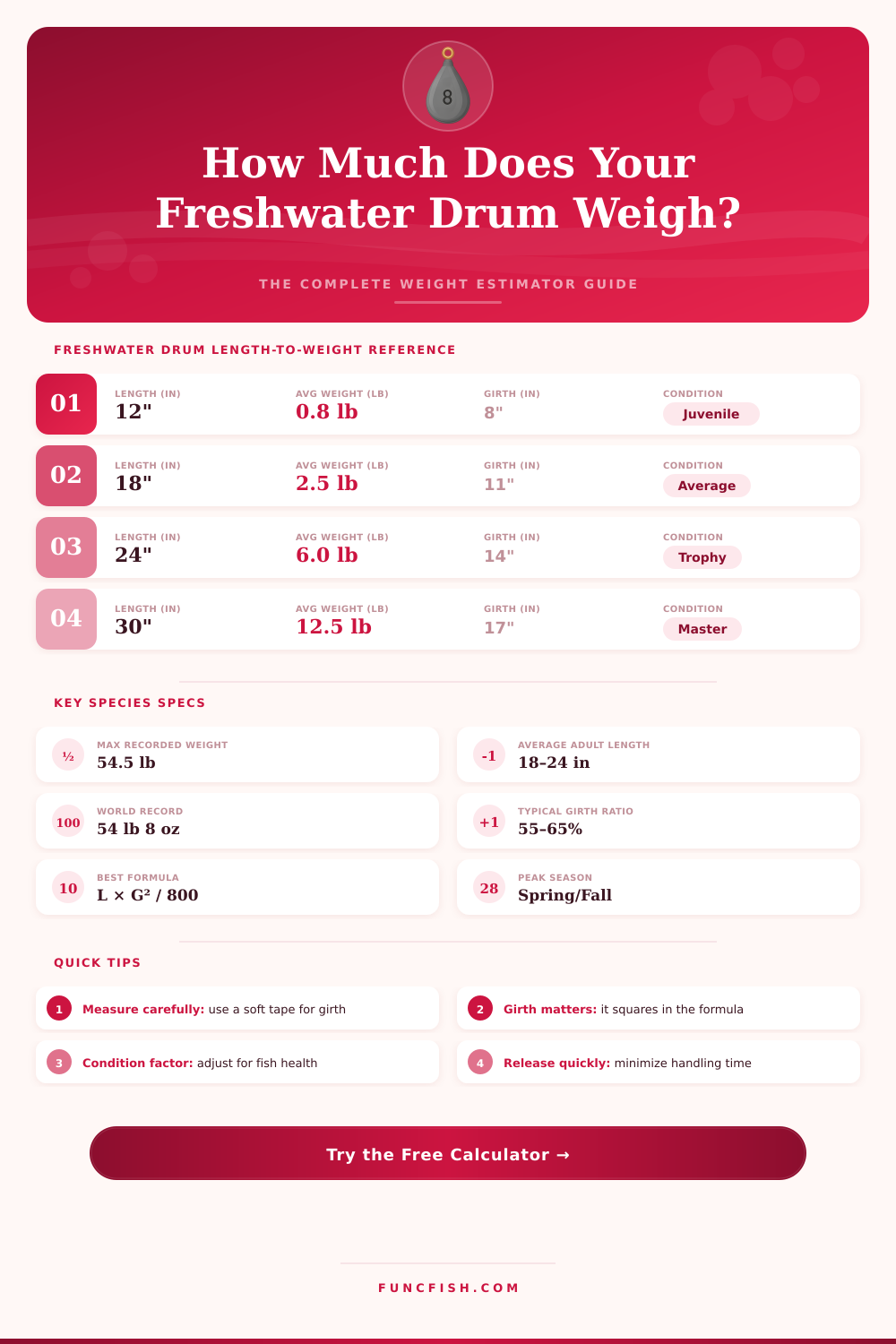
| Length (in) | Length (cm) | Est. Weight (lb) | Est. Weight (kg) | Typical Girth (in) | Size Class |
|---|---|---|---|---|---|
| 8" | 20.3 cm | 0.3 lb | 0.14 kg | 5.5" | Juvenile |
| 10" | 25.4 cm | 0.55 lb | 0.25 kg | 6.5" | Juvenile |
| 12" | 30.5 cm | 0.9 lb | 0.41 kg | 7.5" | Juvenile |
| 14" | 35.6 cm | 1.5 lb | 0.68 kg | 8.8" | Sub-adult |
| 16" | 40.6 cm | 2.3 lb | 1.04 kg | 10.0" | Sub-adult |
| 18" | 45.7 cm | 3.3 lb | 1.50 kg | 11.2" | Sub-adult |
| 20" | 50.8 cm | 4.6 lb | 2.09 kg | 12.5" | Adult |
| 22" | 55.9 cm | 6.2 lb | 2.81 kg | 13.7" | Adult |
| 24" | 61.0 cm | 8.2 lb | 3.72 kg | 14.9" | Adult |
| 26" | 66.0 cm | 10.5 lb | 4.76 kg | 16.2" | Trophy |
| 28" | 71.1 cm | 13.2 lb | 5.99 kg | 17.4" | Trophy |
| 30" | 76.2 cm | 16.3 lb | 7.39 kg | 18.6" | Trophy |
| 32" | 81.3 cm | 19.9 lb | 9.03 kg | 19.8" | Master |
| 34" | 86.4 cm | 24.0 lb | 10.89 kg | 21.0" | Master |
| 36" | 91.4 cm | 28.5 lb | 12.93 kg | 22.3" | Master |
| Formula | Inputs Needed | Accuracy | Best Use Case | Notes |
|---|---|---|---|---|
| Standard (Length Only) | Length only | ±20–25% | Quick field estimate | Uses species K factor |
| Girth Formula L×G²/800 | Length + Girth | ±5–10% | Most accurate field method | Industry standard |
| Length-Weight Table | Length only | ±15–20% | Reference lookup | Species-specific averages |
| Condition Factor K | Length + Weight | Exact | Fish health assessment | K = W/L³ × 10000 |
| Metric (W=aL^b) | Length | ±10–15% | Scientific studies | a≈0.0000057, b≈3.18 |
| Species | Typical Weight | Max Weight | Avg Length | Divisor (Girth Formula) |
|---|---|---|---|---|
| Freshwater Drum | 2–10 lb | 54.5 lb | 18–24" | 800 |
| Common Carp | 5–15 lb | 75+ lb | 20–30" | 800 |
| Channel Catfish | 2–8 lb | 58 lb | 16–24" | 820 |
| Walleye | 1–5 lb | 25 lb | 16–22" | 900 |
| Largemouth Bass | 1–5 lb | 22 lb | 14–20" | 900 |
| Smallmouth Bass | 0.5–3 lb | 12 lb | 12–17" | 1050 |
| White Bass | 0.5–2 lb | 6.8 lb | 10–15" | 900 |
| Sheepshead (FW) | 1–8 lb | 21 lb | 14–22" | 820 |
In order to accurately estimate weight of a freshwater drum, an understanding of the physical dimensions of that fish and its environment are required. Most likely, the freshwater drum that people is weigh may appear to be of a certain length. However, the length of the fish dont necessarily indicate the weight that it will have.
For example, two freshwater drum of the same length may have different weights due to the weight of the belly and shoulders of the fish. Thus, in addition to measuring the length of the freshwater drum, you should also consider the girth of the freshwater drum in determining its weight. The girth of the freshwater drum is a measurement of the circumference of the fish.
How to Estimate the Weight of a Freshwater Drum
In addition to the physical dimensions of the fish, the environment in which the freshwater drum live can also impact the weight of the fish. For instance, freshwater drums that live in areas like reservoir mud flats tend to have diets highly in mussels, resulting in a heavy set freshwater drum. In contrast, freshwater drums that live in main river channels are often required to fight against the river current, leading to a more leaner freshwater drum.
Thus, the environment in which the freshwater drum lives should also be considered when estimating the weight of the fish. Additionally, the season in which the freshwater drum lives can have an impact on the weight of the freshwater drum. For instance, during the pre-spawn season, female freshwater drums may be contain roe, which increase the weight of that fish without increasing its length.
After the spawning season, the female freshwater drum may contain less energy than before the spawning season, leading to a decrease in its weight. In order to accurately and precise determine the weight of a freshwater drum, certain techniques for measuring the freshwater drum should be utilize. The length of the freshwater drum should be measured from the tip of its snout to the end of its tail.
Measuring only the fork length of the freshwater drum will result in underestimating the total length of the fish. A soft tape can measure the girth of the freshwater drum by wrapping around the deepest part of the shoulder and belly of the freshwater drum. Additionally, you can also measure the depth of the freshwater drum from its back to its belly.
A freshwater drum that has a high back may be an indicator of a robust adult freshwater drum, whereas a freshwater drum with a narrow profile may be a younger fish or a leaner freshwater drum. The weight of the freshwater drum can have a significant impact upon the fishing gear that should be utilized to catch the fish. For instance, if a light spinning fishing rig is used to catch a heavy freshwater drum, the fishing rig may snap under the freshwater drum.
In contrast, if a heavy bank rod is used for a light freshwater drum, the fish will be more easy hooked, but the fishing gear will have more power than the freshwater drum possesses. Thus, the strength of the fishing rod and the line class should be determined in relation to the weight of the freshwater drum being targeted. Finally, the weight of the freshwater drum can be estimated from a photograph of the fish.
However, the estimate will not be as precise as if the measurement techniques is used to determine the weight of the fish. Thus, the weight will be estimated with a range of value if the fish is only photographed.