🐟 Grayling Weight Calculator
Estimate your grayling's weight from length & girth measurements — imperial & metric
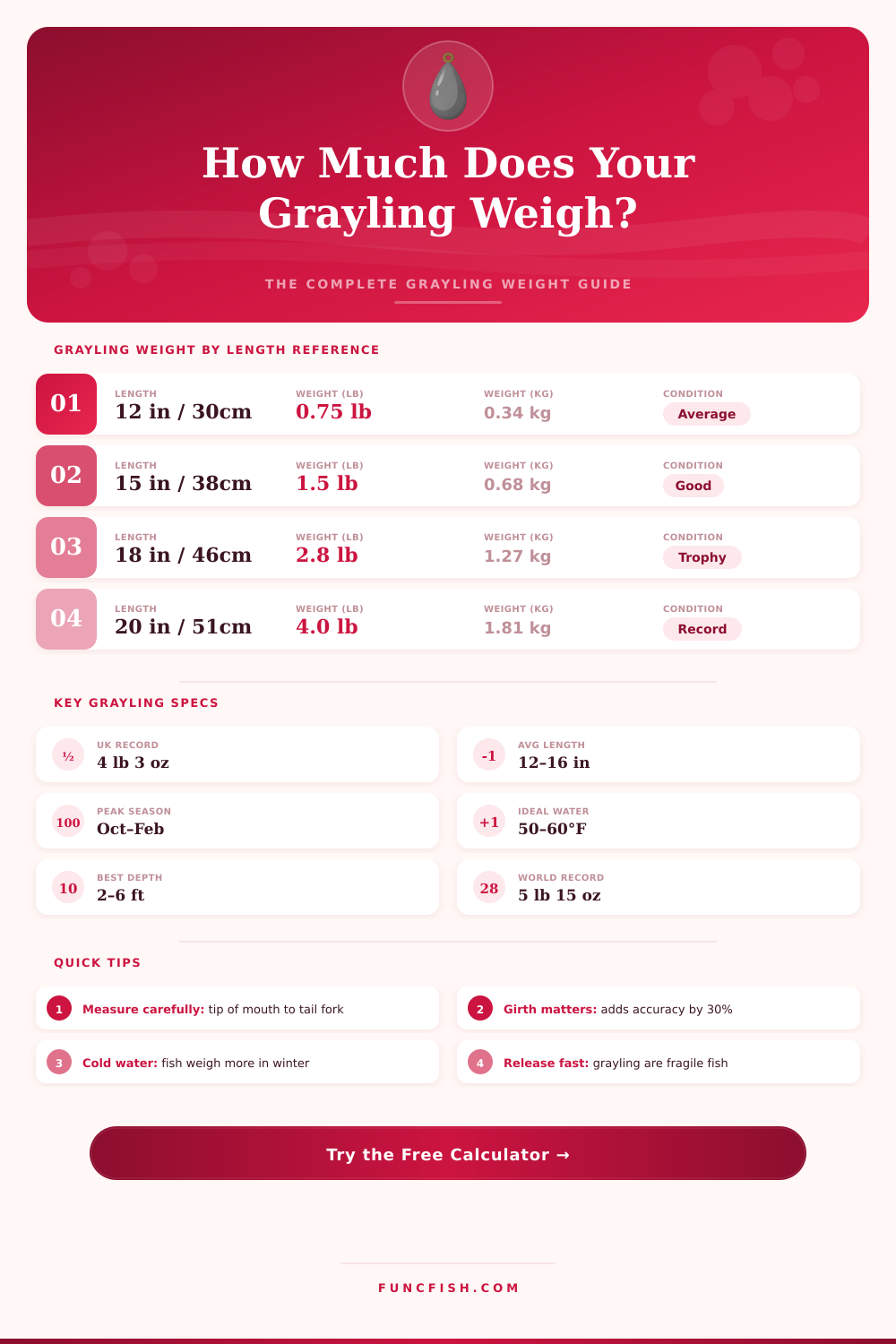
| Length (in) | Length (cm) | Est. Weight (lb oz) | Est. Weight (kg) | Classification |
|---|---|---|---|---|
| 8 in | 20 cm | 4 oz | 0.11 kg | Juvenile |
| 10 in | 25 cm | 8 oz | 0.23 kg | Small |
| 12 in | 30 cm | 12 oz | 0.34 kg | Average |
| 13 in | 33 cm | 1 lb 0 oz | 0.45 kg | Average |
| 14 in | 36 cm | 1 lb 4 oz | 0.57 kg | Good |
| 15 in | 38 cm | 1 lb 8 oz | 0.68 kg | Good |
| 16 in | 41 cm | 2 lb 0 oz | 0.91 kg | Very Good |
| 17 in | 43 cm | 2 lb 6 oz | 1.08 kg | Trophy |
| 18 in | 46 cm | 2 lb 14 oz | 1.30 kg | Trophy |
| 20 in | 51 cm | 4 lb 0 oz | 1.81 kg | Record Class |
| 22 in | 56 cm | 5 lb 4 oz | 2.38 kg | Exceptional |
| Water Type | Condition Factor | Typical Growth Rate | Notes |
|---|---|---|---|
| Chalkstream | 1.00 (baseline) | Moderate–Fast | Rich invertebrate food; good body condition |
| Freestone River | 0.95–1.00 | Moderate | Variable food supply; leaner fish possible |
| Mountain / Alpine | 1.05–1.10 | Slow–Moderate | Cold water; dense, heavy-bodied fish |
| Loch / Lake | 1.00–1.05 | Moderate | Less common habitat; varies widely |
| Season | Weight Modifier | Body Condition | Notes |
|---|---|---|---|
| Winter (Oct–Feb) | +5% | Best condition | Peak season; fish are heaviest |
| Spring (Mar–May) | –5% | Post-spawn lean | Weight lost after spawning (Feb–Apr) |
| Summer (Jun–Aug) | 0% | Recovering | Feeding up; approaching average weight |
| Autumn (Sep–Oct) | +2% | Pre-spawn prime | Feeding heavily before winter spawn |
| Formula Method | Formula | Accuracy | Best Used When |
|---|---|---|---|
| Length + Girth | Weight = (L x G²) / 800 | High (±5%) | Girth measurement available |
| Length Only (cubic) | Weight = L³ / 3200 | Medium (±15%) | Quick streamside estimate |
| Length + Width | Weight = (L x W² x 0.6) / 800 | Medium (±10%) | Belly width measured |
| Fulton K Factor | K = W / L³ x 100,000 | Condition index | Assessing fish health |
In estimating the weight of an arctic grayling, measuring the length of the fishes isnt the only measurement that must be taken. Despite the length of the fish being one of the main measurements that are used to determine the weight of an arctic grayling, the length is not an accurate measurement of the weight of the arctic grayling. It is possible for two arctic grayling fish of the same length to contain different weights due to the different body shapes of the two individual fish.
For instance, one arctic grayling may be a slender fish that lives in a fast moving river, whereas the other may be a deep bodied arctic grayling that lives in a lake. Instead, the girth of the arctic grayling is the main factor that determine the mass of that fish, and measuring the girth of the belly of the fish is a more accurate measurement of the total mass of the arctic grayling than measuring the length of the arctic grayling. The weight calculator for the arctic grayling include the length of the arctic grayling, the girth of the arctic grayling, and factors relating to the environment in which the arctic grayling live in order to provide an estimated weight of the fish.
How to Estimate the Weight of an Arctic Grayling
The environment in which the arctic grayling lives can impact the shape of the fish. For instance, arctic grayling that live in fast rivers tend to be slender, whereas those that live in lakes have deeper bodies and weigh more than the arctic grayling that live in rivers. Thus, one must consider the habitat in which the arctic grayling is spotted in the calculation of the weight of the arctic grayling.
The weight of the arctic grayling also change with the season in which the fish is caught. For instance, arctic grayling that are caught in the spring are typically leaner in weight than the arctic grayling that are caught in the fall, as the spring ice-out period has no food for the arctic grayling. During the fall, the arctic grayling are building up their weight in preparation for the winter.
Thus, you must adjust the weight of the arctic grayling according to the season in which the fish was caught. Additionally, the way that the person measures the weight of the arctic grayling impacts the accuracy of the calculation of its weight. For instance, measuring the length of the arctic grayling with a measuring board and a soft tape is more accurate than measuring the length of the arctic grayling from a photograph of the fish or from a quick glance at the fish.
Photographs of the arctic grayling may make the arctic grayling look longer or thinner than the arctic grayling is. Thus, the calculator accounts for this uncertainty with a confidence band for the weight estimate of the arctic grayling. The fish weight calculator for the arctic grayling also has optional input fields for the dorsal height and the depth of the body of the arctic grayling.
Though the dorsal sail of the arctic grayling does not add much to the weight of the fish, the height of the dorsal sail can help to determine the body shape of the arctic grayling. Additionally, the body depth can help to differentiate between a slender arctic grayling from a fast river from a deep bodied arctic grayling from a lake. Additionally, it isnt accurate to use the weight charts for trout to calculate the weight of an arctic grayling.
For instance, brook trout have deeper bodies and more rounded bodies than arctic grayling, and thus, weigh more than arctic grayling of the same length. Therefore, using this fish weight calculator instead of a trout weight chart is a more accurate method for calculating the weight of an arctic grayling. The ability to calculate the weight of an arctic grayling help people to track the health of the fishery and the quality of the arctic grayling.
By determining the weight of the arctic grayling, people can understand the relationship between the arctic grayling and its environment and the time of year that it was killed. Finally, the ability to calculate the weight of the arctic grayling without a calibrated scale can allow individuals to more easly record there catch.