Ice Fishing Jig Drop Speed Calculator
Estimate how quickly an ice jig reaches fish or bottom after line, jig profile, tipped bait, water temperature, current, and slack-line control are applied.
📌Hardwater Presets
⚙Drop Speed Inputs
Drop Speed Estimate
Calculated from jig fall physics plus hardwater line-control corrections.
Calculation Breakdown
📊Jig Profile Data
📐Ice Jig Reference Tables
| Jig class | Common weight | Typical line | Expected drop character |
|---|---|---|---|
| Micro tungsten for bluegill | 2-4 mm / 0.3-1.0 g | 1-3 lb mono or fluoro | Fast for size, easy to stop above fish |
| Panfish horizontal jig | 1/64-1/32 oz / 0.4-0.9 g | 2-4 lb ice line | Moderate fall with plastic-tail drag |
| Crappie flutter spoon | 1/32-1/12 oz / 0.9-2.4 g | 3-5 lb mono or fluoro | Slower fall, strong flash and wobble |
| Perch basin spoon | 1/16-1/8 oz / 1.8-3.5 g | 4-6 lb fluoro | Quick search drop with controllable flutter |
| Walleye jigging spoon | 1/8-3/8 oz / 3.5-10.5 g | 6-10 lb braid or fluoro | Fast descent, moderate line angle in current |
| Glide or jigging minnow | 1/8-1/2 oz / 3.5-14 g | 6-10 lb braid with leader | Wide glide, slower vertical progress |
| Line diameter | Typical test | Drop effect | Best use |
|---|---|---|---|
| 0.003-0.004 in / 0.08-0.10 mm | 1-2 lb | Very low drag | Micro tungsten and shallow panfish |
| 0.005-0.006 in / 0.13-0.15 mm | 3-4 lb | Balanced drag | Crappie, perch, light walleye |
| 0.007-0.009 in / 0.18-0.23 mm | 5-8 lb | Noticeable drag | Spoons, deadstick, larger bait |
| 0.010-0.013 in / 0.25-0.33 mm | 10 lb plus | High drag on small jigs | Lake trout, pike, heavy current |
🎯Species and Control Targets
| Target | Useful fall behavior | Drop speed target | Stop cue |
|---|---|---|---|
| Bluegill and sunfish | Small jig that stops cleanly | 0.5-1.8 ft/s | Stop slightly above marks |
| Crappie | Controlled fall without swinging past fish | 0.8-2.2 ft/s | Stop above suspended schools |
| Perch | Faster search drop to bottom | 1.5-3.8 ft/s | Touch bottom, lift into cloud |
| Walleye | Fast spoon drop with visible flutter | 2.0-5.0 ft/s | Pause at fish level or bottom |
| Lake trout | Quick descent with room to chase | 3.0-6.5 ft/s | Stop before overshooting marks |
💡Drop-Speed Notes
Small jig rule: line diameter and plastic shape can slow a micro jig more than the hook bend or knot weight.
Spoon rule: a spoon may weigh more than a round jig but still fall slower because it presents more area.
Electronics rule: stop timing matters most when fish are suspended and the jig needs to arrive above the mark.
Current rule: even light current increases line angle, so bottom contact arrives later than a vertical stopwatch test.
Use the result as a rig-matching estimate, then verify with sonar, a marked line, or a timed drop in the actual hole.
With the fish finder humming underneath you, standing over a hole in the ice, you see that green blip pulsing just under the layer where the water temperature changes. You drop your jig and wait. Drop it too quickly and you’ll totally blow by the bite window. Let it float aimlessly and now you look like dead bait instead of wounded prey. Controlling that vertical fall into that still, cold water can be the difference between a full livewell and an empty one.
It is not so much about weight as its about physics meeting finesse. With depth quickness, most folks believe more weight are better. They assume you’ll get the bait down faster with a heavier lure. Here’s where they’re mistaken. Sure, a heavy, dense tungsten jig can sink like a rock, but a slender lead spoon of the same weight will flutter and swing wide due to its frontal area. Conversely, a slender, lead spoon of the same weight will flutter and swing wide due to its frontal area. Plugging in the details on the above calculator, you’ll save yourself the guesswork and know exactely if that extra ounce helps or hurts your presentation.
How to Control Your Jig’s Speed
Let’s talk about line size: it’s important to use a proper one. A lot of people don’t even think about this with ice lines. They’re all very thin, but even so, there’s a diameter to them. In other words, a six-pound braided line may be much smaller in diameter than a six-pound mono, which means there’s less surface area dragging along behind your jig. Not only that, but if you’ve ever dropped a tiny panfish jig down on some thick line, the line itself become almost like a parachute that slows the fall. Use the tool to enter specific line diameters. You can then watch as a lighter fluorocarbon falls twice as fast than a larger-diameter copolymer, since there is less water resistance pushing back up through the line column.
And then there’s the current. Current completely changes things again. Even a slight current from an underwater source or from wind blowing across the surface of a still lake will cause your lure to move off target. The model takes both current direction and speed into account to calculate the amount of horizontal drift that it will experience throughout the fall. That allows you to get on target.
For example, say you’re fishing for suspended walleye around a rock point; you’d like to know whether your jig is coming down next to them or will land ten feet downstream. Knowing what line angle works best lets you adjust before ever raising your rod to give it a twitch.
And then there’s water temperature which acts silently on this scene as well. Colder water; like near freezing, is denser than warmer water. That slight increase in density makes the object less buoyant and offers a little extra resistance to fall. It sounds insignificant, but when you’re attempting to bring your micro-jig to a halt directly over a school of bluegill that fraction of a second can make all the difference.
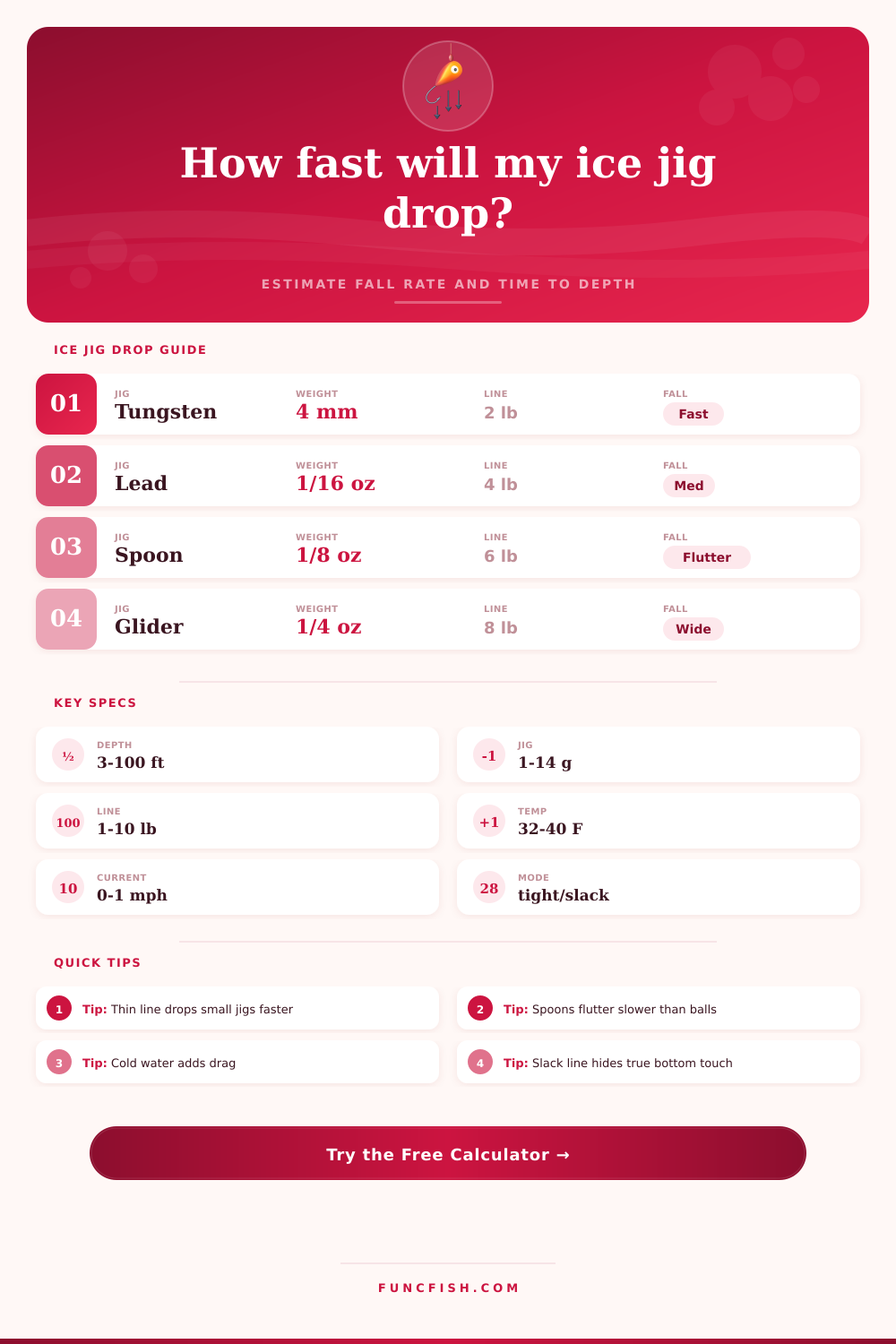
The presets also demonstrate the behavior of various jig profiles in the same scenario. It is like perch hunting on tight line versus walleye seeking forage in loose bottom areas. You’ll notice the round tungsten jig falls rapidly and straight. The glide bait with its long legs will interact with the water differently. It cuts through the water differently because it descends more slowly while still creating a lot of visual disturbance during its fall.
Here’s another wrinkle: Bait choice. A chunk of bait on a hook has more drag and buoyancy than a bare hook does. The live or wax worm tip will slow its fall even more. If you prefer your bait to fall at a certain speed, maybe you have to switch to a heavier jig body to keep it falling like you want it to. That’s where the concept of terminal velocity becomes more than scientific, this is for anglers who is striving for consistency.
As the morning turns into afternoon, changing line or weight based off educated guesses allows you to keep that offering productive. Reference tables give you a quick, real-time check of what is normal. What happens when you use regular gear? Here’s the deal: Four-pound test line with a 1/16 ounce lead jig falls moderately well for crappies. Put a live bait on there and switch to thicker line and now it slows down. You can play around with all of this right in your own home on the kitchen table without having to go out on the ice.
The takeaway is that drop speed comes down to matching the fish’s mood with the action of your lure. A slow, deliberate descent can match the death throes of an injured baitfish, while a rapid fall elicits a reaction strike from aggressive fish. Control over the vertical game come from knowing how current, line size, lure shape and weight affect it. Instead of hoping the fish is hungry, you make sure they see the lure; and know exactly what it is. Small advantages add up fast on the ice.