J Hook to Circle Hook Size Converter
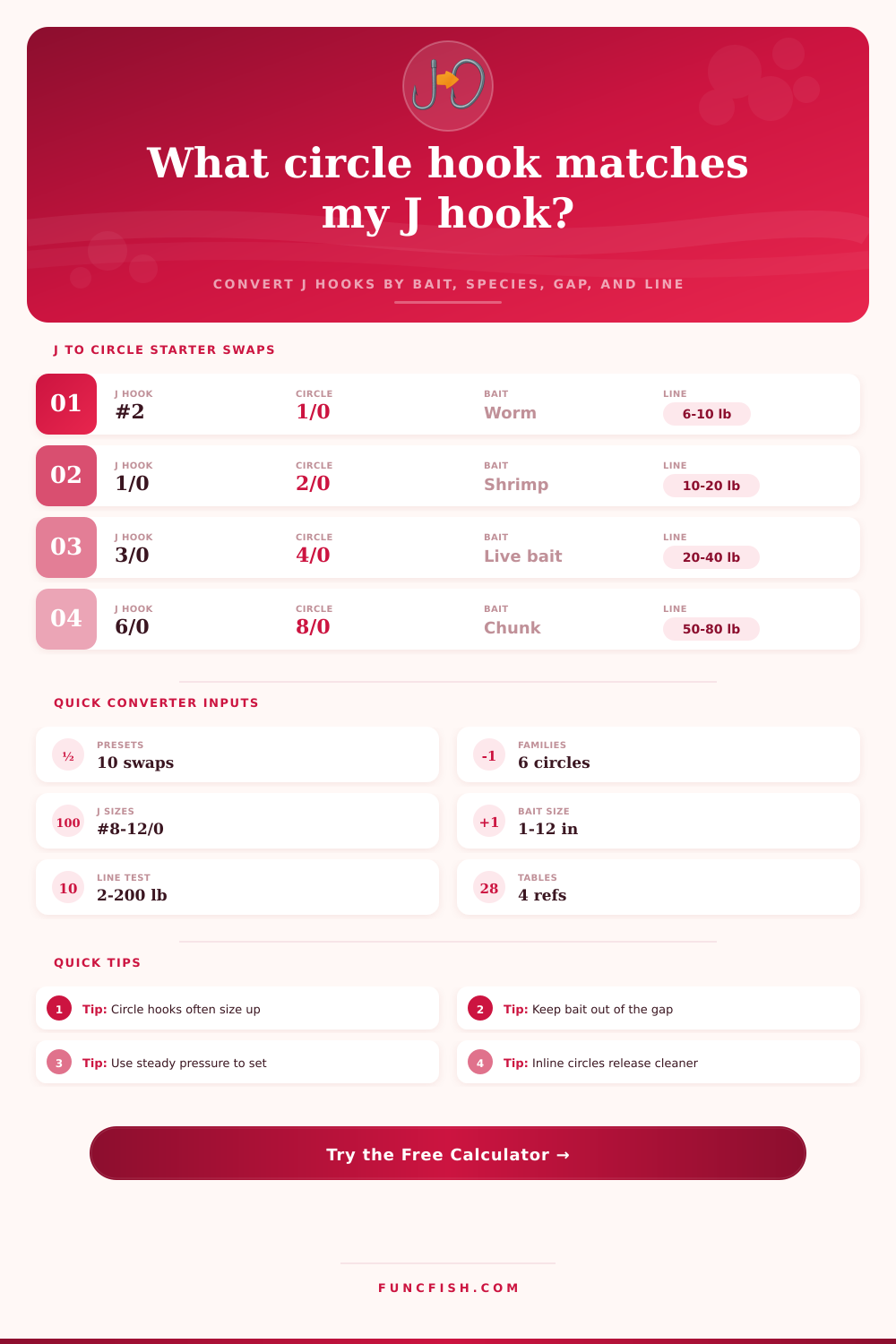
Convert an existing J-hook size into a circle-hook match by checking family shape, bait size, target species, gap clearance, wire strength, line test, and bait presentation.
📌Hook conversion presets
⚙Conversion inputs
Circle hook conversion
Recommended circle size, gap clearance, wire match, and confidence will appear here.
Full breakdown
📊Circle hook family grid
Inline circle
Octopus circle
Kahle circle
Heavy-duty
⚖J hook and circle hook comparison
J hook fit cue
A J hook can work with a slightly tighter bite because the hook point is pulled directly into the fish. The shank length often feels larger than the usable bite gap.
Circle hook fit cue
A circle hook needs the bait to leave the bend and point open. The hook usually slides into the corner under steady pressure instead of a hard snap set.
When to size up
Size up when bait thickness fills more than half the gap, when line test is heavy, or when the circle family has a short shank or turned-in point.
When to hold size
Hold the same nominal size for small bait, exposed hook points, light wire, clear water, and species with smaller mouths or soft takes.
📘Reference tables
| J hook size | Typical circle start | Approx J gap | Circle gap aim |
|---|---|---|---|
| #8 to #4 | #6 to #2 circle | 5 to 7 mm | 6 to 10 mm open bite |
| #2 to #1 | #1 to 1/0 circle | 8 to 10 mm | 10 to 14 mm open bite |
| 1/0 to 2/0 | 2/0 to 3/0 circle | 12 to 14 mm | 14 to 18 mm open bite |
| 3/0 to 4/0 | 4/0 to 6/0 circle | 16 to 19 mm | 19 to 25 mm open bite |
| 5/0 to 6/0 | 7/0 to 8/0 circle | 21 to 24 mm | 27 to 32 mm open bite |
| 7/0 to 9/0 | 9/0 to 11/0 circle | 27 to 35 mm | 35 to 46 mm open bite |
| 10/0 to 12/0 | 12/0 to 14/0 circle | 39 to 48 mm | 48 to 58 mm open bite |
| Circle family | Conversion bias | Best bait fit | Watch point |
|---|---|---|---|
| Inline circle | Same to +1 size | Natural bait, release fishing | Needs clean open gap |
| Tournament circle | +1 size | Regulation bait rigs | Keep bait off the point |
| Octopus circle | +1 size | Shrimp, squid, leeches, strips | Short shank can crowd bait |
| Offset circle | +1 to +2 sizes | Chunks and tough baits | Check local circle rules |
| Kahle circle | +1 to +2 sizes | Wide live baits and chunks | Wide gap can overpower small fish |
| Heavy-duty circle | +2 sizes | High drag, structure, big bait | Needs enough line to drive wire |
| Target species | Common J hook | Circle range | Line cue |
|---|---|---|---|
| Trout, panfish, perch | #8 to #2 | #6 to 1/0 | 2 to 8 lb, light wire |
| Bass, walleye, inshore school fish | #2 to 2/0 | #1 to 4/0 | 6 to 20 lb, light-medium wire |
| Catfish and carp | 1/0 to 6/0 | 2/0 to 8/0 | 12 to 50 lb, medium-heavy wire |
| Snapper, sheepshead, sea bass | #1 to 4/0 | 1/0 to 6/0 | 15 to 50 lb, medium wire |
| Striped bass, bluefish, salmon | 2/0 to 7/0 | 4/0 to 9/0 | 20 to 80 lb, medium-heavy wire |
| Grouper, cobia, amberjack | 5/0 to 10/0 | 7/0 to 12/0 | 50 to 150 lb, heavy wire |
| Tuna, shark, big pelagics | 7/0 to 12/0 | 9/0 to 14/0 | 80 to 200 lb, extra-heavy wire |
| Bait presentation | Circle hook adjustment | Gap priority | Line pressure |
|---|---|---|---|
| Freeline or drift bait | Neutral size with open point | Medium | Steady sweep sets hook |
| Float or suspended bait | Keep wire light enough for subtle takes | Medium | Light line favors smaller circles |
| Bottom rig or fish-finder rig | Add gap for bait roll and current | High | Use enough leader for abrasion |
| Nose-hooked live bait | Size to bait head and swimming freedom | High | Drag pressure should be smooth |
| Cut bait chunk | Size up if chunk fills the bend | Very high | Heavy chunks often need stronger wire |
| Slow troll or bridle bait | Use stable gap and stout wire | High | Constant pull favors heavy circles |
💡Conversion tips
After baiting, look at the hook from the side. If the bait blocks the point path or fills most of the bend, move up one circle size or choose a wider family.
Heavy circle hooks need line and drag pressure to rotate into place. If line test is light, a smaller fine-wire circle can convert better than a bulky hook.
Many anglers switches from J hooks to circle hooks because the circle hooks use the movement of the fish to create a hookup. The point of the circle hook rolls into the corner of the fishs mouth when the fish takes the bait. This action happen without having to hard set the rod, and this is useful when fishing from a kayak or a boat.
Yet many angler struggle with selecting the correct replacement size for the circle hook. A 3/0 J hook is not necessarily the same as a 3/0 circle hook, and these two type of hooks can behave differently when the fish takes the bait. One factor that can influence the size of circle hook that should be selected is the thickness of the bait.
How to Choose the Right Circle Hook
If a thin strip of squid is used, there is more room for the point of the circle hook to travel into the mouth of the fish. If a chunk of thick bunker is used, though, the bend of the circle hook could become filled by the chunk of bait prior to the fish taking it. A circle hook converter tool takes into account the thickness of the bait that will be used.
In addition to considering the thickness of the bait, the tool also takes into account any extra gap that may be required for bridle or skin. The tool also considers how the bait will sit on the hook, such as nose-hooking live bait which will require more clearance than using a small piece of worm. Another factor is the shape of the mouth of the fish that will be targeted, and the way in which the fish will take the bait.
For example, redfish and striped bass will roll the bait in their mouths prior to taking it. A circle hook that features a wider gap will work more better for these species. In contrast, groupers and cobias tend to take the bait more forceful.
These fish will require a circle hook with stronger wire to withstand the force that they use when they take the bait. The strength of the wire of the circle hook and the line test are two factors that interact with each other. For instance, using a heavy circle hook may require more drag on the line.
If the line that is used has less drag than the heavy circle hook can create, though, the heavy circle hook may not be able to rotate proper. The converter tool will check the line class against the wire of the circle hook that is selected, as well as the species that the anglers target. The presentation of the bait can also influence the type of circle hook that should be selected.
For example, if the bait is being cast into the water as a freeline drift, the baseline circle hook will work best. If the bait is being rigged to the bottom of the water column or using a fish-finder setup, though, the current and movement of the bait will crowd the gap of the circle hook. Slow trolling and bridle rigs will have constant tension on the circle hook, so a stout circle hook is preferred for these fishing techniques.
The presentation of the bait is one of the sets of inputs into the circle hook converter tool. The reference tables located on the page can provide anglers with starting points for changing rigs. The tables indicate the changes to the size of the circle hook needed for each type of bait.
The tables also indicate the J hook sizes for each of the most common species of fish. These tables do not replace the circle hook size converter tool, but can indicate to anglers the relationship between the circle hooks, bait, and species of fish in a more general way. A common mistake with circle hooks is to maintain the same size as the J hook from which the circle hook was purchased.
Additionally, another common mistake is to bury the point of the circle into a chunk of large bait. The point of the circle hook will not be able to rotate if it is buried in the chunk of bait, regardless of the amount of tension placed on the line with the fish. The converter tool can alert anglers to these mistake.
Another consideration for anglers is local rules for the type of circle hook that may be used. For example, certain areas may have rules that limit the use of offset circle hooks, or may require the use of inline circle hooks. The selection of each type of circle hook allow anglers to comply with these local rules.
The score that is associated with the result of the converter tool indicates how well the circle hook that is selected will work with the fish that are targeted. A higher score indicates that the combination of the circle hook, the wire, and the fishing line will work for the target species. A lower score indicates that the anglers should reconsider the thickness of the bait or the type of wire for the circle hook.
The value of the converter tool is that it removes the guesswork when converting from J hooks to circle hooks. Anglers must still consider the type of bait that will be used, the species of fish that will be targeted, the way in which the bait will be presented to the fish, and how the fish will take the bait. However, without the converter tool, there is guesswork involved in determining the proper size for the circle hook.
By using the tool, though, anglers can make adjustments to one of the variables and to see how the result changes. Anglers may not be able to create the perfect circle hook combination for the species of fish that is targeted, but the tool does allow anglers to understand how each component of the hook can impact the others.