
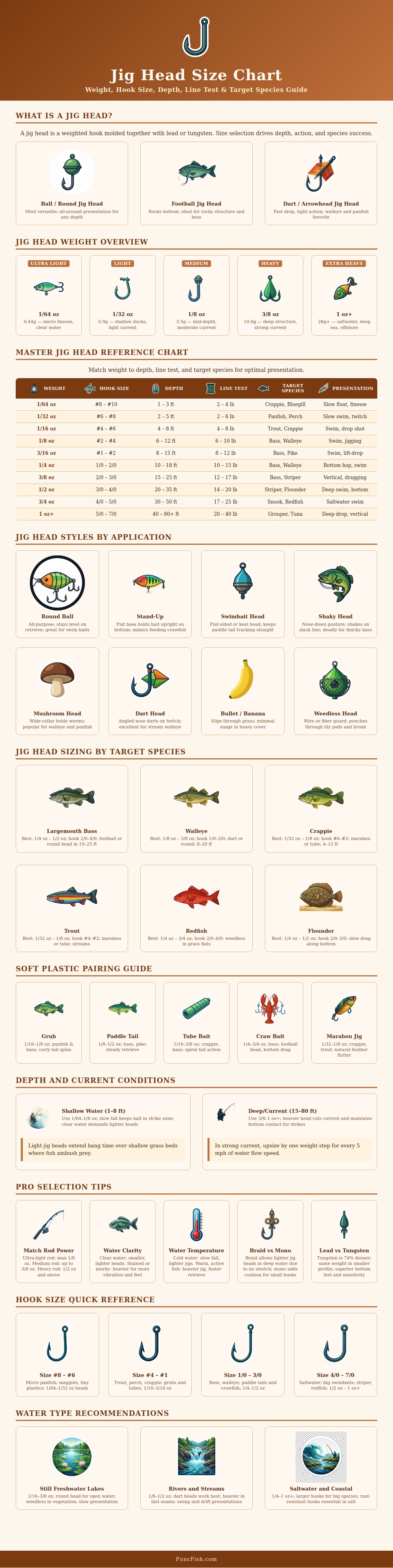
A jig head are a fishing tool that attaches the bait to the hook and the weight. Furthermore, the jig head dictates the speeds at which the bait will sink and the angle at which the bait will move through the water. If the jig head that is selected for the fishing bait are too heavy for the type of bait, then the jig head will cause the bait to sink quickely to the bottom of the water column.
However, if the jig head is too light for the bait, then the bait will drift with the current in the water and will not reach easy the bottom of the water column. In these situations, you must select the jig head according to the depth and speed of the currents in the water that is being fished. The depth and speed of the current in the water is important to consider when choosing the weight of the jig head that you will use in the fishing bait.
How to Choose the Right Jig Head
When fishing in areas of shallow water, it is necessary to use a light jig head for the bait. Using a light jig head allow for the bait to slowly sink to the bottom of the water column and remains in the water for longer period of time. Additionally, using a light jig head is effective when the fish can see the fishing line.
However, when fishing in areas of deep water or strong current, it is necessary to use a heavy jig head for the fishing bait. The heavy jig head will allow the bait to quickly sink to the bottom of deep water areas and will allow it to resist strong currents from move the bait from its intended area to the bottom of the fishing area. Another important factor to consider when selecting a jig head is the shape of the jig head.
Round jig heads are the standard jig head shape and will remain level in the water. However, if fishing areas have rocky bottom, it is best to use a football shaped jig head instead of round jig heads. The football shaped jig head has a wider base that will prevent it from getting stuck on the rocks at the bottom of the water column.
Additionally, shaky head jig heads is another specialized shape that will keep the bait in a nose down position. A nose-down position will create a vibration on the bottom of the water, which will attract the fish that are not bite on other types of lures. You must also ensure that the size of the hook on the jig head match the size of the fish that you are trying to catch.
If the hook on the jig head is too large for the size of the soft plastic lure, it will ruin the movement of the bait. You want to use the smallest hook that can hold the soft plastic bait and the smallest hook that will be able to enter the mouth of the fish. For example, if you are after small panfish, you will not want to use a large hook.
However, if you are after a large fish like a striper, you will need a hook that is strong enough to not pull the fishs mouth away from the hook. Your fishing rod and the fishing line that you use will also have to match the weight of the jig head that you use. If the jig head that you use is too heavy for your ultra-light fishing rod, you will not be able to feel the bottom of the lake with your rod and you could break your fishing rod.
Alternatively, if you use a light jig head with a heavy fishing rod, you will not be able to feel when the fish bite your lure. You can use braided fishing line to help you feel the bottom of the lake with your line. Braid dont stretch.
Alternatively, use monofilament fishing line. This type of line will stretch and this will prevent injury to the mouth of smaller fish. Finally, the environment in which you are fishing will also dictate the type of jig head that you use.
In still lakes, use lighter jig head. In rushing rivers, use heavier jig heads. If the water in which you are fishing is murky, use a heavy jig head to help the fish sense the vibrations.
However, in warm water where the fish are active, use a jig head that allows for the lure to sink slowly because the fish move more slow in warm water. When fishing successfully, match the jig head to the depth of the lake, the type of current in the water and the species of fish in that lake.