Jigging Cadence Calculator
Estimate a practical jigging rhythm from depth, jig style, line diameter, current, rod recovery, lift height, fish mood, and the amount of slack you feed on the drop.
📌Cadence Presets
⚙Cadence Inputs
Results update after calculation.
Cadence Breakdown
🛠Jig Style Response Data
📊Cadence Reference Tables
| Technique | Typical cadence | Lift height | Drop cue | Use when |
|---|---|---|---|---|
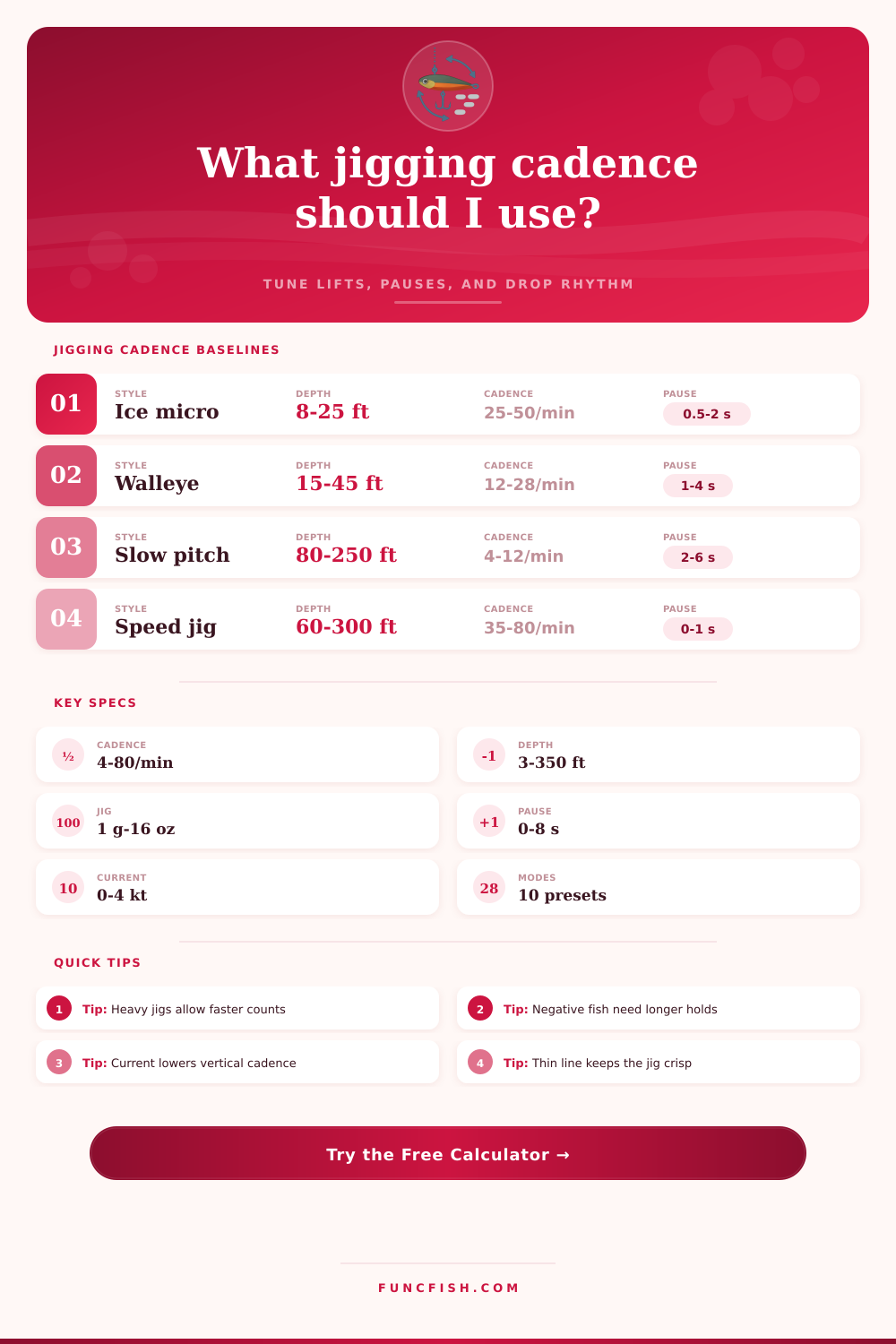
| Micro ice jigging | 25-55 lifts/min | 1-6 in | Watch line tick | Panfish, crappie, shallow marks |
| Vertical walleye jig | 10-30 lifts/min | 8-24 in | Pause after bottom | Edges, current seams, humps |
| Blade bait snap | 12-35 lifts/min | 6-18 in | Let blade fall tight | Cold bass, walleye, stripers |
| Drift bucktail | 6-22 lifts/min | 10-30 in | Touch bottom, lift again | Fluke, river jigging, inshore drift |
| Slow pitch jigging | 4-14 lifts/min | 18-48 in | Free fall, then load rod | Reef fish, amberjack, snapper |
| Speed jigging | 35-90 lifts/min | 14-36 in | Minimal pause | Tuna, kingfish, aggressive pelagics |
| Target | Cadence bias | Pause bias | Line contact | Notes |
|---|---|---|---|---|
| Panfish and crappie | Medium-fast | Longer hold | Light slack | Small bites often happen after the hop. |
| Walleye | Medium | Bottom-aware | Semi-tight | Too much slack hides the pick-up. |
| Bass | Medium | Short pause | Tight fall | Blade baits work best with crisp stops. |
| Fluke and flatfish | Slow-medium | Bottom touch | Tight drift | Maintain contact without dragging constantly. |
| Reef fish | Slow | Controlled fall | Direct vertical | Angle and structure risk matter more than speed. |
| Tuna and pelagics | Fast | Very short | High tension | Cadence should stay repeatable under load. |
| Line choice | Drag effect | Stretch effect | Cadence impact | Best match |
|---|---|---|---|---|
| Thin braid | Lowest | Very low | Allows faster, deeper cadence | Vertical jigging, deep water |
| Standard braid | Low | Very low | Good all-round contact | Walleye, bass, inshore |
| Fluorocarbon main | Medium | Low-medium | Smooth fall, slightly slower | Clear water and pressured fish |
| Monofilament | Medium-high | High | Slower hook-to-jig response | Shallow casting and light jigs |
| Heavy braid | High | Low | Needs heavier jig or slower count | Structure and offshore power |
| Wire trace | Very high | Low | Shorten cadence and reduce slack | Toothy fish and heavy cover |
💡Cadence Calculation Notes
Drop window: The calculator separates lift time, fall time, and intentional pause so the final cadence is not just a random lifts-per-minute number.
Line angle: Current, drift, slack, and jig drag are combined into a vertical contact estimate. High angles usually need more jig weight or less slack.
Rod recovery: Moderate and slow-pitch rods need time to unload. A faster count than the rod can recover often kills jig action.
Fish mood: Aggressive fish tolerate speed. Negative fish usually need shorter lifts, longer holds, and cleaner contact.
A jig isn’t something that you work by going up and down. It’s a tool for controlling time. How long does fish have to look at your bait? How long do they have to react to your bait? How long do they have to commit to biting before you pull it out from under them?
Most anglers treat cadence like a metronome setting. Pick a pace and go with it regardless of the conditions. Current, water temperature, and drag on the lure all change your window of opportunity. These factors causes you to miss many bites.
Why Good Timing Helps You Catch More Fish
Once you put the rig information into the calculator above it will run the numbers for you. But what are those numbers telling you? Knowing that is the real key.
Line diameter is the first variable to throw off the beat of most folks. Pound test? Wrong! Water doesn’t care how strong your line is; it cares how much surface area it has. Lifting high with a thick braid creates a ton of drag whether you’re in current or not. That drag will pull the bait off the vertical track and slow its fall. By considering what type of line you’re using, the tool factors that into contact rating. When the system tells you to slow down, odds are good your line is producing enough friction where you can’t maintain a fast cadence while keeping it tight to the bottom. With thinner lines you can count faster without losing the direct contact needed to feel those subtle bites.
The other quiet rhythm killer is recovery time with the rod. When you get a fast action rod that snaps back into place in a hurry, you can give them really short, punchy lifts which triggers those aggressive strikes. With a parabolic slow pitch rod, you’re storing up all that energy and then letting it release slowly which gives you this long gliding fall. If you take a soft action rod and jig it 30 times a minute, you’ll tire yourself out. The lure will just kind of be fluttering around uselessly right by the end of your rod. So the calculator helps you find sustainable cadence based off your rod’s physical limits. It is not a pace that you would of being able to support.
The pause bias comes down to one thing, mood of the fish. Active and aggressive fish (warm-water bass; tuna) will frequently strike when the bait is being lifted off the bottom, or just after momentum ceases. They want something fast, and then they want to react. Conversely, pressured fish, particularly in cold water in the winter, can be very negative and you need to have patience with them. Give them time to inspect the lure until they’re confident enough that it’s not going to hurt them to eat it. You’ll notice from the reference tables on the page that generally pelagic fish such as walleye and panfish often ask for longer pauses then others do. Tacking some additional seconds onto your pause isn’t lazy. It’s a tactical adjustment that provides shy fish the confidence to bite.
Another variable that complicates things is depth. Visual cues and vibration take longer to reach the fish. So down deep, the fall phase turns into part of the presentation. If I’m using a slow pitch jig at two hundred feet, the bait will be spending four seconds or more on its way down before I even begin my lift. It’s prime fishing time. Half your retrieve is being ignored if you ignore the depth variable.
Lift time and fall time are separate tools. When you use only one, you see only half the picture, such as how fast you can pump the handle. Everything changes with the current because it pulls your line to the side. The greater the force of the current pushing on your line, the greater the widening of the angle. The greater the widening of the angle, the more slack that builds-up as it drops back down. As the current pulls hard and you continue to raise the bait high, the lure either gets pulled out of the fish’s holding area or climbs inefficiently. Tighten the pause, lower the lift height and adjust for the current. You aren’t just moving the bait but also fighting to keep it at a vertical profile.
Perfect cadence is a lot more a matter of discipline than it is athleticism. What it does do for you is make you slow down, look at the water and adjust your jigging based on how the fish are reacting to the current situation. The most skilled jiggers don’t guess their cadence. They create it based off the physics of their setup and the realities of the conditions. Start treating the lift just as much as the fall and the pause. You will find yourself getting bites in areas where you never imagined they would be. Pay attention to the timing and the water will clue you in.