Kayak Paddle Length by Width Calculator
Estimate kayak paddle length from kayak width, paddler height, torso reach, seat height, stroke angle, blade type, cadence, and water load.
📌Scenario presets
⚙Paddle sizing inputs
Measure from seat surface to nose or eye level for reach comparison.
Paddle length result
Calculation breakdown
🛶Kayak width comparison grid
Sea Kayak
Recreation
Fishing
Whitewater
📏Width-to-length sizing table
| Kayak width | Typical kayak | Low-angle paddle | High-angle paddle | Calculator note |
|---|---|---|---|---|
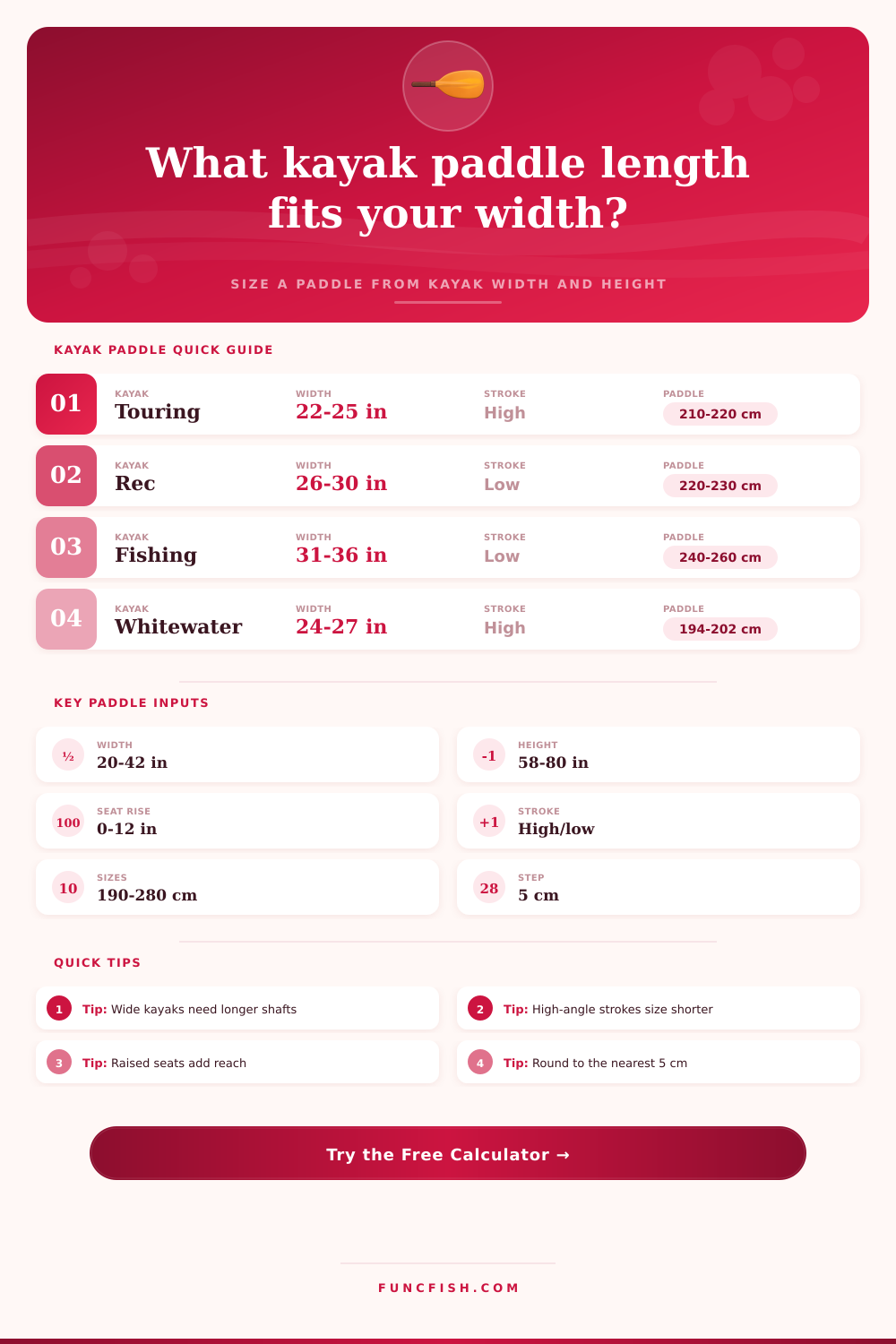
| 20-23 in / 51-58 cm | Narrow sea kayak | 215-220 cm | 205-215 cm | Less beam means less shaft reach |
| 24-27 in / 61-69 cm | Touring or day kayak | 220-230 cm | 210-220 cm | Most paddlers land in the middle |
| 28-31 in / 71-79 cm | Recreational kayak | 230-240 cm | 220-230 cm | Width starts to dominate height |
| 32-36 in / 81-91 cm | Fishing sit-on-top | 240-260 cm | 230-245 cm | Raised seats often add another size |
| 37-42 in / 94-107 cm | Very wide fishing platform | 250-280 cm | 240-260 cm | Check blade clearance before buying |
🧍Paddler height and torso reference
| Paddler height | Torso height | Common base size | When to size up | When to size down |
|---|---|---|---|---|
| Under 5 ft 2 in / under 157 cm | 24-27 in / 61-69 cm | 200-215 cm | Wide rec kayak or high seat | Narrow boat and high-angle stroke |
| 5 ft 2 in-5 ft 8 in / 157-173 cm | 27-30 in / 69-76 cm | 210-225 cm | Low-angle cruising or fishing kayak | Whitewater, wing, or fast cadence |
| 5 ft 9 in-6 ft / 175-183 cm | 30-33 in / 76-84 cm | 220-235 cm | Boat wider than 30 in | Narrow sea kayak with high angle |
| 6 ft 1 in-6 ft 4 in / 185-193 cm | 33-36 in / 84-91 cm | 230-245 cm | Fishing seat or low cadence | Performance touring blade |
| Over 6 ft 4 in / over 193 cm | 36 in+ / 91 cm+ | 240-260 cm | Very wide kayak or limited reach | Whitewater or compact high-angle setup |
🔀Stroke and blade comparison table
| Stroke or blade | Length effect | Best boat width | Cadence match | Fit warning |
|---|---|---|---|---|
| High-angle Euro blade | Shorter by 5-10 cm | 20-28 in / 51-71 cm | 60-75 spm | Too long feels splashy and slow |
| Low-angle touring blade | Longer by 5-10 cm | 24-34 in / 61-86 cm | 45-62 spm | Too short clips the gunwale |
| Fishing hook-retriever blade | Longer by 5-15 cm | 30-40 in / 76-102 cm | 35-55 spm | Check reach around rod holders |
| Wing paddle | Shorter by 3-8 cm | 20-25 in / 51-64 cm | 65-85 spm | Needs clean forward stroke path |
| Greenland paddle | Often longer overall | 20-27 in / 51-69 cm | 50-70 spm | Narrow blades change the feel |
🧭Result interpretation table
| Calculator result | On-water feel | Try shorter if | Try longer if | Adjustment size |
|---|---|---|---|---|
| Reach margin under 25 cm | Blade may hit side deck | Only for high-angle sprinting | Low-angle or fishing strokes | +5 to +10 cm |
| Reach margin 25-40 cm | Balanced for most paddlers | Cadence feels slow | Hands feel too low | 0 to 5 cm |
| Reach margin over 40 cm | Long sweep and leverage | Shoulders tire early | Very wide kayak still needs it | -5 to 0 cm |
| High width adjustment | Boat beam drives the choice | Seat is actually low | Standing or high-frame seat | 5 cm steps |
| Wide fit range | Both sizes can work | Racing or whitewater | Camping, fishing, or relaxed touring | Test both |
💡Kayak paddle sizing tips
Check the seat height before trusting a chart. A raised frame seat changes the shaft angle more than a small change in paddler height, especially on 32 in to 38 in fishing kayaks.
Use the shorter end for fast vertical strokes. If the calculator gives a range and you paddle with strong torso rotation, start with the shorter 5 cm size to reduce shoulder load.
The thing that most people do when they purchase their initial paddle is look at the height chart on the back of the package. They don’t consider boat size or shoulder width. Wrong. Every time you place a paddle into the water it alters the shape of the stroke based on your kayak’s width. Going strictly by width are dangerous. When you go by both seat height and width you are dialing it in.
Before thinking about how high you will have to reach to make contact with the water, understand how far away your hips is from the gunnel. Five centimeters can be the difference between a paddle that feels like an extension of your arm or dead weight in the water. The paddle shaft is kept fairly vertical when seated in a narrow sea kayak. Your hands is pushed outward as a wider fishing platform pushes them further apart. That means you need a longer shaft for the same effective angle.
How to Choose the Right Kayak Paddle Length
Your elbows flare out if the shaft’s too short. You burn your shoulder muscles instead of using your core to engage. Too long and you have no leverage and create drag with each recovery phase.
Plug in your seated torso height and boat width into the calculator above. It’ll do the math for you. This way, you aren’t guessing if extra beam means needing a larger size or just a different feather angle. It even accounts for seat rise. A two-inch change in height won’t affect your reach more than a high-back fishing chair does.
The length of the shaft should be based off of stroke style (before adding in any boat geometry). Shorter shafts is better for high angle paddlers who want their blade vertical for efficiency. They power their paddle with torso rotation. Longer shafts are better for low angle cruisers, who like their blade flat on the water. These guys relies on leverage instead of speed. Select your favorite stroke type and cadence and the tool will recommend something suited to it.
Generally speaking if you’re going to be doing a bunch of sweeps for fish or getting in and out of docks you’ll want the longer end of whatever the recommended range is. You get more leverage on those big swings. On your forward drive you don’t have to overextend your shoulder. Length is also influenced subtly through blade design. Wing-shaped blades catch water immediately and can be slightly shorter than the more forgiving traditional oval or spoon shapes. They can gets away with being longer and not feel awkward. For long tours it’s best to keep them shorter so they don’t tire out as fast.
The chart below compares blade styles to optimal cadence ranges, showing how our physical style fits into the picture. Less about what the manufacturer tells you and more about how paddle interacts with your boat width. Gear has an effect that many paddlers overlook as well. Fishing rods, coolers and even dry bags can change your kayak’s center of gravity. If your paddle isn’t long enough to counterbalance, it can leave the kayak feeling unsteady. When you’re loaded down with camping gear, having just a little bit more length makes a big difference. This is especially true in choppy water. You’ll have much better bracing leverage from a slightly longer paddle too.
Passive hull stability depends less on balance, while active paddling plays a bigger role, particularly with sit-on-tops whose cockpit area are wide open. Don’t be afraid to experiment with different numbers instead of settling on just one. For instance, maybe the calculator says “try 230” but then it also says “in the range of 225-235”. If you’re all about high-cadence touring (and speed), go shorter. If you need something comfortabley on long days (your biggest concern), go longer.
The correct paddle becomes invisible in your hands. You can concentrate on where you are going on the water, not wrestling with leverage problems. Begin by taking the width measurement. Adjust to match how high your seat sits. Believe me, if you get the length right, everything feel more doable than it would of otherwise.