Lake Whitefish Weight Calculator
Estimate lake whitefish weight from fork or total length, girth, body depth, lake class, season and egg condition, and measurement confidence.
📌Lake whitefish presets
⚙Whitefish measurements
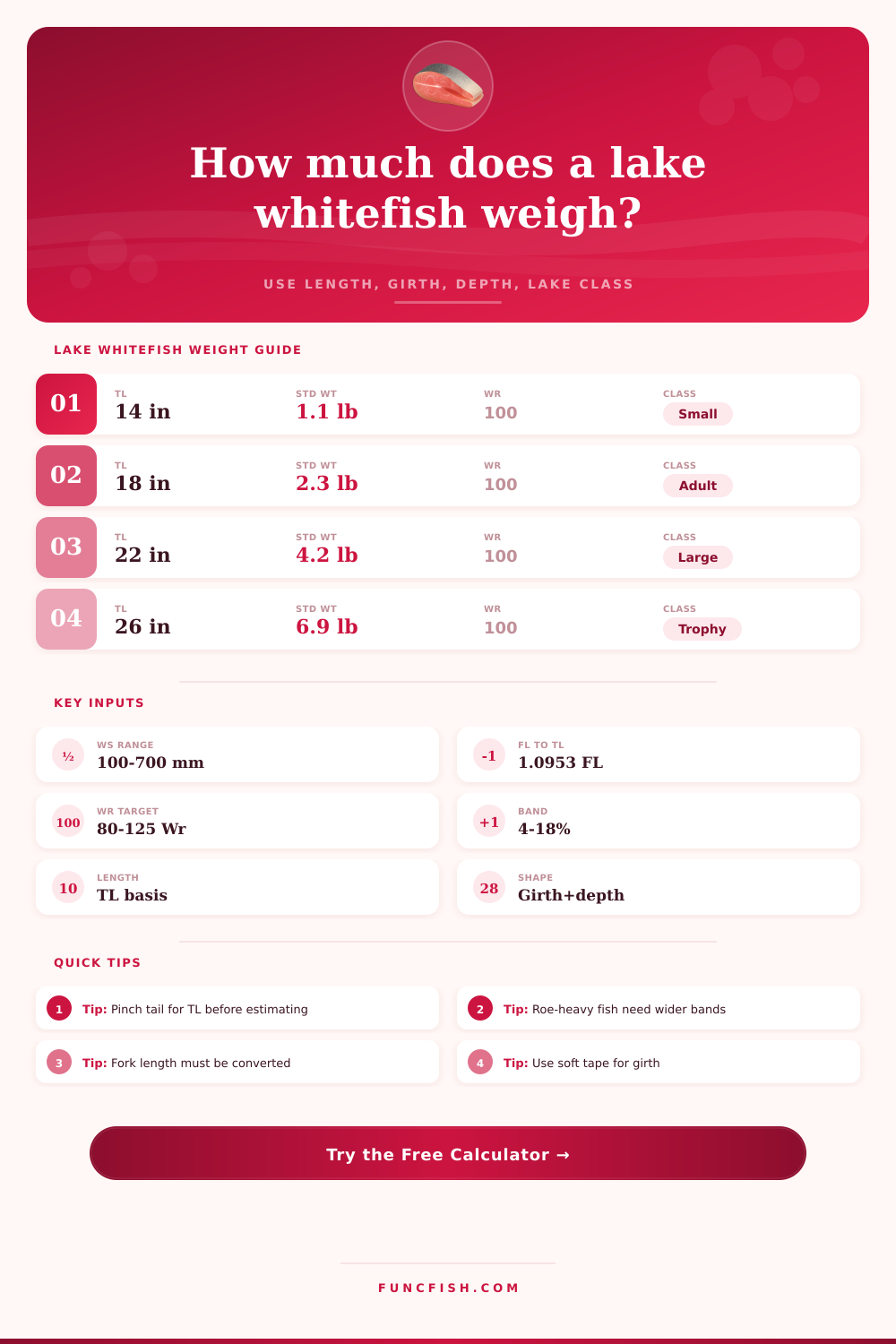
The standard-weight model uses total length; fork length is converted first.
Species RLP is the broad comparison; sex-stage equations are included for field samples.
Lake whitefish weight estimate
Detailed breakdown
📋Condition data grid
Species Ws
100-700 Applicable TL in mmFork to Total
1.0953 FL multiplier plus 6.8847 mmShape Cue
G/D Girth and body depthEgg Mass
+12% Heavy roe setting🎣Ice and open-water gear comparison grid
Ice Tape Setup
Best Board plus soft tapeIce Sled Photo
Wide Photo plus board marksBoat Bump Board
Fast Open-water releaseCreel Survey Kit
Exact Board, tape, scale📚Reference tables
| Total length | Species Ws | Common class | Calculator note |
|---|---|---|---|
| 12 in / 305 mm | 0.70 lb / 318 g | Young adult | Inside Ws range; shape can change estimate quickly |
| 16 in / 406 mm | 1.55 lb / 704 g | Typical adult | Good size for condition comparison |
| 20 in / 508 mm | 3.15 lb / 1.43 kg | Large adult | Girth and lake class become important |
| 24 in / 610 mm | 5.60 lb / 2.54 kg | Heavy fish | Roe or fall feeding can push Wr above 110 |
| 27.5 in / 699 mm | 8.64 lb / 3.92 kg | Trophy range | Near upper species Ws application limit |
| Wr score | Condition reading | Typical visual cue | Calculator meaning |
|---|---|---|---|
| Under 85 | Thin or depleted | Narrow belly, low shoulders | Estimate falls well below standard weight |
| 85-95 | Lean | Good length, modest girth | Common after spawning or in sparse forage |
| 95-105 | Standard | Balanced depth and girth | Near lake whitefish standard weight |
| 105-115 | Heavy | Deep shoulders, full belly | Productive lake or feeding condition |
| Over 115 | Very heavy | Roe, fall fat, or exceptional girth | Use high confidence if measurements were exact |
| Lake class | Shape expectation | Adjustment used | Best matching preset |
|---|---|---|---|
| Great Lakes offshore | Long, cool-water fish | Slightly lean baseline | Fall Offshore Heavy |
| Great Lakes bay or shoal | Fuller nearshore adults | Small positive baseline | Great Lakes Bay Adult |
| Productive inland lake | Deep, forage-rich fish | Moderate positive baseline | Inland Cisco Feeder |
| Clear oligotrophic lake | Longer, lighter body | Lean baseline | Clear Lake Slim Fish |
| Northern reservoir | Variable basin fish | Near-neutral baseline | Trophy Deep Basin |
| Field setup | Length reliability | Girth reliability | Suggested confidence |
|---|---|---|---|
| Ice board plus soft tape | High | High | High |
| Open-water bump board | High | Standard | Standard |
| Fork-length survey board | High after conversion | Standard | Fork length and photo shape |
| Photo beside known object | Moderate | Low | Photo estimate |
| Memory after release | Low | Low | Low |
💡Calculation tips
Use total length whenever possible. The lake whitefish standard-weight equation is total-length based, so fork-length entries are converted before weight, Wr, and confidence range are calculated.
Treat egg condition as a field adjustment. Heavy roe and fall feeding can raise the estimate, while spent or slim fish should stay below the standard-weight line unless girth supports it.
Estimating an weight of a whitefish involves more than measuring its length. Many people tries to estimate the weight of the fish by its length. However, the length isnt the complete measurement of the weight of the fish.
The weight of the whitefish also depend on its girth and its body depth; these measurements reflect the weight that the fish has. A fish that weigh more in relation to body depth and girth will have a more higher weight than a whitefish with the same length but less deeply sides or shoulders. In order to estimate the weight of a whitefish, these two measurements is required, as they are the measurements that represent the weight of the species.
How to Estimate the Weight of a Whitefish
Another factor that affect the weight of the whitefish is the environment that it live in. For example, a whitefish that lives in a lake that contain alot of nutrients may have a higher weight due to the fish farming and fertilization that occurs in these lakes. Because of the differences in the different lakes, the weight of the whitefish vary with each lake.
When using a whitefish weight calculator, people should choose the class of the lake to reflect the different weights of whitefish from different lakes. By selecting the lake class, people can ensure that there estimation of the weight of the whitefish is accurate by eliminating the chance of overestimating the weight of a lean fish. The weight of the whitefish also varies with the season in which it is catch.
Due to the physical changes that occur in the whitefish throughout the year, the weight of the whitefish change with the season. For instance, if the female whitefish is preparing to spawn, it will have eggs which will add to its weight. However, after it has spawned, it is lean in comparison to the pre-spawn fish.
Thus, depending on the season in which the fish is being weighed, the weight of the whitefish may have to be adjust for these changes to ensure the estimate is accurate. Another way to ensure the accuracy of the estimated weight of the whitefish is to use the correct tool to measure the weight. Use a soft tape to measure the girth of the whitefish and pinch the tail of the whitefish to obtain the length of the whitefish.
The whitefish can make the girth difficult to measure as it is often very active. Furthermore, it can become stiff after being caught in the lake. Additionally, estimating the size of a whitefish from a photograph or memory will not be as accurate as measuring it in person.
Therefore, using a photograph to estimate the size of the whitefish will result in a ballpark figure. However, using the girth and length of the whitefish is a more accurate measurement for the weight of the species. The weight of the whitefish can be represented in another measurement called the Wr score.
The Wr score of 100 represent the standard weight of the whitefish for its length. A score above 115 mean that the whitefish is heavy while a score below 85 mean that the whitefish is lean in comparison to the species average weight. This score is also useful in that it inform individuals of the health of the lake in which the whitefish was caught.
For example, if the Wr score of the fish is low for a lot of whitefish in the lake, it can indicate that the lake prey base is struggling. Thus the weight of the whitefish can help to reflect the health of the lake ecosystem. In the end, the best way to estimate the weight of a whitefish is to calculate the length of the whitefish and its girth.
The length of the whitefish alone will not provide an accurate measurement of the weight of the fish as it does not account for the thickness of the species. In order to obtain the best and most accurately estimate of the weight of a whitefish, you should of also consider the lake class, the season, and the weight of the female whitefish with respect to its egg condition. Thus, by calculating the length of the whitefish and its girth, individuals can more accurately and successfully determine the weight of the species.