Leader to Lure Loop Size Calculator
Estimate the finished loop opening, tie-off mark, tag allowance, lure-eye clearance, action freedom, and foul-risk score for loop knots tied directly to plugs, jigs, spoons, swimbaits, streamers, and small flies.
📌Lure loop presets
⚙Loop sizing inputs
Measure the clear inside opening of the line tie, not the outside wire diameter.
Use the body width around the lure eye; this catches nose-wrap risk.
Leader package diameter is more useful than breaking strength for loop stiffness.
Positive values enlarge the loop; negative values tighten it after all material and lure adjustments.
Most loop knots shrink as wraps seat; heavy fluoro and wire shrink less but spring wider.
Leader to lure loop forecast
Calculation breakdown
📊Leader material data
Soft Mono
Fluoro
Hard Mono
Wire
📏Loop size by lure style
| Lure style | Typical eye ID | Finished loop range | Clearance rule | Action note |
|---|---|---|---|---|
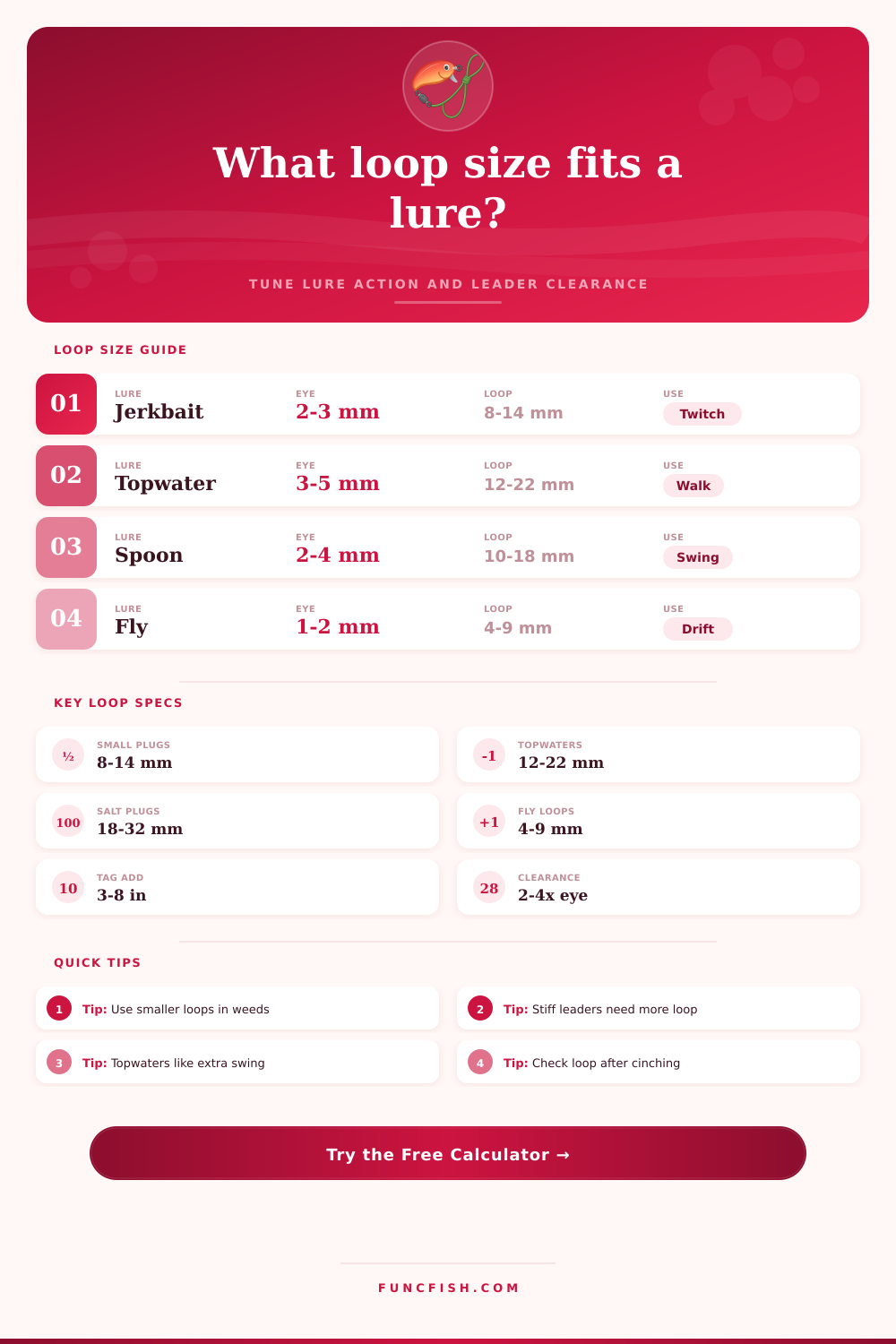
| Small jerkbait or minnow plug | 2-3 mm / 0.08-0.12 in | 8-14 mm / 0.31-0.55 in | 3-5x eye ID | Tight enough for twitch control, loose enough to avoid choking the line tie. |
| Walking topwater or popper | 3-5 mm / 0.12-0.20 in | 12-24 mm / 0.47-0.94 in | 4-6x eye ID | Extra swing helps the nose walk, cup, and recover between rod taps. |
| Casting spoon | 2-4 mm / 0.08-0.16 in | 10-20 mm / 0.39-0.79 in | 4-5x eye ID | A moderate loop lets the spoon wobble without rolling around the leader. |
| Jighead, bucktail, or hair jig | 2-4 mm / 0.08-0.16 in | 6-16 mm / 0.24-0.63 in | 2.5-4x eye ID | Short loops keep the jig tracking cleanly through cover and bottom contact. |
| Soft swimbait on fixed eye | 3-5 mm / 0.12-0.20 in | 10-18 mm / 0.39-0.71 in | 3-4x eye ID | Balanced loop size preserves tail kick while limiting nose roll. |
| Glidebait or jointed wakebait | 4-7 mm / 0.16-0.28 in | 18-35 mm / 0.71-1.38 in | 4-6x eye ID | A larger oval loop keeps heavy baits from binding at the start of a glide. |
| Offshore stickbait | 5-9 mm / 0.20-0.35 in | 22-45 mm / 0.87-1.77 in | 4-5x eye ID | Large loops reduce leverage shock but must clear split rings and belly hooks. |
| Streamer or wet fly | 1-2 mm / 0.04-0.08 in | 4-10 mm / 0.16-0.39 in | 3-6x hook eye | Small loops free the fly without making a visible hinge in clear water. |
🎣Species and leader comparison
| Species group | Common leader | Loop preference | Typical lure range | Adjustment cue |
|---|---|---|---|---|
| Bass and pickerel | 8-17 lb mono/fluoro | 8-18 mm / 0.31-0.71 in | 1/8-3/4 oz plugs, jigs | Shorten around grass, enlarge for walking baits. |
| Trout and grayling | 3X-0X tippet, 4-12 lb | 4-10 mm / 0.16-0.39 in | streamers, wet flies | Keep loops slim in clear current to avoid micro drag. |
| Redfish and speckled trout | 15-30 lb fluoro | 10-22 mm / 0.39-0.87 in | spoons, plugs, jigheads | Add clearance for spoons, trim loop in oyster shell. |
| Snook and juvenile tarpon | 25-50 lb fluoro | 14-28 mm / 0.55-1.10 in | topwaters, twitch baits | Heavy fluoro needs loop room so lures can turn. |
| Walleye and sauger | 6-12 lb fluoro/mono | 6-14 mm / 0.24-0.55 in | jigs, shad raps, spoons | Use compact loops for vertical jig control. |
| Pike and muskie | 40-100 lb wire/fluoro | 18-40 mm / 0.71-1.57 in | glides, spoons, swimbaits | Wire loops must clear the lure nose through the turn. |
| Striped bass and bluefish | 30-80 lb mono/fluoro | 18-36 mm / 0.71-1.42 in | surf plugs, metals | Surf tumble favors a loop that is free but not oversized. |
| Tuna, bonito, and GT | 80-200 lb shock leader | 25-55 mm / 0.98-2.17 in | stickbaits, pencils | Shock leader stiffness and heavy drag both enlarge the target loop. |
⚓Knot allowance reference
| Connection | Strength tendency | Shrink behavior | Starting tag allowance | Best use |
|---|---|---|---|---|
| Non-slip mono loop | Strong with mono and fluoro | Moderate shrink as wraps seat | 4-7 in / 100-180 mm | General plugs, spoons, and jigheads. |
| Original Rapala loop | Good with softer mono | Moderate to high shrink | 5-8 in / 130-200 mm | Small crankbaits, jerkbaits, and topwaters. |
| Homer Rhodes loop | Good heavy-leader option | Low to moderate shrink | 6-10 in / 150-250 mm | Heavy mono and saltwater leaders. |
| Perfection loop | Clean loop but less compact at eye | Low shrink, fixed loop | 3-6 in / 75-150 mm | Pre-tied fly loops and light leaders. |
| Figure-eight loop | Reliable compact loop | Low shrink | 3-6 in / 75-150 mm | Wire, heavy mono, and quick fixed loops. |
| Haywire twist loop | Wire-specific connection | Very low shrink | 4-7 in / 100-180 mm | Single-strand bite leaders for toothy fish. |
📝Gear matching grid
| Rod and line setup | Leader size | Lure eye style | Recommended loop shape | Risk to watch |
|---|---|---|---|---|
| Ultralight spinning for trout or panfish | 2-8 lb / 0.10-0.22 mm | Small welded eye or hook eye | Small round loop, 4-8 mm | Oversized loop can visibly hinge the lure. |
| Medium spinning for bass and walleye | 8-15 lb / 0.23-0.34 mm | Split ring removed or open line tie | Oval loop, 8-16 mm | Too small can choke jerkbait or jig movement. |
| Inshore spinning for flats and marsh | 15-40 lb / 0.35-0.62 mm | Spoon eye, topwater nose, jighead eye | Oval loop, 12-26 mm | Shell and grass favor trimming the loop down. |
| Surf plug rod with shock leader | 40-80 lb / 0.65-0.95 mm | Heavy plug eye or split ring | Long oval loop, 18-36 mm | Wave tumble can wrap long loops around front hooks. |
| Heavy casting for pike and muskie | 60-100 lb wire/fluoro | Large bait eye or solid ring | Open oval loop, 20-42 mm | Stiff wire must not lever the bait off-center. |
| Offshore popping or stickbait gear | 100-200 lb mono/fluoro | Solid ring or reinforced eye | Large oval loop, 28-55 mm | Heavy drag demands tag length and knot seating room. |
💡Loop sizing notes
Clearance check: The finished loop should slide around the lure eye without pinching at the knot, but it should not be so long that the loop can reach the front hook, blade clevis, or squared lure nose during a hard pause.
Material check: Stiff fluorocarbon, hard mono, and wire often need a slightly larger loop than soft mono at the same lure size because the loop behaves like a spring and can push the lure off-axis.
But then after spending an hour tying a great knot, you’ll look up and find it has sabotaged your whole presentation. You couldn’t get the lure to swim because it was choking on the line tie or even worse, it’s wrapped around a dock piling because the loop is so big from the bass smashing it hard. That’s a tough problem for an angler who cares about his/her terminal tackle. If your knot won’t hold under pressure it doesn’t matter, but if it kills the action of the bait in the water, what good is it?
Once you plug in the specifics of your gear, the leader to lure loop size calculator above does the math for you so you don’t have to guess how much more room stiff fluorocarbon realy requires than softer monofilament. The issue is that line isn’t a line; it’s a substance with properties such as friction, stiffness and memory. So when you cinch down a loop knot, you’re effectively forming a miniature spring between your leader and your lure eye. And that spring can be too stiff. This prevents the lure from pivoting freely and mutes the walk of a topwater plug or the wobble of a jerkbait. Or it can be too loose, impeding the movement of the loop itself. That’s where folks mess up I think. Most worry about breaking strength but fail to consider the physical volume of what they’re tying.
How to Choose the Right Loop Size
For instance, twelve-pound fluorocarbon leader will have much more diameter than a piece of equal size (i.e., same pound test) mono line. This is why, unless you compensate for the thickness of the material initially, your finished loop won’t be as large as you expect and you’ll wind up with less then you bargained for. So use the eye of the lure you’re fishing as starting point. Then follow the clearance rule. The loop needs to be several times larger than the inside diameter of the lures eye, large enough not to pinch off. When the knot touches the metal it becomes a stress point that will fail under the shock loads from heavy fish like snook or tuna.
But even if you get the loop cleared away from the eye, there’s still more work to do. The nose of the lure must also be cleared. A short swimbait with a long loop may appear clean sitting still but will wrap around its front treble hooks erratically in cover. That’s where the tool seeks information about foul exposure and water conditions. For example, a tighter anti-foul setting is called for around rocks or wood whereas open water lets you swing freely with maximum freedom.
The first consideration is what you are tying with. Soft mono gets soft and hugs itself into tight loops that don’t fight back. Stiff leaders like wire and heavy fluoro will resist flexing. This means you must start with a bigger loop to get the same size open-looped leader. Use thick wire, tie a normal Rapala loop knot and suddenly you’ve got a microscopic gap, enough to make the lure track sideways. That’s why the calculator takes those material biases into account automatically and factors in expected shrinkage of wraps as they’re seated down onto the cinch. It doesn’t sound like much, but when you’re after wary fish like bonefish or trout where an added millimeter of hinge visibility can spoil a strike, it makes a big difference.
That’s increased when considering action goals. If I want a big oval loop to get my gliding bait going side-to-side without binding on my leader, that changes things. Likewise, if I’m using a jig vertically, a nice tight little loop keeps the bait pointing up at the rod tip so I can be precise with my jigging actions. No single perfect size exists. It all comes down to how you intend to use the lure, what environments you will use it in, and how you want it moving. Your subtler presentations, knot strength, casting distance, etc.; all being traded for something that won’t foul.
It is not efficient to experiment with this stuff on the boat. Fraying out the ends of your lines, tying three variations of a loop and casting before it even comes tight…wastes time and energy. A systematic approach give you confidence walking down to the water with the knowledge that your initial offering will be set up right. That doesn’t mean you shouldn’t feel for the tension while tightening. Make sure the knot seats properly with an even pull. Avoid burning and drying out your line with excess friction heat. Just eliminate guesswork during the setup process by having something to shoot for. You should of had a plan.
Ultimately, it’s all about connection. Your connection to your bait through a tautly tuned loop transfers energy from your rod to your bait, undisturbed. The lure runs true. Bites are felt sharply and the hold is maintained until the hook rises. Most importantly for me, the right sized knot result in fewer adjustments. This means more time spent looking at what happens out there on the water when your line is moving.