🦺 Life Jacket Size Calculator
Find the right PFD size by weight, chest measurement, and water activity type
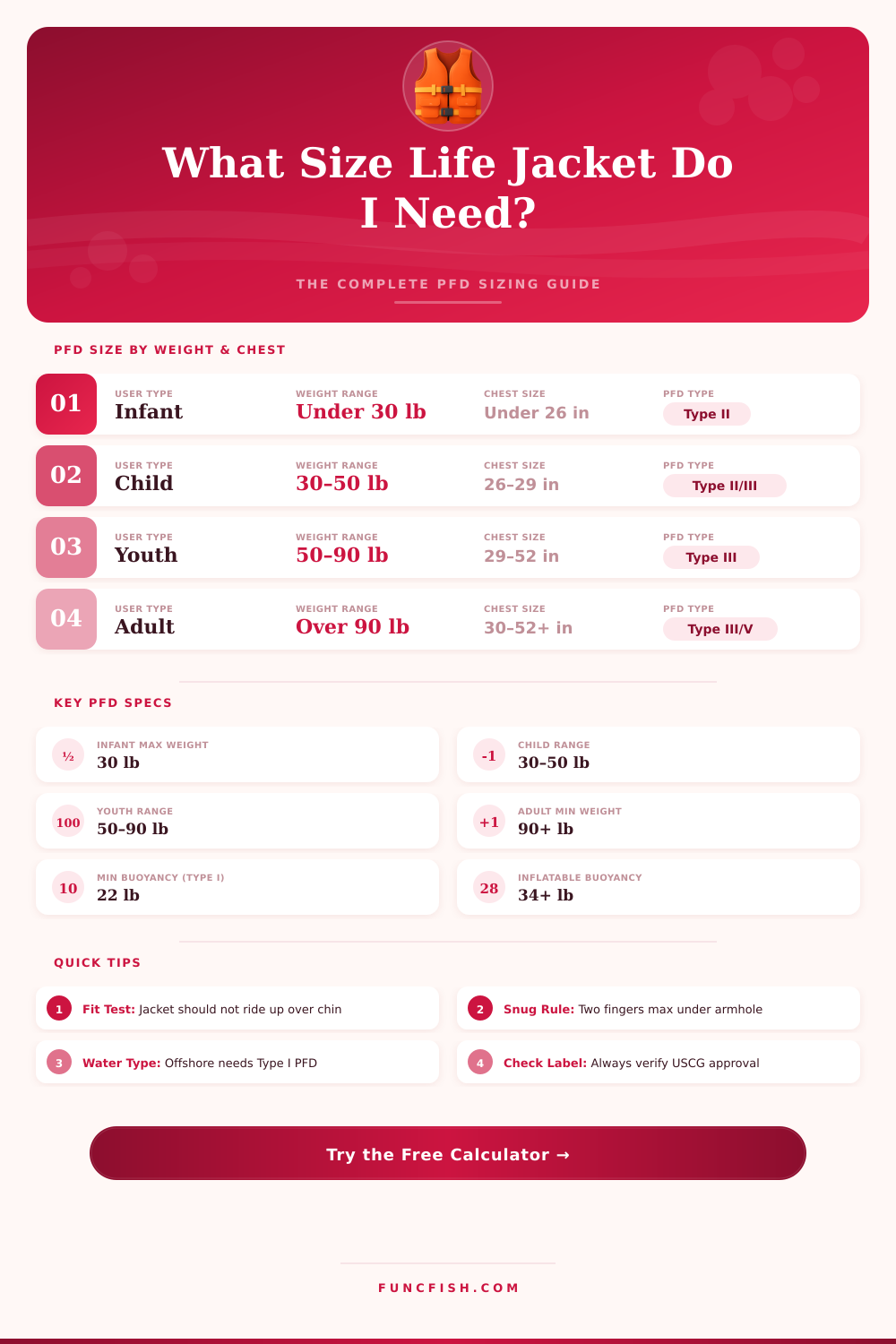
| Wearer Type | Weight Range | Weight (kg) | Chest Size (in) | Chest (cm) | Recommended Type |
|---|---|---|---|---|---|
| Infant | Under 30 lb | Under 13.6 kg | Under 26 in | Under 66 cm | Type II (Infant) |
| Child (Small) | 30–50 lb | 13.6–22.7 kg | 20–26 in | 51–66 cm | Type II / Type III |
| Youth | 50–90 lb | 22.7–40.8 kg | 26–29 in | 66–74 cm | Type III Youth |
| Adult Small | 90–150 lb | 40.8–68 kg | 30–38 in | 76–97 cm | Type III Small |
| Adult Medium | 150–200 lb | 68–90.7 kg | 38–44 in | 97–112 cm | Type III Medium |
| Adult Large | 200–250 lb | 90.7–113 kg | 44–50 in | 112–127 cm | Type III Large |
| Adult XL/XXL | Over 250 lb | Over 113 kg | Over 50 in | Over 127 cm | Type I / Type III XL |
| Activity | Recommended Type | Min Buoyancy | Key Feature Needed |
|---|---|---|---|
| Offshore / Open Ocean | Type I | 22 lb (10 kg) | Self-righting, high visibility |
| Near-Shore / Lake | Type II | 15.5 lb (7 kg) | Face-up righting, low cost |
| Kayaking / Canoeing | Type III | 15.5 lb (7 kg) | Freedom of movement |
| Whitewater Rafting | Type III (WW) | 15.5 lb (7 kg) | Impact-resistant foam |
| Fishing / Angling | Type III / V | 15.5 lb (7 kg) | Pockets, tackle access |
| PWC / Jet Ski | Type III / V | 15.5 lb (7 kg) | Impact protection, snug fit |
| Stand-Up Paddleboard | Type III Inflatable | 15.5 lb (7 kg) | Low profile, waist-mount option |
| Commercial Vessel | Type I Inflatable | 34 lb (15.4 kg) | SOLAS approved |
| Fit Test | How to Measure | Pass Criteria | Fail Indicator |
|---|---|---|---|
| Chin/Face Clearance | Lift arms, have assistant lift PFD straps | Does not cover chin or face | Rides up over chin |
| Armhole Snugness | Try to fit fingers under armhole | Max 2 fingers fit | More than 2 fingers = too loose |
| Side Closure | Clasp all buckles, check side gaps | Less than 1 in gap each side | Gap over 1 in = too large |
| Weight Range | Compare body weight to label | Within label weight range | Below or above rated range |
| Shoulder Straps | Check shoulder ride-up when arms raised | Stays on shoulders | Slides off shoulders |
| Waist/Hip Fit | Pull down on bottom edge | Cannot pull below hip bones | Pulls past hip bones = too big |
A life jacket must fit corectly in order for the life jacket to be of any safety value to the wearer during water activities. If a life jacket is too large for the wearer, the life jacket may ride up over the wearer’s chin or may slip down during wearing. Either of these problem with a life jacket can prevent the life jacket from providing the safety that the wearer would otherwise recieve from the life jacket.
When selecting a life jacket, there are many different factor to consider. For instance, the wearer’s weight and there chest circumference can impact the way that a life jacket will fit the wearer. Many life jackets has weight specifications for the wearer, but the weight listed for the wearer may not ensure that the life jacket will fit the wearer apropiately.
How to Choose and Fit a Life Jacket
For example, the manufacturer may categorize life jackets as being Infant size, Child sizes, Adult sizes, Adult 3X sizes, etc. However, not all individuals of the same weight will have the same chest circumference. For instance, two individuals of 160 pound each may have different body shapes than each other. An individual with a broad chest may have a different size requirement for their life jacket than an individual with a slim body and chest circumference.
In addition to the wearer’s body measurements, the type of activity that the wearer will perform in the water can also impact the type of life jacket that is required for that individual. For instance, if the wearer will be paddling in a kayak, there must be enough arm clearance for the wearer to perform this activity. However, if the wearer will be performing the activity in cold water, the wearer may be required to wear thick layer of clothing, such as a neoprene wetsuit.
In this case, the wearer may have to wear a life jacket of a larger size to ensure that the thick clothing will not pinch against the wearer’s body. Additionally, the type of water in which the wearer will be performing the activity may require a life jacket of a different type than another water activity. For instance, children or novices who are navigating calm water typically wear Type II foam life jackets.
These life jackets are designed to turn the wearer’s body to an upright position in the water. Type III life jackets are designed to permit the wearer to have easy arm movement, which is useful for fishing activity. Type I life jackets provide more buoyancy for those who are navigating to more open waters, though they have a bulkier profile than other life jackets.
Inflatable life jackets have a slimmer profile than other life jackets, though they are only effective if the wearer can operate the inflation mechanism of the life jacket. In order to ensure that the life jacket fits apropiately for the wearer, the wearer should test the life jacket while in the water. For example, when wearing the life jacket, the wearer should be able to lift their arms high above their head.
If the life jacket rides up over the wearers chin, the life jacket is too large for the wearer. The chest strap should lie flat against the body, and the armholes should permit the wearer to swing their arms full. Furthermore, the life jacket should keep the wearer’s airway open and their face clear while in the water.
If the life jacket fails to pass each of these tests, it isnt of the appropriate size for the wearer. The type of activity that the wearer will perform in the water will impact the type of life jacket that they require. For example, children under 88 pounds must use youth life jacket, and they should never use adult life jackets that their parents may have passed down to them.
For individuals who are in the middle of two life jacket size, the wearer should use the chest measurement to determine which size of life jacket to purchase. Finally, the wearer should always test their life jacket while in the water prior to beginning the trip that they are to undertake. By testing the life jacket, the wearer can ensure that the life jacket will function as it should during their trip.