Line Capacity Downsize Calculator
Convert a reel's published line capacity when you move to a smaller diameter line, then size the backing and top-shot length for a practical spool fill.
📌Scenario presets
⚙Spool and line inputs
Line downsize capacity estimate
Full breakdown
📋Line material capacity factors
Mono
Fluoro
4-Carrier Braid
8-Carrier Braid
📏Capacity conversion reference
| Diameter change | Area ratio | Capacity result | Practical note |
|---|---|---|---|
| 0.012 in to 0.011 in | 1.19x | About 19% more line | Small mono change |
| 0.012 in to 0.010 in | 1.44x | About 44% more line | Common finesse step |
| 0.012 in to 0.008 in | 2.25x | About 125% more line | Braid often needs backing |
| 0.40 mm to 0.30 mm | 1.78x | About 78% more line | Surf or trolling downsize |
| 0.35 mm to 0.23 mm | 2.32x | About 132% more line | Thin braid conversion |
| Reel style | Suggested fill | Lip clearance | Why it matters |
|---|---|---|---|
| Spinning reel | 94% to 97% | 2% to 5% | Too full can cause loops |
| Baitcaster | 90% to 95% | 3% to 7% | Heavy spools brake slower |
| Surf spool | 96% to 99% | 1% to 3% | Distance depends on clean lip flow |
| Offshore reel | 92% to 98% | 2% to 6% | Reserve matters under long runs |
| Fly reel | 85% to 92% | 8% to 15% | Room is needed for loose wraps |
| Scenario | Typical top shot | Reserve target | Backing approach |
|---|---|---|---|
| Bass spinning braid | 90 to 130 yd | 30 to 50 yd | Mono base, braid top |
| Walleye deep jig | 120 to 180 yd | 40 to 80 yd | Thin braid with mono backing |
| Surf long cast | 200 to 300 yd | 100 yd plus | Full main line or long top shot |
| Offshore top shot | 50 to 150 yd | 300 yd plus | Braid backing with mono top |
| Fly backing | 20 to 35 yd fly line | 50 to 250 yd | Dacron or gel-spun backing |
💡Capacity checks
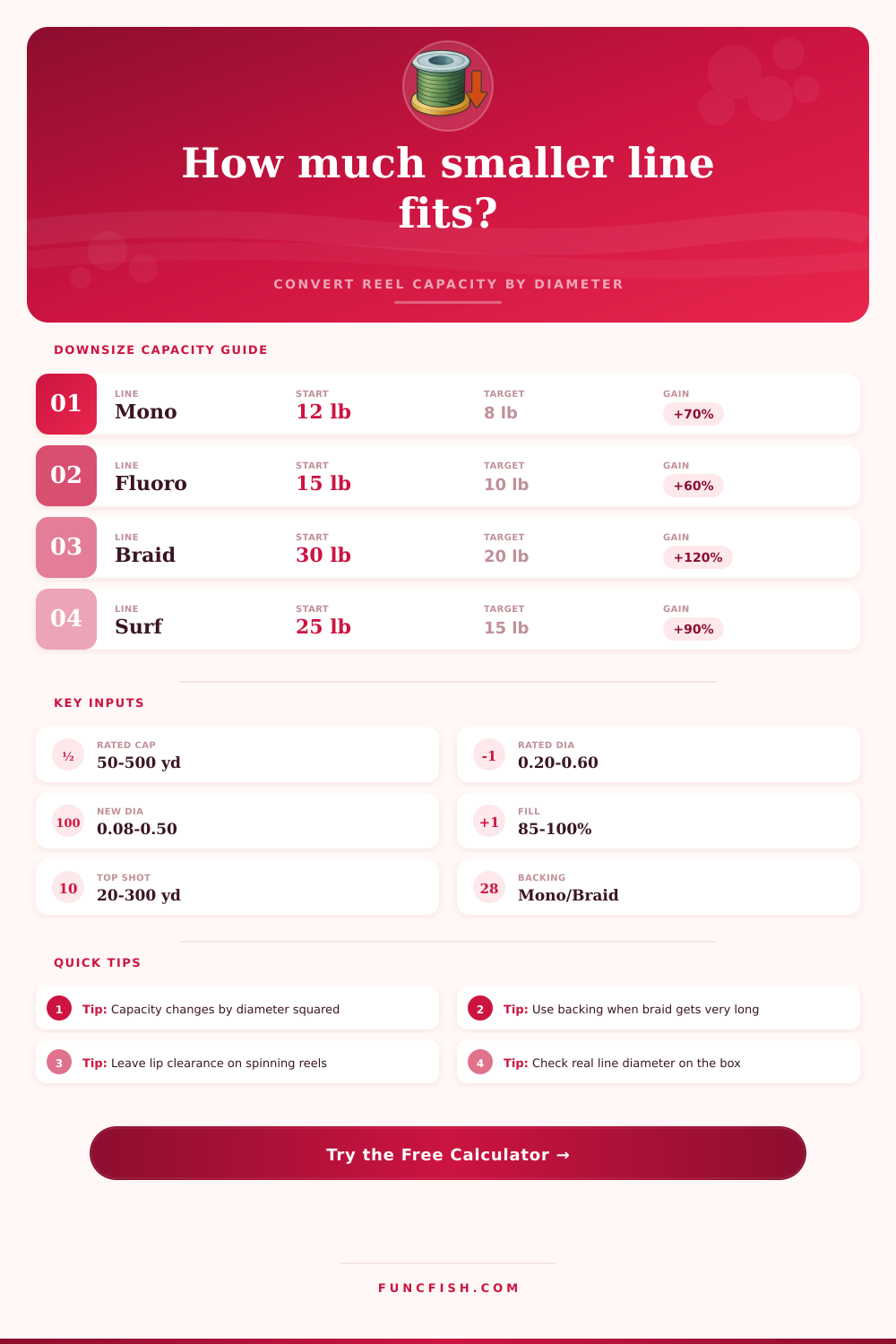
Tip: Reel capacity is a volume estimate. The most reliable conversion uses actual line diameter, not pound test, because capacity changes with diameter squared.
Tip: When the downsized line would fill far more than you need, use backing to control spool depth, reduce slip, and keep the working line near the spool lip.
When you decides to use a smaller line diameters on your fishing reel, you must consider the total amounts of line that your fishing reel can hold. You must consider not just if the line that you desire to use will physicaly fit on the reel, but also if it will provide the length of line that you require for your fishing effort. The diameter of the line is more important than the pound rating of the line because the total amount of line that can sit on the reel is dependent upon the square of the diameter of the line.
Thus, an small change in the diameter of the line will have a large effect upon the total amount of line that your fishing reel can contain. The fishing reel line diameter calculator allow you to enter the published rating of the fishing line, the diameter of the line, and the type of fishing that you will be performing. The calculator accounts for the fact that fishing reels do not tend to be perfect cylinders, that spinning fishing reels require some extra line at the lip of the reel to avoid the creation of wind knots in the line, and that baitcasters require a different fill percentage than the fishing reel than do spinning reels.
Check Your Reel Capacity When Using Smaller Line
Additionally, offshore fishing reels require more line to be prepare on the reel in reserve in case the fish begins to pull many yard of line off of the reel. Each of these factors is considered in the line diameter calculator for the best estimate of the number of feet of line that your fishing reel can contain. The material of the fishing line also has an effect upon the amount of line that can reside on the fishing reel.
For instance, fishing lines that contain monofilament material typically pack neat into the fishing reel and exhibit good gripping of the amount of backing that is loaded onto the line. Fluorocarbon lines are stiffer than monofilament lines which create gaps in the line that reduces the amount of line that can be loaded on the reel. Braid lines also pack very dense onto the spool, but the braid line tends to be slippery so it often requires some form of base layer of monofilament line or a taped arbor to the line to prevent the line from spinning on the spool.
Each of these type of lines can be selected on the calculator to account for each of these factors. An additional consideration in the use of a smaller line diameter is the issue of backing. If the line calculations indicates that the new line will fill the fishing reel to a depth that is much more than the depth that you wish for the line to reach when it is cast into the water, backing will help to control the amount of line that is on the reel.
Additionally, using backing line will allow for your working line to remain near the lip of the fishing reel which will allow it to cast more efficient. The user can also enter the number of yards of backing line that is required to achieve the desired length of your shot line. Additionally, the calculator will also warn you if the top-shot length that you select is too long for the line that you are downsizing to hold.
Too much line loaded onto the reel can create slipping of the line under load. There are a few additional factors that will change the results of the line calculation. For instance, changes in the temperature of the line will change the diameter of the line slightly which will change the amount of line that can be loaded.
Additionally, the bulk of knots that are created in the fishing line with heavy leaders will reduce the amount of line that is loaded onto the reel. Finally, line fill levels will differ between fishing reels with “level wind” functions and those with “free-spool” functions. Thus, while there are a variety of factors that can change the result of this calculation, the calculator is still a reliable calculation of the line that can be loaded on the fishing reel.
Additional manual adjustments can be made with the setup of the fishing reel. The main goal in any of this calculation is to ensure that the line that is loaded onto the fishing reel is matched to the distances and depths that are encountered during the fishing process. Thus, if the calculations of the line diameter and the line capacity of the fishing reel are to be matched to the condition that will exist while fishing, the fishing reel will perform correct with that line.