🦐 Live Shrimp Bait Freshness Calculator
Estimate how long your live shrimp will stay active based on water temperature, container size, aeration & conditions
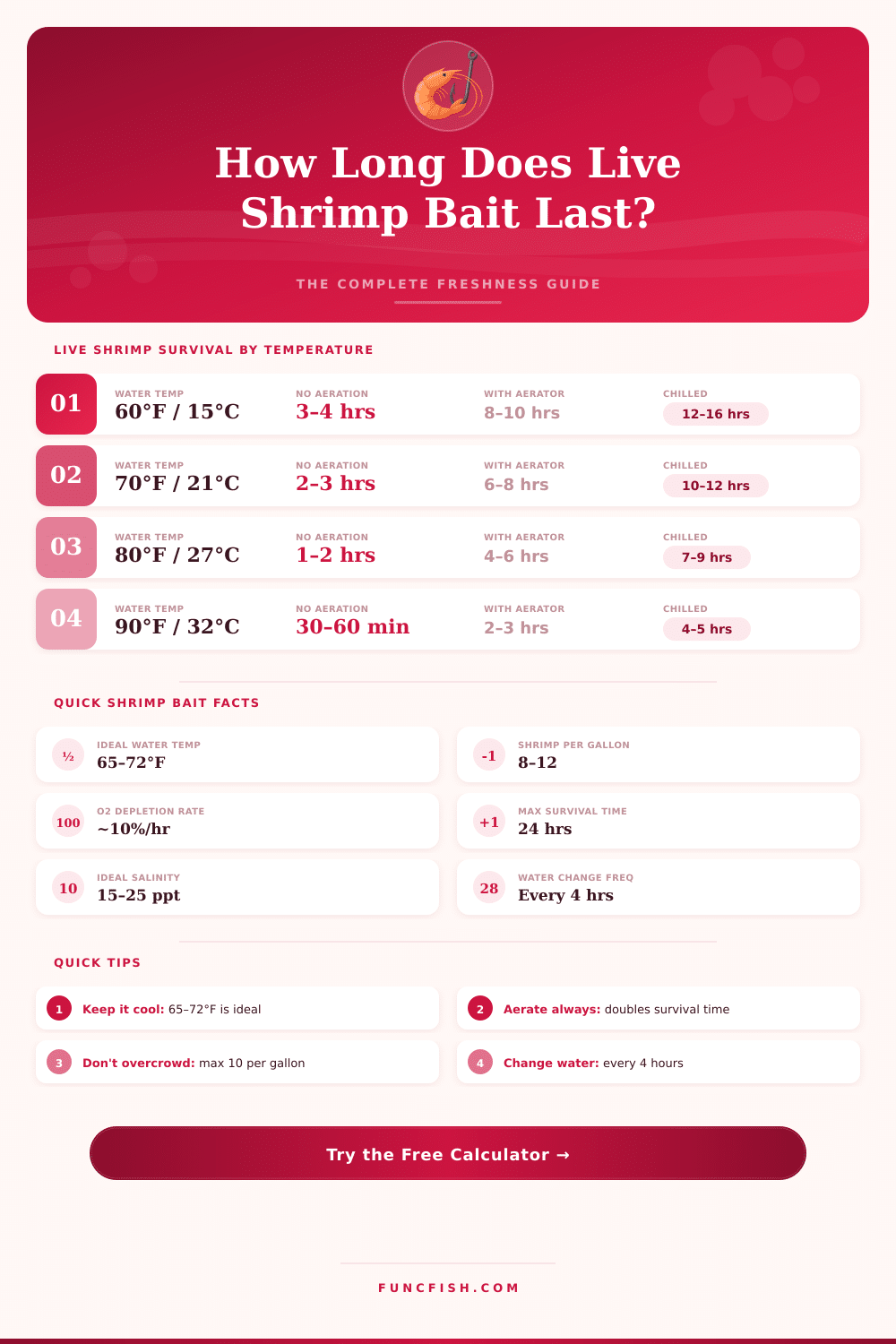
| Water Temp (°F / °C) | No Aeration | Battery Aerator | Live Well / Recirculating | O2 Injected |
|---|---|---|---|---|
| 55°F / 13°C | 4–5 hrs | 12–16 hrs | 18–24 hrs | 36–48 hrs |
| 60°F / 15°C | 3–4 hrs | 8–12 hrs | 14–20 hrs | 28–40 hrs |
| 65°F / 18°C | 2–3 hrs | 7–10 hrs | 12–18 hrs | 24–36 hrs |
| 70°F / 21°C | 1.5–2.5 hrs | 5–8 hrs | 10–14 hrs | 18–28 hrs |
| 75°F / 24°C | 1–2 hrs | 4–6 hrs | 7–11 hrs | 14–22 hrs |
| 80°F / 27°C | 45–75 min | 3–5 hrs | 5–8 hrs | 10–16 hrs |
| 85°F / 29°C | 30–50 min | 2–3.5 hrs | 3–6 hrs | 7–12 hrs |
| 90°F / 32°C | 20–35 min | 1–2 hrs | 2–4 hrs | 4–8 hrs |
| Target Species | Best Shrimp Size | Hook Size | Rig Type | Depth Range |
|---|---|---|---|---|
| Redfish | Medium–Large (2–4 in) | 1/0 – 3/0 | Carolina / Popping Cork | 1–4 ft / 0.3–1.2 m |
| Speckled Trout | Small–Medium (1.5–3 in) | #2 – 1/0 | Popping Cork / Float | 2–6 ft / 0.6–1.8 m |
| Flounder | Large (3–4 in) | 2/0 – 4/0 | Knocker Rig / Bottom | 3–12 ft / 0.9–3.7 m |
| Sheepshead | Small (1–2 in) | #2 – #1 | Free-lined / Jig Head | 5–20 ft / 1.5–6 m |
| Snook | Large–Jumbo (3–5 in) | 2/0 – 5/0 | Free-lined / Live Rig | Surface–8 ft / 0–2.4 m |
| Largemouth Bass | Medium (2–3 in) | #1 – 2/0 | Texas Rig / Split Shot | 2–15 ft / 0.6–4.6 m |
| Catfish | Large–Jumbo (3–5 in) | 4/0 – 6/0 | Bottom Rig / Slip Sinker | 4–30 ft / 1.2–9 m |
| Pompano | Small–Medium (1.5–3 in) | #2 – #1 | Pompano Rig / Dropper | 3–10 ft / 0.9–3 m |
| Container Type | Typical Capacity | Max Shrimp (Med.) | O2 Output | Best For |
|---|---|---|---|---|
| Plain Bucket (5 gal) | 5 gal / 19 L | 15–20 | Passive only | Short trips under 1 hr |
| Battery Aerator Bucket | 5 gal / 19 L | 30–40 | 0.5–1 L/min | Half-day inshore trips |
| Small Live Well (20 gal) | 20 gal / 76 L | 80–120 | 2–5 L/min | Full-day boat trips |
| Standard Live Well (30 gal) | 30 gal / 114 L | 120–180 | 5–8 L/min | Charter / tournament |
| Cooler with Ice Water | 10–48 qt | 10–30 | None (temp control) | Cold water species |
| O2 Injected Commercial | 20–100 gal | 200–500 | Pure O2 injection | Bait dealers / overnight |
| Water Type | Salinity (ppt) | Survival Modifier | Notes |
|---|---|---|---|
| Fresh Water | 0 ppt | –50% survival time | Marine shrimp die quickly in fresh water |
| Brackish Low | 5–10 ppt | –25% survival time | Osmotic stress reduces lifespan |
| Brackish High | 10–15 ppt | –10% survival time | Marginally acceptable for marine shrimp |
| Optimal Saltwater | 15–25 ppt | Baseline (0% modifier) | Best for Gulf/Atlantic species |
| High Salinity | 25–35 ppt | –10% survival time | Slightly stressful, monitor closely |
When dealing with Live Shrimp Bait it ranks among the most reliable baits that one can use. Almost every fish takes it, so it works for every angler, whether expert hunter or just starting newcomer. It works just as well, whether you cast close to the shore or search deeper waters.
Whether you fish beside mangroves after trout, or cast in deep channels for redfish (the Live Shrimp Bait always succeeds). Black drum, ladyfish, barracuda, grouper, pompano, redfish, snook, sea trout, sheepshead, tarpon and whitefish, all want to have it.
How to Use Live Shrimp Bait
Shrimp is found everywhere in stores, which is one of its main benefits. Big freshness matters a lot, because more alive baits stay on the hook while you cast. Live Shrimp Bait beats the dead, although even dead version still works well.
Even so dead shrimp often attracts unwanted fishes, puffers, catfishes and rays show up just as quickly. Even frozen shrimp from the store gives good results, but the alive always beats.
The way you hook the shrimp really affects teh result. The best spots are between the two black marks beside the head or a bit before the tail, where the body gets thin. Like this the bait stays active longer and moves naturally through the water.
If you need to cast long-range, then pushing the hook through the tail helps most. On the other hand, removing the tail releases strong smell in the water, that fishes quickly notice. The Live Shrimp Bait should move naturally threw the water, not as if it leans weird to one side.
To keep your baits alive, you must care about them. A good bucket simply does not work, if you want them to last a while. A separate cooler helps the cause, low temperature of the water keeps more oxygen in it.
Hot water can not hold so much oxygen as cold, and in a bucket it warms up soon. An air pump helps a lot. Keep away from sunblock and lotions on your hands; they both kill the shrimps.
Lay a small net in the bottom of the bucket, so that the shrimps do not jump around all the time.
But here is the key spot, shrimp attracts everything that swims in the water. So you will get lots of fishes of every size. Every time you need to rebait, you lose precious moments for catching.
A bit of mullet or other baits sometimes target bigger prey better, and limit the small bites. Because of that, especially for redfish, I found more luck with finger mullet or cut bait than depending only on shrimp.
A jig-head, designed to keep the shrimp level, works well, whether with a float or without it. A sliding float, that slips slowly through docks and fences, proves really useful. Free lining of Live Shrimp Bait works just as well, same as running it under a float.
This bait works well for getting children or newcomers into fishing, because itstays easy and fun.