Livebait Bridle Length Calculator
Estimate finished bridle loop length, floss cut length, hook clearance, tow-point placement, and swim control for bridled live baits used with circle hooks and trolling or drift rigs.
📌Livebait bridle presets
⚙Bridle rig settings
Measure around the bait where the needle or band will pass.
Use the width between entry and exit holes, nostrils, or band posts.
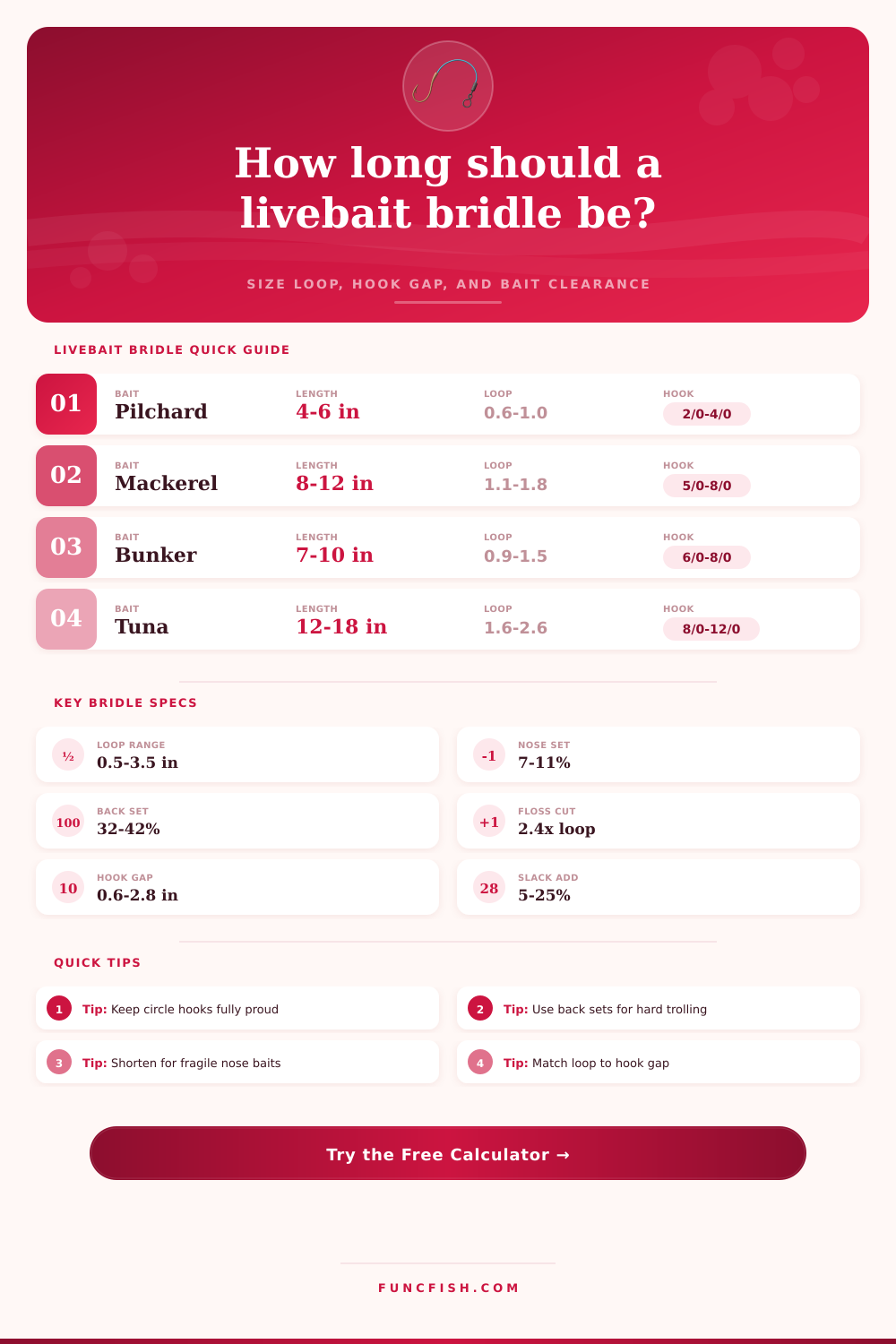
Nose bridles often use 6-11%; shoulder or back bridles usually use 28-42%.
Add slack for active baits, kite spread, or a stiff bridle material.
Extra material consumed by half hitches, twists, bands, or knot tags.
Livebait bridle sizing forecast
Formula breakdown
📊Bridle material data grid
Waxed Floss
Dacron Loop
Soft Copper
Silicone Band
📏Common livebait bridle size table
| Bait type | Typical live size | Nose bridle loop | Shoulder or back loop | Common circle hook |
|---|---|---|---|---|
| Sardine or pilchard | 4-7 in / 10-18 cm | 0.45-0.85 in / 1.1-2.2 cm | 0.70-1.10 in / 1.8-2.8 cm | 2/0-5/0 |
| Threadfin herring | 5-8 in / 13-20 cm | 0.55-0.95 in / 1.4-2.4 cm | 0.80-1.25 in / 2.0-3.2 cm | 4/0-6/0 |
| Menhaden or bunker | 7-11 in / 18-28 cm | 0.80-1.35 in / 2.0-3.4 cm | 1.10-1.70 in / 2.8-4.3 cm | 6/0-9/0 |
| Blue runner or hardtail | 8-13 in / 20-33 cm | 1.00-1.60 in / 2.5-4.1 cm | 1.30-2.05 in / 3.3-5.2 cm | 7/0-10/0 |
| Live mackerel | 8-14 in / 20-36 cm | 1.00-1.75 in / 2.5-4.4 cm | 1.40-2.30 in / 3.6-5.8 cm | 6/0-10/0 |
| Goggle-eye | 7-10 in / 18-25 cm | 0.90-1.45 in / 2.3-3.7 cm | 1.10-1.80 in / 2.8-4.6 cm | 6/0-8/0 |
| Finger mullet | 5-9 in / 13-23 cm | 0.60-1.10 in / 1.5-2.8 cm | 0.90-1.45 in / 2.3-3.7 cm | 4/0-7/0 |
| Skipjack or bonito | 12-20 in / 30-51 cm | 1.60-2.60 in / 4.1-6.6 cm | 2.10-3.40 in / 5.3-8.6 cm | 10/0-16/0 |
🪝Hook gap and bridle clearance table
| Circle hook size | Approx. gap | Minimum proud gap | Suggested bait class | Bridle caution |
|---|---|---|---|---|
| 2/0 | 0.55 in / 14 mm | 0.22 in / 6 mm | small sardine, pilchard | avoid bulky bands |
| 4/0 | 0.72 in / 18 mm | 0.30 in / 8 mm | herring, finger mullet | short nose loop |
| 6/0 | 0.92 in / 23 mm | 0.38 in / 10 mm | bunker, goggle-eye | watch shoulder girth |
| 8/0 | 1.15 in / 29 mm | 0.48 in / 12 mm | mackerel, hardtail | good all-round size |
| 10/0 | 1.45 in / 37 mm | 0.62 in / 16 mm | large mackerel, tuna bait | keep loop centered |
| 12/0 | 1.80 in / 46 mm | 0.78 in / 20 mm | bonito, small skipjack | use stronger floss |
| 14/0 | 2.20 in / 56 mm | 0.96 in / 24 mm | big skipjack, marlin bait | check tow stability |
| 16/0 | 2.65 in / 67 mm | 1.15 in / 29 mm | giant tuna bait | heavy loop only |
🎣Gear and species comparison grid
| Target | Preferred bridle point | Hook style | Loop strategy | Drag or tow load |
|---|---|---|---|---|
| Sailfish and white marlin | nostril or nose | light-wire circle | short loop, free swing | light to moderate |
| Yellowfin and bluefin tuna | shoulder or back | strong circle | gap-based loop, extra tag | moderate to heavy |
| Kingfish and wahoo | nose or shoulder | circle or stinger-safe rig | compact loop, high clearance | fast current |
| Striped bass and bluefish | nose cartilage | inline circle | small loop, low bulk | drift or slow troll |
| Tarpon and snook | nostril or shoulder | inline circle | medium loop, lively bait | light current |
| Halibut and lingcod | back or belly | heavy circle | longer loop, controlled swim | deep sinker load |
| Snapper and grouper | nose or shoulder | heavy circle | short loop, high hook gap | reef drag load |
| Blue marlin | back or shoulder | tournament circle | long loop, stable tow | slow troll load |
📘Bridle placement reference
| Placement | Tow point range | Best bait behavior | Loop adjustment | Primary risk |
|---|---|---|---|---|
| Nose cartilage | 6-10% from nose | natural forward swim | base loop | tear-out on soft bait |
| Nostril pass | 7-11% from nose | lively surface swim | base plus 5% | hook riding too close |
| Shoulder set | 25-34% from nose | strong slow-troll track | base plus 15% | reduced bait roll |
| Back set | 32-42% from nose | heavy bait control | base plus 22% | dragging high |
| Belly set | 34-48% from nose | deep drift stability | base plus 25% | baits tire faster |
| Kite bridle | 8-14% from nose | surface skipping control | base plus 18% | loop twisting |
Bridle sizing tip: If the hook point or barb sits tight against the bait, increase the finished loop until at least one third of the hook gap remains proud outside the bait profile.
Rigging tip: Fragile baits usually hold better with a shorter nose loop and a smaller needle span; heavy back bridles can accept more loop slack because the bait body supports the load.
The live mackerel hooked up with the circle hook, which buried itself in the bait. It never swung around to the corner of its mouth, so it couldn’t pull free. Ugh, missed trophy yellowfin. Bait was good, current was on, your knot was solid. But the point never touch the fish.
Typically this indicates either a choke between hook gap and the bait body, or a bridle loop that is to short. Line type does not matter as much as getting that distance right. The livebait bridle serve as a sort of steering cable for the fish. By placing the tow point at correct distance from nose of the bait, you dictate how the bait swims relative to your leader and rigging while keeping hook point away from any obstructions. Too far back and the bait drags its chin up and tire fast. Too close to the nose and those delicate baits like sardine are likely to tear right out when under load.
How to Measure Your Bridle Loop
Using this calculator on this page, you don’t need to guess in the heat of the moment. Variables such as hook size, girth of the bait and tow angle is fed into the calculator which spits out an exact loop length to keep the hook point clear. Hook clearance awareness alters your setup. Circle hooks are meant to catch fish in the corner of mouth when the line goes taut, so they can’t go straight through soft flesh right away. The hook has no way to turn because the line pulls it hard against the bait’s head or shoulder where your bridle holds them.
The loop calculator takes this into account by producing a final loop size that includes the slack required for your chosen material. Thick floss take up more room than skinny wire. An additional millimeter of flex ensures the hook rotates free at bite time to meet the fish correctly. A lot of it has to do with materials too. Thin waxed rigging floss will cleanly cut through cartilage, doesn’t add bulk to the knot, and requires less loop length to produce the same effective standoff distance than copper wire or silicone bands.
Both of these material are much thicker because of how they are made. If you’re thinking, “well why don’t I just go to dental band instead?”, then know that’s going to add nearly half an inch to the amount of cut length needed to provide the desired hook pride. That’s not hypothetical, either. That distinction can mean catching the hook on a scale of your bait or getting it well clear of the bait all together.
Those figures swing when placement is added into the mix. A nose bridle will give naturaly swim while stressing the delicate cartilage structures of fish. The shoulders/back are durable enough for heavy trolling, but they change how the bait moves through water. Where the bridle is anchored changes the length of the loop. The tool then tweaks the recommendation accordingly. The same loop length won’t work for an over-sized nose set skipjack as it will for a small nose set herring. The goal is to keep the bait stable and clear of hooks.
A lot of folks will go with the “one size fits all” mentality for their hooks, even in bad conditions. If they tie on any type of bait to anything they’ll throw, it’s going to have that common two inch loop on the end of it. That doesn’t work if you’re throwing several different hook and fishing for multiple types of fish. Because an 8 inch loop isn’t needed for a 1/16th ounce bait that’s being thrown on a 2/0 circle hook like it is for a 12/0 tournament hook. Adjusting the loop size to match your hook gap result in better hook-ups and eliminates the chance of angler over-angling his bait.
Precision is not intuitive, but calculated sizing is beautiful. Measure the width across the back of the bait (bridle point). Pick a matching size circle hook. Determine where you place the tow. Do the math on the geometry of the loop formation. Add some slack for the bulk of the knot material. Add more slack for clearance distance. Voila! An exact number to cut down your piece of wire or floss then tie it.
Get that measured length in the boat and believe the laws of physics. The right-sized bridle allows your bait to swim naturaly but also gives the hook a direct line to the fish’s jaw. That little tweak at the deck table is what separates fighting a trophy from holding an empty rod in your hand.