🐟 Livewell Aerator Calculator
Calculate required flow rate, oxygen output, and pump size for your livewell based on tank volume and fish load
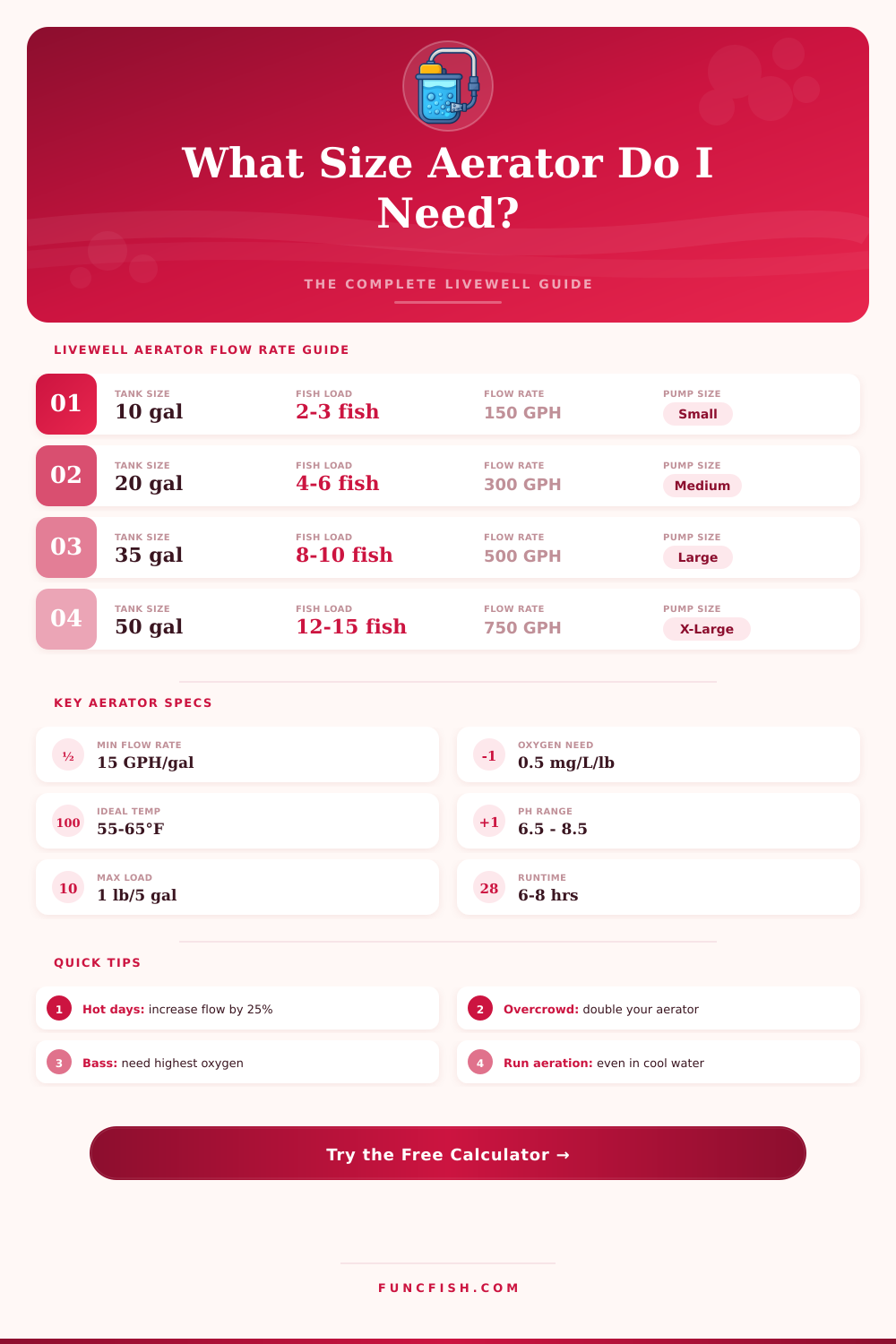
| Tank Size | Fish Load (lbs) | Min Flow (GPH) | Rec. Flow (GPH) | Min Flow (L/hr) |
|---|---|---|---|---|
| 10 gal (38 L) | 2–4 lbs | 150 | 250 | 568 L/hr |
| 15 gal (57 L) | 3–6 lbs | 225 | 375 | 852 L/hr |
| 20 gal (76 L) | 4–8 lbs | 300 | 500 | 1136 L/hr |
| 25 gal (95 L) | 5–10 lbs | 375 | 625 | 1420 L/hr |
| 30 gal (114 L) | 6–12 lbs | 450 | 750 | 1703 L/hr |
| 40 gal (151 L) | 8–16 lbs | 600 | 1000 | 2271 L/hr |
| 50 gal (189 L) | 10–20 lbs | 750 | 1250 | 2839 L/hr |
| 60 gal (227 L) | 12–24 lbs | 900 | 1500 | 3407 L/hr |
| Species | Typical Weight | O2 Need (mg/L/lb) | Ideal Temp (°F) | Sensitivity |
|---|---|---|---|---|
| Largemouth Bass | 1–5 lbs | 0.55 | 65–75°F | High |
| Smallmouth Bass | 1–4 lbs | 0.60 | 60–70°F | Very High |
| Walleye | 1–6 lbs | 0.50 | 55–68°F | High |
| Crappie | 0.25–1.5 lbs | 0.40 | 60–72°F | Medium |
| Bluegill / Panfish | 0.1–0.75 lbs | 0.35 | 65–75°F | Low |
| Catfish | 2–15 lbs | 0.45 | 70–80°F | Low |
| Trout | 0.5–4 lbs | 0.70 | 50–62°F | Very High |
| Striped Bass | 3–20 lbs | 0.60 | 62–72°F | High |
| Muskie / Pike | 5–30 lbs | 0.50 | 58–68°F | High |
| System Type | Best For | Efficiency | Temp Control | Max DO |
|---|---|---|---|---|
| Recirculating Pump | Most livewells | Good | Moderate | 7–9 ppm |
| Flow-Through | Rivers, cool water | Excellent | Best | 8–11 ppm |
| Aeration Only | Panfish, short trips | Fair | None | 6–7 ppm |
| O2 Injection | Tournament, high load | Best | None | 12–20 ppm |
| Combination | All-around use | Very Good | Good | 9–12 ppm |
In order to maintain the health of the fishes within a livewell, a person must have an understanding of the three main factors that impact the health of the fish within that well. If a person dont provide enough oxygen to the fish within the livewell, the fish will die as a result of not being able to breathe. Although the fish may not exhibit any signs of distress, those fish will die within the livewell if the oxygen levels drops and the waste builds up within that water.
In order to determine the amount of water that a livewell can hold, a person must take into account a few factors. For starters, livewells often lose some of their volumes to the baffles and corners of the livewell. For instance, a livewell that is 28 inches in length, 14 inches in width, and 12 inches deep will hold approximately 25 gallons of water when accounting for the amount of water that cannot circulate within the corners of the livewell, as well as the 88% rate at which the livewell can be filled with water.
How to Keep Fish Healthy in a Livewell
Furthermore, because of the stagnant water within the corners of the livewell, a person must have an understanding of the actual volume of water that will be contained within the livewell in order to ensure that the well circulates the water properly. The type of fish that is contained within the livewell will impact the aeration of that well. For instance, a person can stock bass more heavy within the livewell than trout, yet trout will require more water exchange rate to ensure there health.
Additionally, catfish can be more heavily stocked within the livewell than other types of fish, but the increased waste that these fish create will require more water exchange rates within the livewell. Finally, schools of crappie or baitfish will contain a high number of fish, increasing the amount of oxygen that is required of the livewell. In addition to the type of species within the livewell, the temperature of the water will impact the amount of dissolved oxygen that is available to the fish.
Water at 72 degrees F will contain less dissolved oxygen than water at 58 degrees F, indicating that higher water temperature will increase the metabolism rates of the fish. Thus, when water temperatures exceeds 69 degrees F, 12% more flow and air will be required to ensure the health of the fish. Additionally, when the water temperatures reach the hot zone of the livewell, 28% more flow and air will be required of the livewell.
In these cases, venturi injector or oxygen cones can be used to increase the amount of dissolved oxygen within the water. A person must also consider how long the livewell will be in travel or how choppy the water may be within the area in which the livewell will be deployed. If the livewell is to take long trailer ride or if the water within the livewell is choppy, the sloshing of the water within the livewell will decrease the effectiveness of the circulation of the water within that well.
In these cases, insulated coolers will help the water to remain cooler, yet bare plastic livewells will heat up twice as fast when the sun is shining upon the plastic. Additionally, a person must also take into account the life of the battery. If the battery is weak, there will be a shorter life span of the livewell.
There are a few different aeration method that can be used within the livewell. For instance, spray bars will allow for even rinsing of the water within the livewell, but require a moderate draw of electrical current. Aeration stones will provide more oxygen to the water within the livewell, but will provide less movement of the water than other methods of aeration.
Finally, dual stage aerations are often used when the livewell contains heavy loads of fish, but will use up the battery power at a faster rate than single stage aeration system. A person should avoid using the manufacturer specification of the livewell to determine how large of an aeration system should be sized for the well. The manufacturer provides specifications based off calm water conditions and light loads of fish.
Instead, the rate at which the water should be turned over within the livewell should be between the rate of 2.6 and 4 times per hour, based upon the species of fish within the livewell. For instance, trout should have a rate of water turnover that is 18% greater than panfish, as venturi injectors will provide 18% more air than a recirculation system of similar strength. A person must also consider the limits of how many fish is allowed to be within the livewell.
For instance, bass have a limit of 0.10 pounds of fish per gallon of water within the livewell in cooler water temperatures. However, that limit drops to 0.06 pounds of fish per gallon for trout in those same conditions. Furthermore, if the number of pounds of fish within the livewell is increased to a multiple times the rating for that species, the ratio of oxygen requirement will increase 25% for those fish within the livewell.
Thus, the water within the livewell will become murky prior to a complete turnover of the water within the well. Another factor to consider is the battery that will power the aeration system. For instance, a 35 amp hour battery will provide some amount of runtime to the livewell based upon the strength of the battery and the power that the aerations system draws.
Yet, if a dual stage aeration system is used for the livewell, that battery will be depleted at a much faster rate. Thus, the runtime of the livewell should be calculated based upon 85% of the capacity of the battery to account for the age of the battery and the depth at which the battery is being discharged. Finally, another consideration is the exchange interval for the water within the livewell.
For instance, if the exchange interval is not under five minutes, the livewell is not providing enough oxygen for the fish within the well. Furthermore, if the exchange interval is over 12 minutes, the livewell is definitely not providing enough oxygen to the fish within that well.