Margin Pole Length Calculator
Match your shipped pole length to the exact margin line, bank setback, lateral angle, cover pressure, rig drop, and species load before you settle on a top kit.
🎣 Margin presets
⚙ Pole reach inputs
Calculated margin setup
📏 Gear/species comparison grid
📊 Pole length and section reference
| Pole class | Common shipped length | Typical section length | Best margin use |
|---|---|---|---|
| Short whip | 2.5-4.0 m / 8-13 ft | 0.50-0.80 m / 20-31 in | Silvers tight to the near bank |
| Compact margin pole | 4.0-5.0 m / 13-16 ft | 0.80-1.10 m / 31-43 in | Canal shelves, short corners, close rushes |
| Carp margin pole | 5.0-8.0 m / 16-26 ft | 1.10-1.50 m / 43-59 in | Commercial carp, platforms, reeds, lilies |
| Match pole short kit | 6.0-9.5 m / 20-31 ft | 1.40-1.70 m / 55-67 in | Longer shelves with controlled presentation |
| Full pole extension | 11-13 m / 36-43 ft | 1.60-1.80 m / 63-71 in | Far margin lines when shipping space is clear |
🐟 Species matching table
| Species group | Typical margin size | Elastic range | Main line guide |
|---|---|---|---|
| Roach, rudd, small skimmers | 1-12 oz / 30-340 g | No.6-10 solid | 1.5-3 lb / 0.07-0.12 mm hooklength |
| F1 carp and stockies | 8 oz-3 lb / 0.2-1.4 kg | No.10-14 hollow | 3-5 lb / 0.12-0.16 mm hooklength |
| Bream and hybrids | 1-5 lb / 0.5-2.3 kg | No.10-14 solid or hollow | 4-6 lb / 0.14-0.18 mm hooklength |
| Tench and crucians | 8 oz-6 lb / 0.2-2.7 kg | No.12-16 hollow | 4-7 lb / 0.16-0.20 mm hooklength |
| Commercial carp | 2-12 lb / 0.9-5.4 kg | No.14-18 hollow | 5-8 lb / 0.18-0.23 mm hooklength |
| Heavy cover carp or catfish | 5-20 lb / 2.3-9.1 kg | No.18-20 hollow | 7-10 lb / 0.21-0.28 mm hooklength |
🧭 Cover and condition allowances
| Margin feature | Length allowance | Tip over target | Reason for extra reach |
|---|---|---|---|
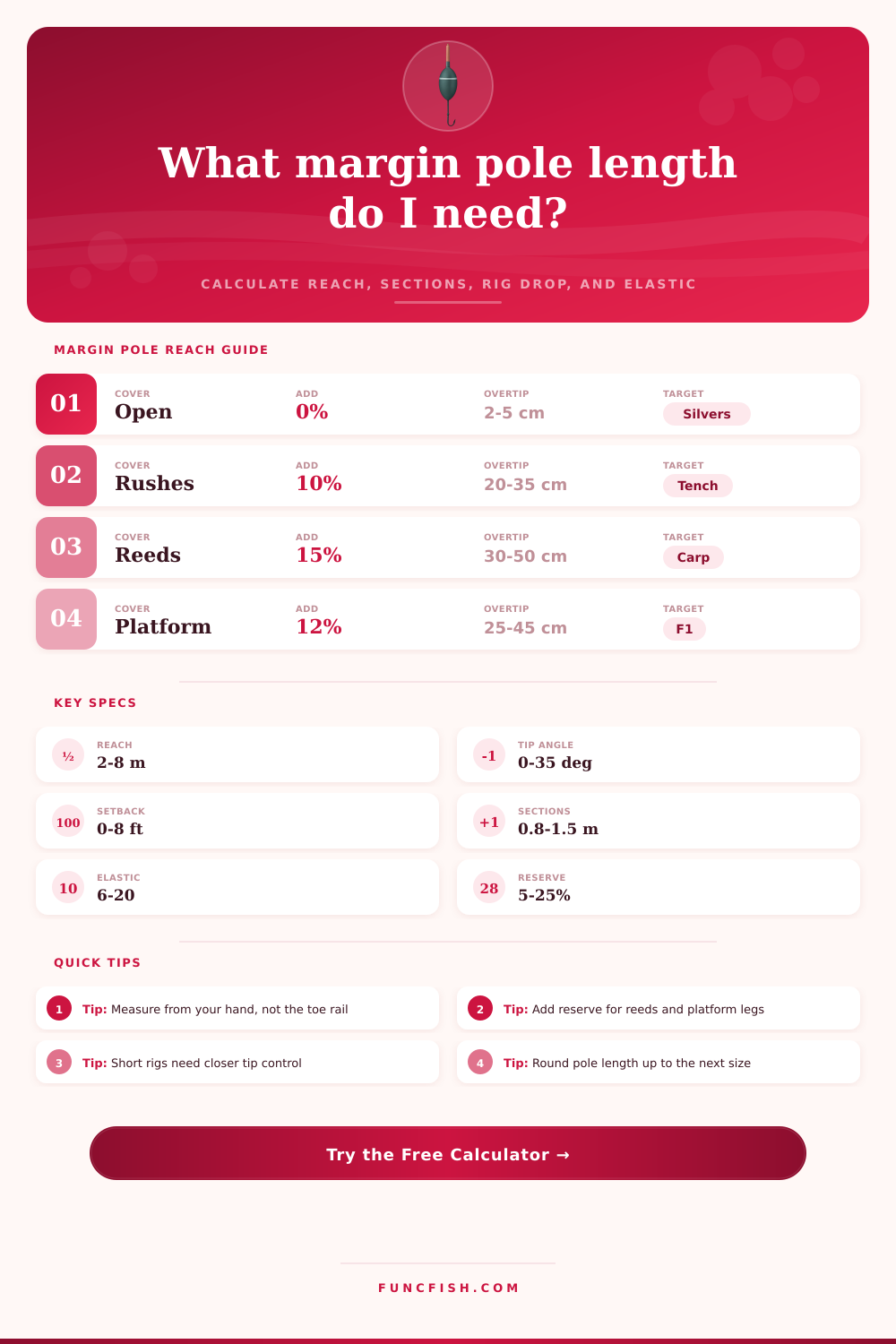
| Open water edge | 0-4% | 2-5 cm / 1-2 in | Little cover, tidy presentation |
| Soft grass or rushes | 5-10% | 10-25 cm / 4-10 in | Keeps rig clear of trailing stems |
| Reeds and lily stems | 10-15% | 20-50 cm / 8-20 in | Gives room to lift fish before they turn |
| Platform legs or pallets | 10-14% | 25-45 cm / 10-18 in | Lets you drop beside structure without fouling |
| Roots, stones, and snags | 14-20% | 30-60 cm / 12-24 in | Builds in steering room for the first run |
🔧 Pole type data used by the calculator
| Selected type | Section length | Reach efficiency | Practical range |
|---|---|---|---|
| Short margin pole | 0.80 m / 31 in | 97% | 2.5-5.0 m / 8-16 ft |
| Carp margin pole | 1.10 m / 43 in | 96% | 4.0-8.0 m / 13-26 ft |
| Commercial match pole | 1.50 m / 59 in | 94% | 5.0-13 m / 16-43 ft |
| Power top kit setup | 1.35 m / 53 in | 93% | 4.0-9.5 m / 13-31 ft |
| Telescopic whip | 0.65 m / 26 in | 98% | 2.0-5.0 m / 7-16 ft |
| River pole package | 1.45 m / 57 in | 92% | 5.0-11 m / 16-36 ft |
| Full match pole | 1.70 m / 67 in | 91% | 9.5-16 m / 31-52 ft |
💡 Calculation tips
There you are, standing at the muddy bank of some commercial lake and holding a pole that is not quite long enough for the situation. Fish is firing up on a small strip along the edge of a thick, impenetrable wall of reeds, but you’re still sitting there with gear that barely reaches over the drop-off at the end of your line. Frustrating right? You know the swim holds fish, but your equipment can’t quite get it done comfortabley. Well that’s the gap we’re trying to fill with this thing.
After you input your target distance and bank setback, the calculator above does all the geometry for you. Most of us fail to take into account how much horizontal reach we lose if we lift tip to make an easy presentation with the rig. Angling that pole upward just a mere fifteen degrees cost you almost three and a half percent of your forward progress. Sounds like a small fraction right? Until you consider that means a few inches of distance you’re missing out on trying to slip a float past wary bream through tight cover. The math factor that loss in to help you avoid coming up short on the day.
How to Choose the Right Pole Length
Half the battle is knowing where you’re starting from. So many beginner angler measure from the end of the platform or from their feet, which gives them an unrealistic impression of how far out they can reach. When the box is down and held comfortable and securely in your hands then that’s what you need to take your measurements from. The setback on bank can add as much as seven hundred millimeters to your needed length before we’ve even thought about the water depth. It is not because of laziness, but because you want to keep control. Overreaching will put more stress on the tip if a carp suddenly turn sharply in the shallow water and lessen your leverage to get hold of fish.
So how long do I bring? That depends off cover pressure. A little slack is fine when fishing open water, whereas a lot more is necessary when poking around lily stems or reeds. You want plenty of pole to pop your fish up over the top of an obstruction so she doesn’t get her line tangled in all that muck down there. These allowances are clearly spelled out in the reference tables on the page and show just how different a ten percent allowance for spongy stuff is compared to a twenty percent allowance for serious snag territory. It’s not dead space. It’s insurance money and something you don’t want to pay dearly for with a busted rig and lost opportunity at key times.
The same rule applies to elastic choice; the right amount of stretch for protection against the strain should also match the force being exerted by the fish. Sensitive elastic isn’t going to help when targeting hard fighting carp or even F1 hybrids so there is little point in rigging a tiny silver on stiff stuff. Instead you want something like hollow elastic rated at a higher number than usual to take the shock of abrupt runs and avoid a fine hooklength being snapped. Your line strength should match the fish you are targeting. If it doesn’t, you’ll get too big a bite or miss bites by masking them, such as when using heavy elastic with a delicate presentation. Or, you could break light tackle under the strain of heavier fish.
Section length also plays a subtle role in your comfort. Longer sections result in fewer joints to put together and less time rigging up, but you need more clear space behind you to get them shipped safely. Shorter sections may be slower at extending but give you greater manoeuvrability in tight swims that are crowded with other anglers. Based on all of this, the tool has calculated the total number of sections for your chosen pole type. This assists you in seeing if it’s going to be possible to have a long carp margin pole for your swim set-up constraints, or maybe a compact match pole might suit you better.
But there’s another variable that pure distance doesn’t take into consideration: Wind and current. If it’s breezy out, your float will get pushed backwards and shorten your reach if you don’t compensate. That’s why the calculator takes those environmental factors into account. Instead of showing up with a set-in-stone plan that falls flat when Mother Nature interferes, it provides a realistic target based on drag from the wind or tow. This gives you something to work with.
So in a nutshell, it’s all a matter of gaining sufficient mechanical advantage to boat ‘em but still be able to make the accurate presentation to put your bait in front of the fish when they bite. That’s why I like the tool because it takes all the math out of the equation and gets us back to fishing. Next time you go back to that gnarly stretch along the bank, you’ll have the exact length for slipping your rig under the reeds. You can put it in front of those finicky carp to stick a hook in their jaws and bring ’em home drama free. Those few more inches of measured length can mean the difference between catching them or not.